Team Personality Types Assessment
Ready to improve teamwork and make group interactions more productive?
Learn about YOUR team personality types with an assessment tool described below, and take a powerful step toward building better communication.
Everyone on your team has value and can contribute, but there are likely times that you wonder why your teammates do what they do.
Learn About Your Teammates –
and Their Personality Tendencies!
As a team leader, it can be tremendously helpful to gain more knowledge about yourself and those on your team concerning personal styles of influence. Each individual has unique behavioral tendencies and strengths which influence everything from group interactions to their preferred tasks and focus.
According to many psychologists, “the foundation of personal and professional success lies in understanding others, knowing yourself, and realizing the impact of your actions and attitudes.”
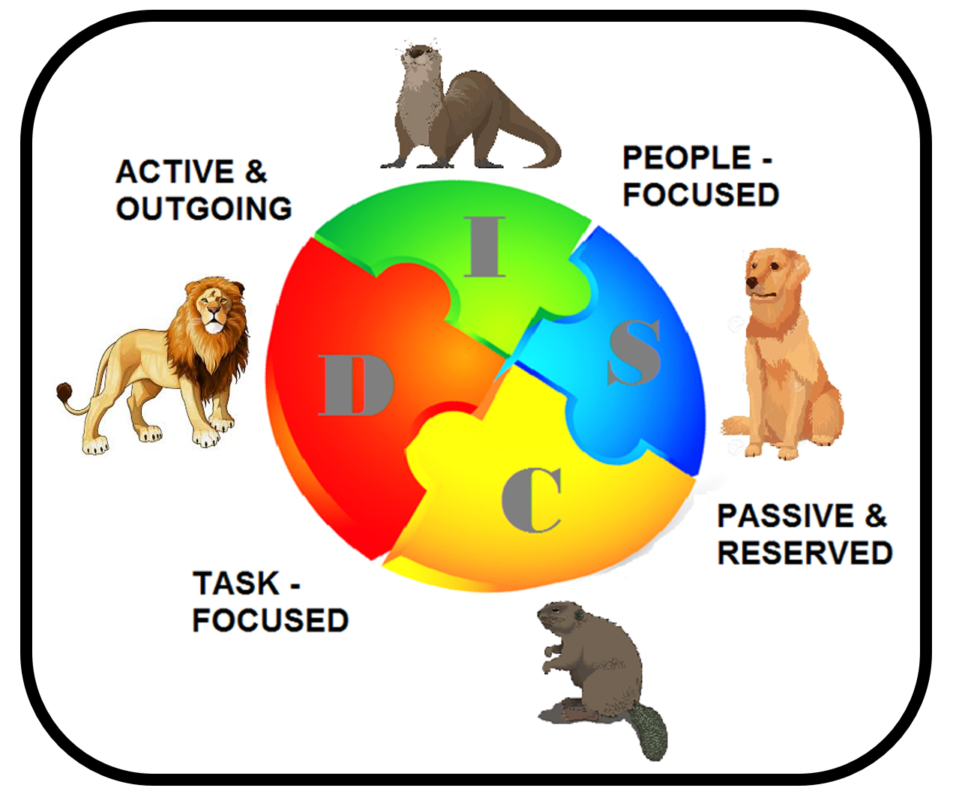
Many organizations consider the beneits of tthe DISC vs MBTI to boost communication. Sean likes the DISC model (which the animal types below are based upon) as it has been proven as a valid and easy to implement team assessment, and a valuable way to better understand yourself and your teammates.
Every Team Has Communication Problems.
The best teams do not avoid misunderstandings. They understand why they happen.
Different personalities communicate differently. They solve problems differently. They respond to feedback differently and handle change differently.
When your team learns to recognize those differences instead of becoming frustrated by them, collaboration improves, trust grows, and leadership becomes far more effective.
Sean Glaze’s interactive Team Personality Types Workshop helps organizations improve communication using engaging personality assessments and practical strategies your team can apply immediately.
✓ Improve communication across every level of your organization
✓ Reduce misunderstandings and the conflict they create
✓ Build trust by understanding how teammates think
✓ Strengthen leadership by adapting to different styles
✓ Create more productive and collaborative teams
Why Team Personality Types Matter
Most workplace conflict is not caused by bad intentions.
It is caused by different communication preferences.
One employee wants details before making any decision. Another wants the bottom line and wants it fast. One values harmony and avoids direct confrontation. Another values candor and sees conflict as healthy. Neither person is wrong. They are simply wired differently.
Without a shared framework for understanding those differences, teams default to frustration. With one, they default to empathy.
Understanding team personality types gives your people a common language that helps them:
- Communicate more effectively by adapting their message to the listener
- Appreciate different working styles instead of dismissing them
- Adapt their leadership approach based on who they are leading
- Collaborate with less friction and more patience
- Build stronger relationships across departments and roles
That awareness often changes conversations immediately. And in Sean’s experience after 20 years of coaching and facilitating, awareness is always the bridge to better behavior.
Each activity was structured such that, although it was great fun, it always had a deeper intention of building connections with and understanding of others. Many came to me afterward and expressed what a fun and important experience the morning had been. Lots of fun and laughter with lots of important takeaways.
Gayle Greenwood, The Lovett School
What Participants Discover in This Workshop
This is not a personality quiz people forget about on the drive home.
Every element is designed to create awareness that participants can immediately apply to real relationships on their team.
Self-Awareness
• Their own communication style
• Their natural strengths and blind spots
• How they prefer to receive feedback
• Their tendencies under pressure
• What motivates them most
Team Awareness
• How coworkers prefer to communicate
• Why conflict happens between styles
• Decision-making differences
• How different styles approach change
• How to lead each personality effectively
“Sean did a tremendous job in helping us to see each other’s strengths and weaknesses and gave us the floor to vocalize our concerns or opinions to help draw in the others. It was very helpful to do the group breakouts based on the ‘numbers’ because you could visualize where everyone was.
It gave those that might not speak up an opportunity to do so and, overall, it was helpful to get perspective on how everyone thinks and works!”
“I loved that we could see where we were similar and where we were different in a physical manner. He used various teaching methods, which targeted our different learning styles.
He gave us a safe and polite way to express how we felt. I left the day feeling much more confident about how I was viewed / understood and also with a much better understanding of how each of us work.”
Animal Personality Types vs DISC:
Which Is Right for Your Team?
Many organizations start with the Animal Personality workshop. It is fast, memorable, and creates immediate group energy.
For teams that want deeper insight and individualized reporting, Sean facilitates the internationally recognized DISC assessment.
Here is how to think about the difference:
Animal Personality Types: Fun, Fast, and Memorable
Participants identify with one of four animal styles. The framework is simple enough to explain in minutes and memorable enough to reference months later in a real conversation.
|
|
||||
|
|
DISC Assessment: Greater Depth and Personalized Reporting
For organizations that want more than a fun workshop, Sean facilitates the full DISC assessment through PeopleKeys, one of the most respected personality assessment platforms available.
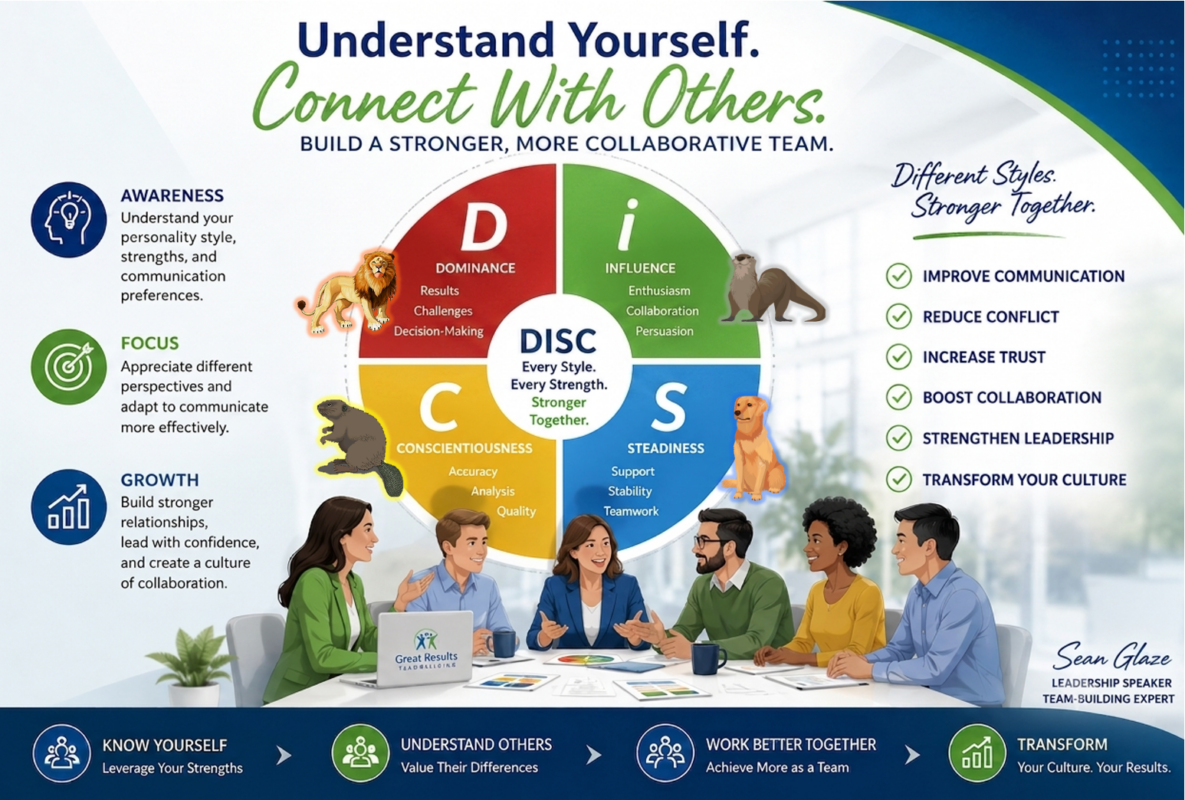
DISC measures four behavioral dimensions:
|
D Dominance How you handle challenges |
I
Influence How you interact and influence others |
S
Steadiness How you respond to pace and consistency |
C Conscientiousness How you respond to rules and procedures |
Each participant receives an individualized report that reveals their unique behavioral profile, communication preferences, and development opportunities. Sean debrief the results with your group and guides your team through applying the insights to real conversations, feedback situations, and leadership challenges.
For Quick Assessments, “Animal Types” are Fun…
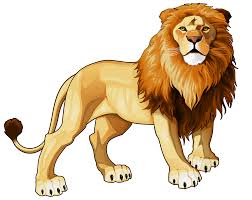
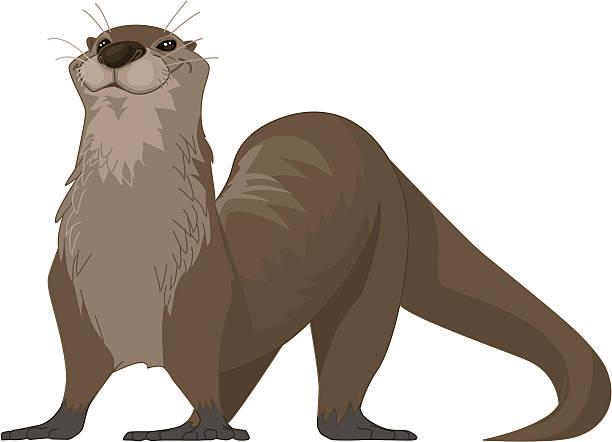
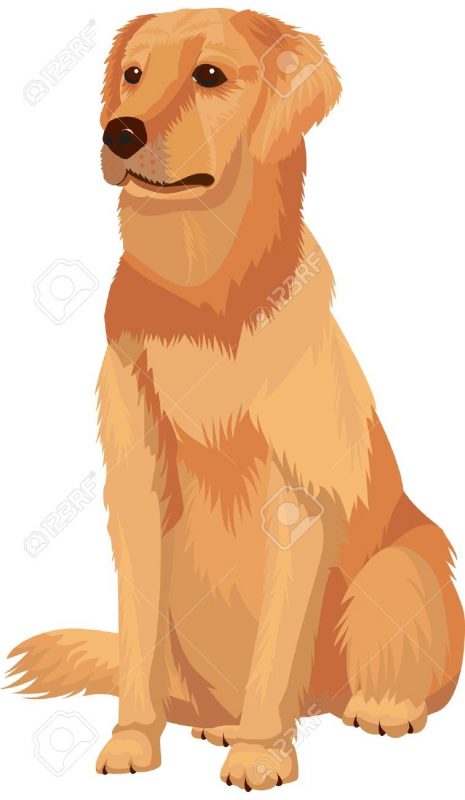
The teams that may be looking for a useful but less comprehensive team personality instrument are often happy to learn about themselves and their teammates through the shorter and less thorough “Animal Personality Types” quiz that will help to identify them as one of four animal styles:
(Otter, Lion, Golden Retriever, or Beaver!)
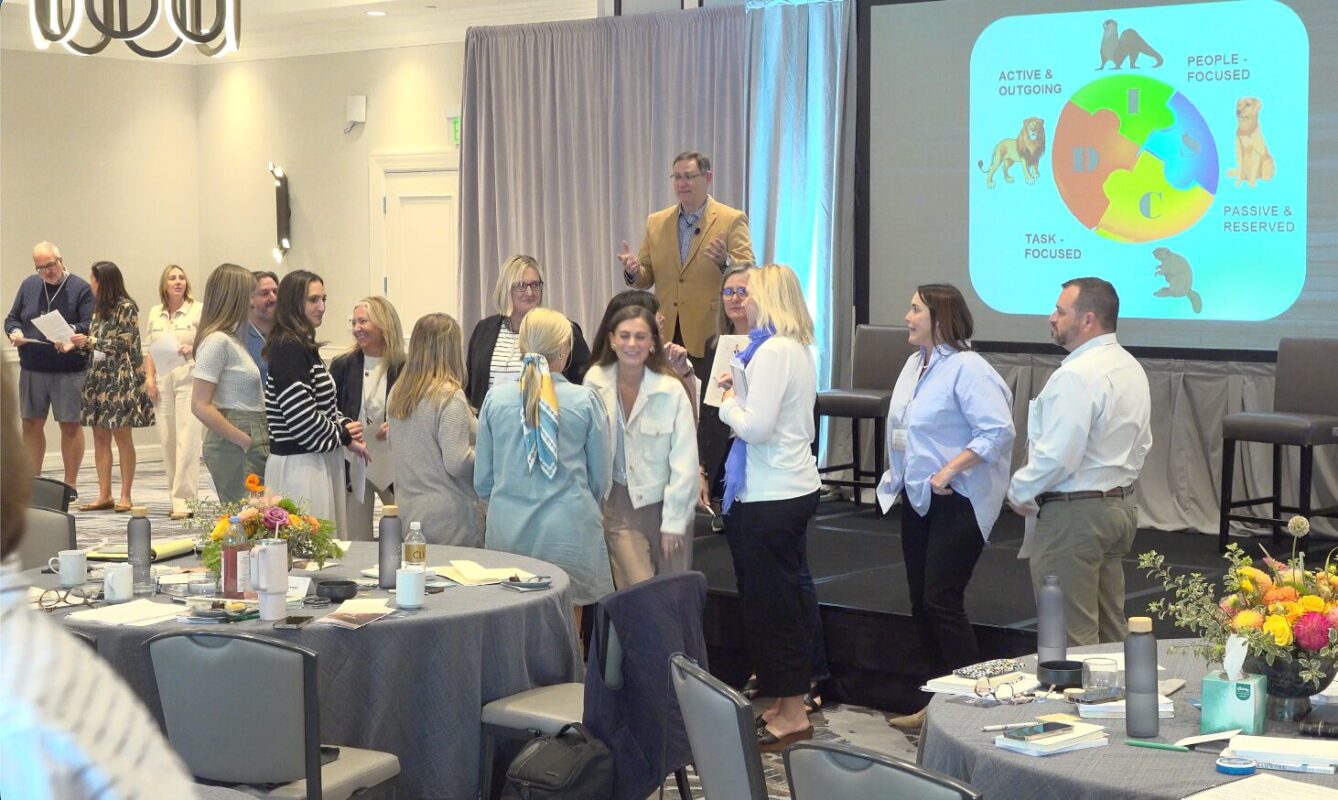
Developed by Gary Smalley, the Animal Styles roughly relate to the very well-known DiSC personality inventories that have been widely used. For athletic teams or work groups who are simply seeking an accurate but less comprehensive option, this is a brief and enjoyable option.
After each participant completes a short questionnaire, we take a moment to score and discuss each individual’s results. This offers a useful self-assessment of personal behaviors and preferences, and is a great opportunity to better understand why our teammates act the way they do…
KNOWLEDGE ABOUT TEAM PERSONALITY TYPES HELPS YOUR PEOPLE COMUNICATE BETTER –
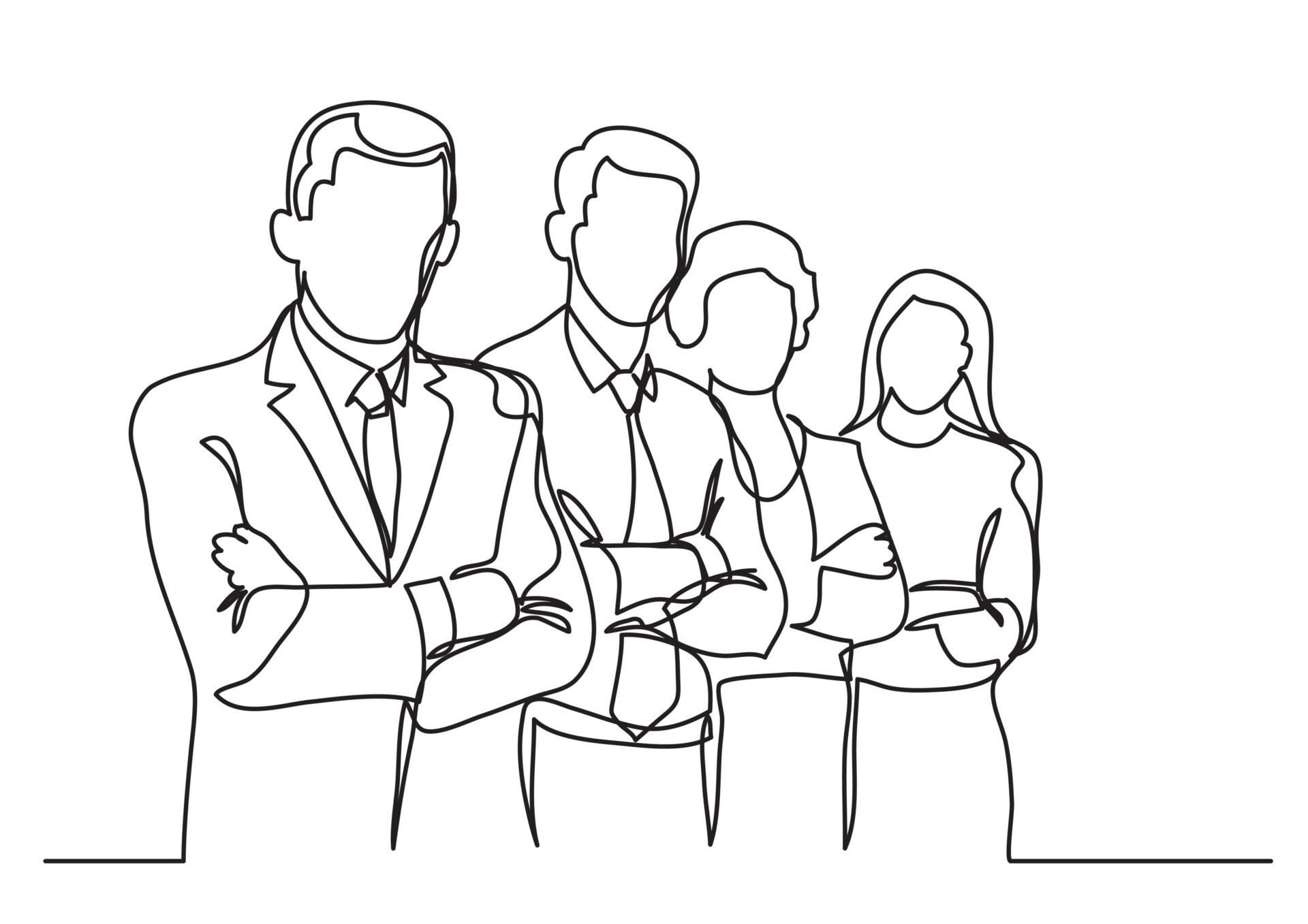
AWARENESS OF THEIR TENDENCIES AND COMMUNICATION NEEDS HELPS YOU AND COWORKERS “PUT YOUR MESSAGE IN THE. RIGHT ENVELOPE!”
For More Comprehensive Client Needs,
Sean Uses the More Detailed “DISC”
Sean is a certified consultant trained as a group facilitator to discuss and help your group apply the results of every DISC Assessment Instrument.
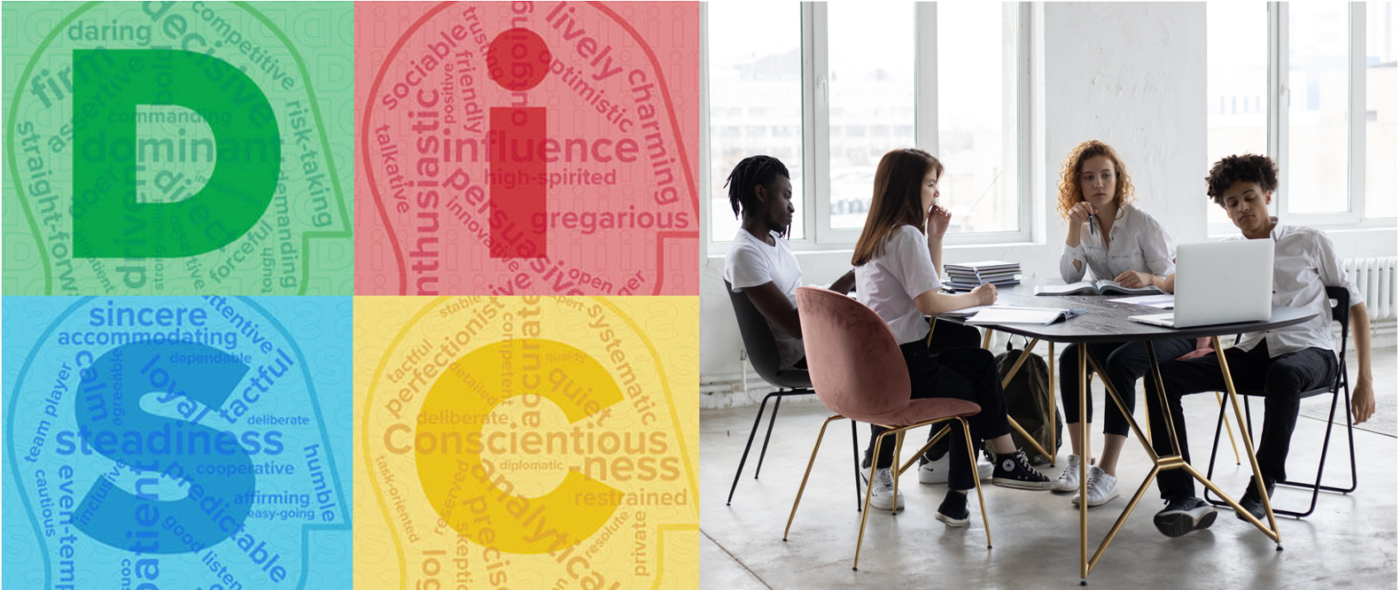
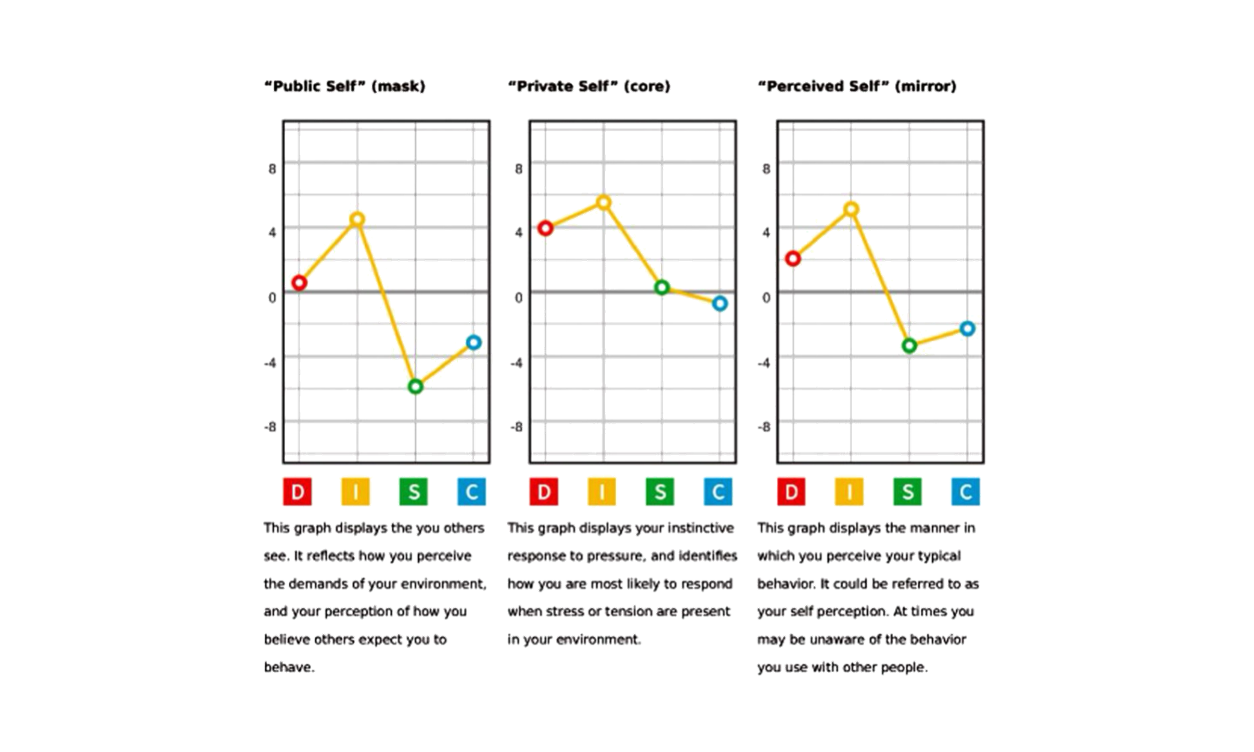
DISC is a comprehensive online assessment that measures and reports on your key tendencies, behaviors and individual characteristics. DiSC is an acronym that stands for the four main personality types:
(D)ominance, (i)nfluence, (S)teadiness and (C)onscientiousness.
.
Each individualized report offers you and your team key understandings about your strengths and challenges. As your consultant, Sean will provide your online access to the test and work together with you to unpack the results as part of a training program to identify how your team’s performance can be enhanced by the DISC insights and information.
If you are experiencing high employee turnover, frustrated with conflict resolution issues, or just want to identify the team personality types in your organization to help improve team interactions and collaboration, the DISC profile is a valid and powerful instrument…
A TEAM PERSONALITY TYPES TRAINING IS A FUN WAY TO INSPIRE MORE EFFECTIVE COMMUNICATION ACROSS YOUR ORGANIZATION!
Which Personality Assessment Is Right for Your Organization’s Communication Needs?
Buyers often compare several tools before making a decision. Here is an honest overview of the most common options and why Sean primarily uses Animal Styles and DISC.
| Assessment | Best Used For | Strengths | Limitations |
| Animal Styles | Team events, conferences, retreats | Memorable, fast, fun, no cost per person | Less scientific depth, no individual reports |
| DISC | Leadership development, management training | Validated, practical, immediately applicable, certified facilitation | Higher investment, requires skilled debrief |
| Myers-Briggs (MBTI) | Individual self-understanding | Widely recognized, 16-type depth | Less actionable for team communication, complex for group use |
| StrengthsFinder | Talent development, role alignment | Strengths-based framing, positive culture | Does not address communication friction between styles |
| Enneagram | Personal growth, leadership coaching | Deep psychological insight | Complex, difficult to apply quickly in group settings |
Workshop Outcomes
After this workshop, teams typically experience measurable shifts in how they communicate and collaborate together – wheter in person or virtually…
✓ Communicate more clearly across different personality types
✓ Reduce misunderstandings by adapting their message to the listener
✓ Hold better meetings by understanding how different styles process information
✓ Improve feedback conversations using personality-aware language
✓ Strengthen trust by appreciating different working styles
✓ Improve leadership effectiveness by adapting style to the individual
✓ Become more collaborative with less frustration
✓ Build a shared team language that lasts long after the event
Who Gets the Most from This Workshop
This program is especially effective for:
|
Leadership Teams Executives and managers who need to communicate more effectively across different styles and develop others more intentionally |
Sales Teams
Sales professionals who need to read and adapt to different buyer personalities in real time |
Management Retreats
Leadership groups getting aligned around shared communication standards and expectations |
| Remote and Hybrid Teams
Distributed teams that lose communication nuance over screens and need a shared framework for reducing friction |
Healthcare Teams
High-stakes environments where communication breakdown has real consequences |
Growing Organizations Companies adding new people quickly who need a shared language for how their team works |
Also ideal for: manufacturing teams, financial services, construction, schools and faculty teams, and any organization where communication breakdown is costing productivity.
Sean’s Approach: Knowledge That Becomes Action
Most personality workshops explain the four styles and stop there. Participants leave knowing their label but not sure what to do differently on Monday morning.
Sean builds every session around application, not just awareness. Participants learn:
- How to adapt their communication style to each personality type
- How to coach and develop team members who are wired differently than they are
- How to deliver feedback in a way each style can actually hear and act on
- How to build trust with people who think, decide, and work differently
- How different personalities respond to change, and how to lead through it
- How to run meetings that work for Lions, Otters, Retrievers, and Beavers simultaneously
As a PeopleKeys Certified DISC Facilitator with 20 years of coaching and facilitation experience, Sean knows that awareness without application fades fast. Every activity, every debrief, and every takeaway is designed to produce a behavior change that sticks.
“Sean is an engaging presenter and facilitator who offered interactive activities, shared great insights and positive takeaways at our housing retreat. It was fun, rewarding, and energizing. We left with golden nuggets to reflect on and utilize as we continue to grow and function as a strong team.”
Elaine Turner, Senior Director, Emory University Housing Operations
Frequently Asked Questions
What are team personality types?
Team personality types are behavioral frameworks that describe how different people prefer to communicate, make decisions, process information, and respond to pressure. Understanding these types helps team members adapt to each other rather than assuming everyone thinks and works the same way.
What is the DISC personality assessment?
DISC is a research-validated behavioral assessment that measures four dimensions: Dominance, Influence, Steadiness, and Conscientiousness. It is one of the most widely used team communication tools in the world and is especially effective because it focuses on observable behaviors rather than abstract psychological traits.
Are Animal Personality Types the same as DISC?
They are based on the same four behavioral dimensions. Animal Styles use a Lion, Otter, Retriever, and Beaver framework to make those dimensions more memorable and accessible. DISC provides more depth, individualized reporting, and scientific rigor. Both are effective depending on your team’s goals.
Which personality assessment is best for teams?
It depends on what you need. For a large group, a conference, or a team that wants an engaging introduction, Animal Styles is the right fit. For a leadership team or management group that wants to go deeper, DISC provides richer insight and personalized reports.
How long is a personality workshop with Sean?
The Animal Styles workshop runs 60 to 90 minutes and fits well as part of a larger event, a conference breakout, or a team meeting. The DISC workshop typically runs two to three hours and can expand to a half-day program with additional application exercises.
Can DISC improve workplace communication?
Yes, and consistently. Teams that go through a facilitated DISC debrief develop a shared language for communication differences. That shared language makes difficult conversations easier and reduces the frustration that comes from assuming everyone processes information the same way.
Is DISC scientifically validated?
DISC has been validated through decades of research and is used by thousands of organizations worldwide. The PeopleKeys platform Sean uses maintains rigorous validation standards. That said, like any behavioral model, it describes tendencies rather than absolutes. It is a powerful tool for awareness and communication, not a definitive personality diagnosis.
How many people can participate?
Sean works with groups of 8 to 800 people. The Animal Styles workshop scales effectively to large groups. DISC workshops are most impactful with smaller teams of 8 to 50 people where personalized debrief and discussion is possible.
Is this available virtually?
Yes. Both workshops are available in-person and virtually. Sean has facilitated virtual DISC and Animal Styles sessions for remote and hybrid teams across the country using breakout rooms, live polling, and interactive discussion formats.
Can this be combined with a keynote?
Absolutely. Many clients book Sean for a keynote plus a personality workshop as part of the same event day. This is one of Sean’s most popular configurations because participants leave with both an inspiring framework and a practical tool they can use immediately.
Do participants receive individual reports?
With the Animal Styles workshop, participants complete a short questionnaire and discuss results as a group. With DISC, every participant receives a personalized behavioral report they can reference long after the event.
How is the workshop customized?
Every program begins with a pre-event discovery conversation. Sean learns about your team’s specific dynamics, communication challenges, and goals before designing the content. No two programs are identical because no two teams are identical.
Can the workshop be combined with a team culture survey?
Yes. Sean’s team culture survey measures your team’s current strengths and gaps across all five pillars of a GREAT culture. The results can inform which workshop topic will have the most impact for your specific team.
Ready to Improve Team Communication?
Whether your team needs a fun introduction through Animal Personality Types or a deeper DISC experience, Sean customizes every session around your team’s goals, your people, and the specific communication challenges you want to solve.
Schedule a discovery call to talk through which option fits your next event.
talk with sean about your event