IS TEAM BUILDING WORTH IT?
Only if you Know the ROI Difference Between Fluff- and Profitable Fluff!
.

.

Have you’ve ever sat through a team building event, smiled politely, and thought “well, that was a nice afternoon but nothing’s going to change?”
You were probably not wrong.
A lot of team building is what skeptics say it is.
Entertaining. But empty of impact.
But if you lead a team that isn’t performing at the level it’s capable of, it’s worth understanding why some team building delivers real ROI —
Because most doesn’t.
But there is something different…

“I loved all of the group activities! They were very engaging and memorable because it took a total team effort with lots of communication and really gave us all a chance to get to know one another on a personal level.
The challenges were a very fun, educational, team building experience – one of the best I’ve attended in my career. Sean touched on areas that I could apply at work, plus my home life. He did an excellent job and I’d love to hear him again.”
“Sean Glaze provided a fun and interactive session for our engagement teams. He was able to take practical activities and create true leaning opportunities – his quick wit and ability to build relationships made the afternoon fly by.
I still find myself thinking about Sean’s activities and adapting my management style to make the person I’m working with feel more valued. I highly recommend Sean Glaze to inspire your group…”
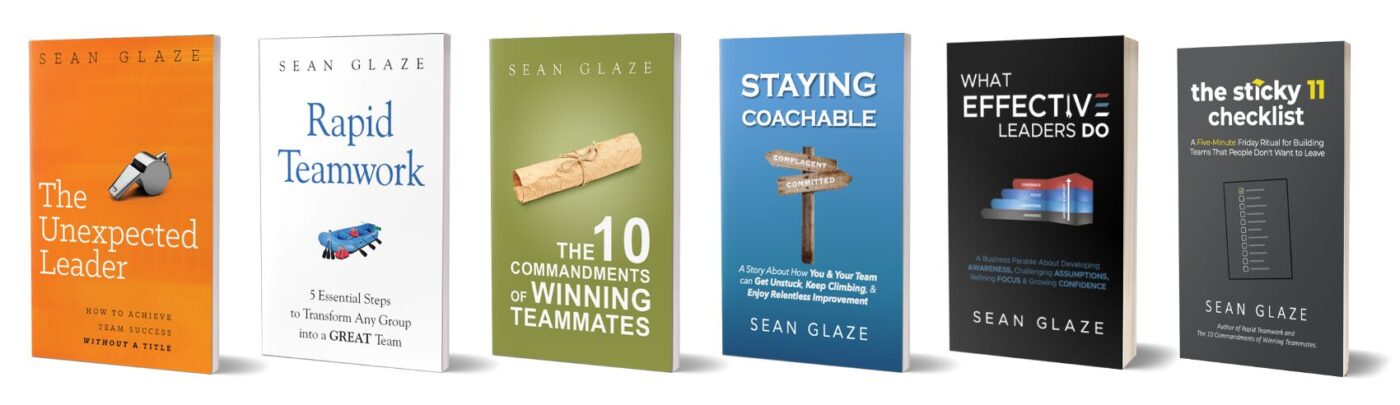
After 20 years of coaching teams — first on a basketball court, then with organizations like Cisco, John Deere, the CDC, and Emory University — I kept running into the same pattern.
Leaders would try team building. It wouldn’t stick. They’d write it off entirely. And then the same friction, the same communication breakdowns, the same silos would grind away at their team’s performance month after month.
What they had experienced wasn’t team building. It was recreation with a name tag on it.
There is a second category. One built around intentional design, real facilitation, and the specific friction your team is actually dealing with. Leaders who experience it don’t call it fluff.
They call it the best investment they made all year.
I call it Profitable Fluff —
And the name is intentional. Because from the outside, it looks like every other team event. But what happens inside the room, and what changes on Monday morning, is completely different.
Walk into almost any organization and you’ll find the same thing. Smart, capable, hardworking people who aren’t performing at the level they’re capable of.
It’s not a talent problem. It’s not a strategy problem.
It’s a culture problem.
And here’s the thing about culture that most leaders don’t hear enough: culture is always a symptom of leadership. Not because you’re a bad leader – but because almost nobody equips leaders with the actual tools to build the kind of team culture that drives real performance.
Most leaders were promoted because they were great at something else (engineering, sales, clinical work, operations). Then somebody handed them a team and said good luck.
So they do what they know. Strategy. Metrics. Meetings.
And they get results that are adequate. But rarely exceptional.
Because the piece that transforms a group of talented individuals into a team that genuinely wins together is still missing.
This is the distinction that changes everything… and you can’t unsee it…
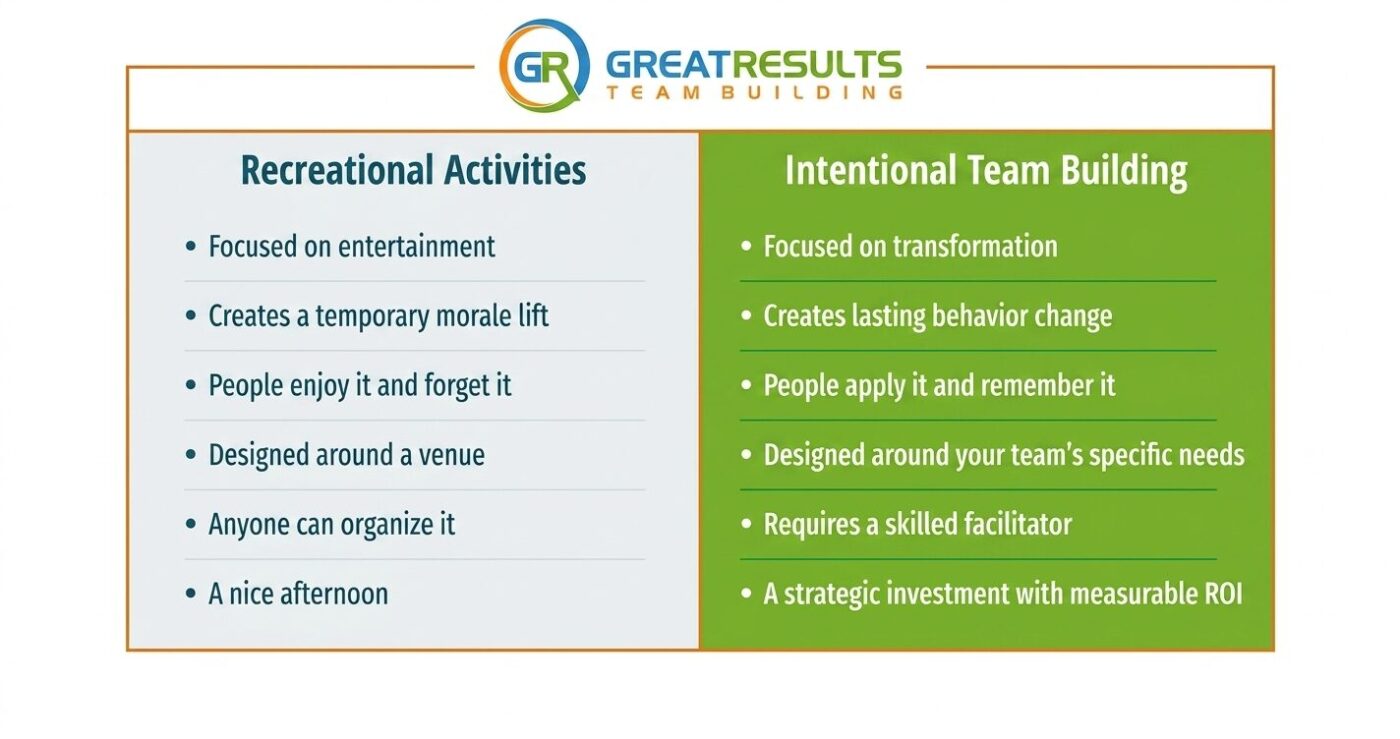
A bowling alley can host a team event.
It cannot change how your people collaborate or hold each other accountable.
That requires design. Facilitation. And a framework built around what your team is actually experiencing – not just an entertaining afternoon.
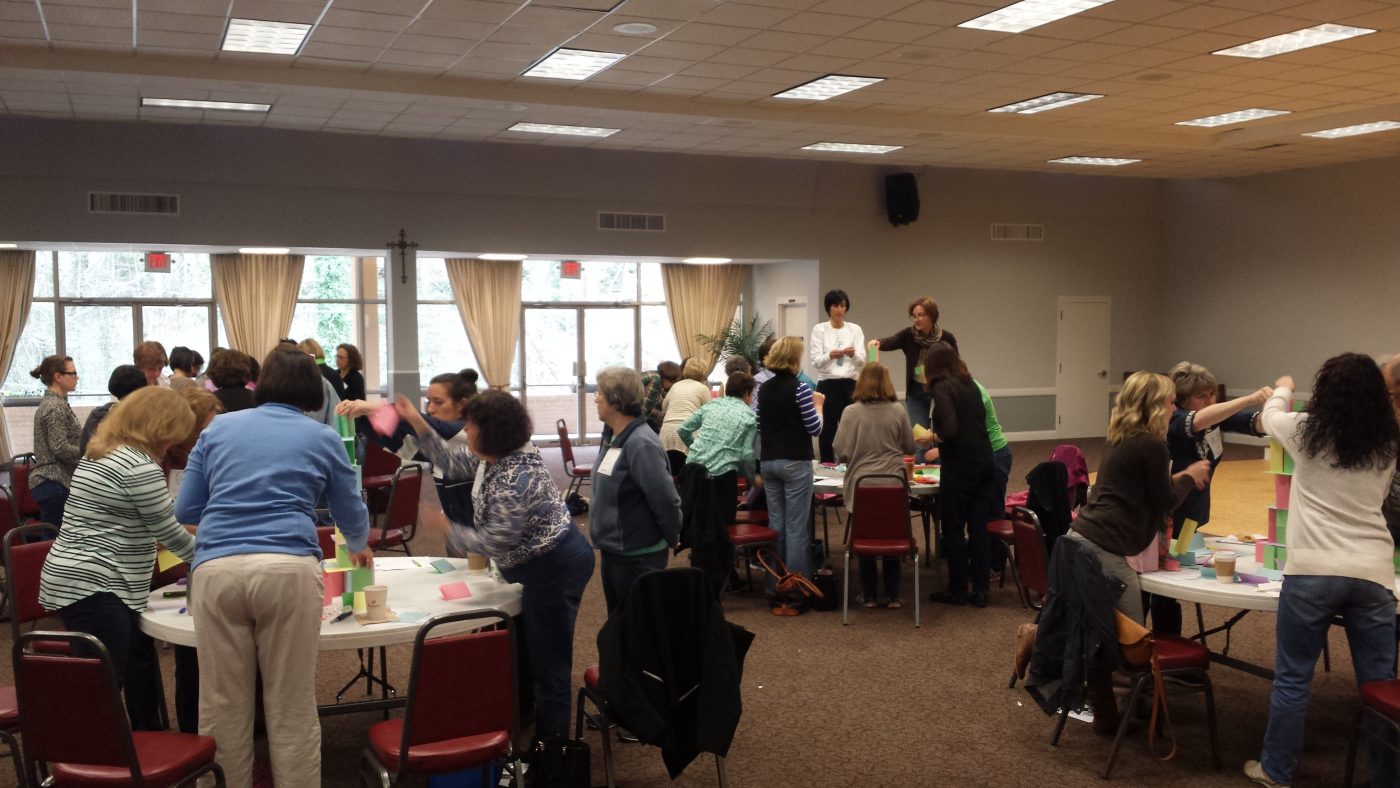
When I design a program for a corporate group, I’m not picking activities from a catalog. I’m building an experience around what that specific team needs…
-the conversations they’re not having
-the friction they’re not addressing
-the awareness they don’t yet have about each other.
Every program is built on what I call the GREAT Culture framework — five things that high-performing teams consistently have in common.
G — Goals. Every great team needs a clear, shared, compelling reason they’re here. Not a vision statement on a wall — a sentence that actually answers why we are doing this together.
R — Relationships. Teams that genuinely know each other — backgrounds, motivations, communication styles — collaborate more openly and extend more grace when things get hard.
E — Expectations. Clear agreements about roles and standards, combined with a culture that treats mistakes as learning rather than liability.
A — Accountability. Real accountability isn’t fear of consequences. It’s caring enough about your teammates to do what you said you’d do — because you understand what happens when you don’t.
T — Thanks. What gets recognized gets repeated. Consistent, specific recognition is one of the highest-ROI investments any leader can make.
When a team walks out of a well-designed corporate team building event built on these principles, things change.
They know things about each other they would never have discovered in a meeting. They have a shared language for the friction that used to slow them down. And they leave with something they can actually use on Monday.
Is team building actually worth the investment?
When it’s recreational, usually not — at least not in any measurable way.
When it’s intentional and well-facilitated, the research is clear. Engaged teams outperform disengaged ones on every business metric that matters, from profitability to retention to productivity.
The question isn’t whether team building is worth it. The question is whether what you’ve been doing qualifies as intentional team building.
How do I know if my team needs this?
If your people have the talent but not the results. If communication breakdowns are costing you time and trust. If your best performers are quietly disengaged. If you’ve lost good people recently and the real reason wasn’t the salary.
Any one of those is a signal.
All of them together is a system telling you something needs to change.
What makes Sean’s programs different from other options?
Every program is built around your team’s specific friction — not a generic plan.
The facilitation is grounded in 20-plus years of real coaching experience, a certified DISC-based framework for understanding team personality styles, and a proprietary culture model used by teams at Cisco, John Deere, the CDC, Emory University, Ecolab, and dozens of other organizations.
You’re not hiring a venue. You’re hiring a proven process.
Here’s an honest observation after two decades of doing this work.
Most culture initiatives fail not because the intentions are wrong.
They fail because there’s no system behind them. An energizing event whose effects fade within a week. A values initiative that produced a nice poster but no observable change in behavior. A keynote that everyone said was great and nobody referenced a month later.
What makes culture stick is not the intensity of a single event.
It’s the architecture of connected, reinforcing investments over time.
A framework your leaders keep coming back to. A language your team shares. And a facilitator who understands that the event is the beginning of the work — not the work itself.
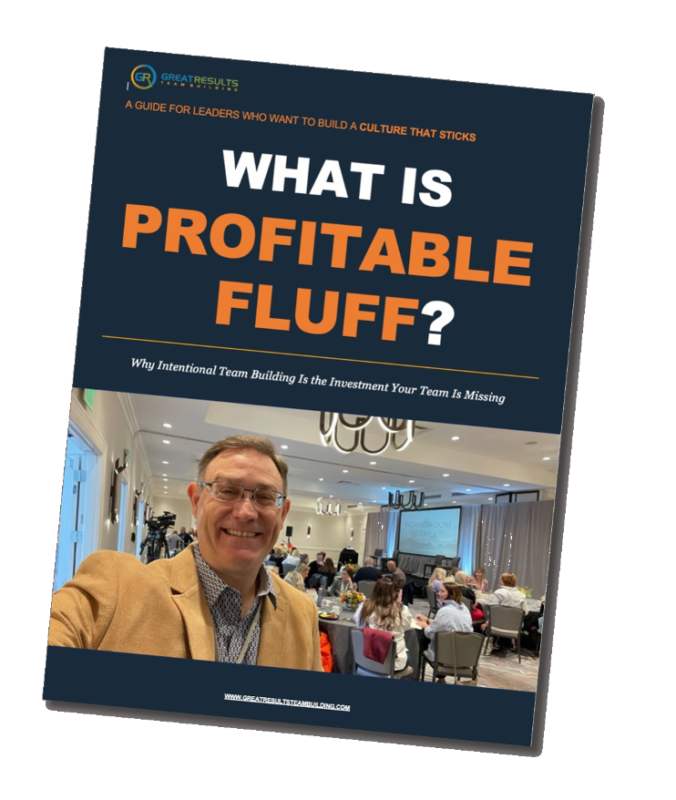
You’ve probably been there. Someone books a bowling night, calls it team building, and everyone has a decent time. But Monday rolls around and nothing’s different. Same friction. Same conversations that aren’t happening. If that’s your experience, the skepticism makes complete sense…
But what if there’s a version that actually changes things?
After 20 years coaching teams – and working with organizations like Cisco, John Deere, and the CDC – I’ve seen what happens when team building is designed with intention…
Download the Free Guide and Find Out -->
No cost. No pitch. Just the helpful info for a better team experience.
If you’re past the research phase and ready to have a real conversation about what your team needs,
I’d love to hear what’s going on.
Every engagement I take on starts with me listening before I recommend anything.
Ready to talk about your team?
Book a Call