How AI Will Change Team Building and Culture
What Leaders Need to Understand About Connection, Collaboration, and Accountability in the Age of AI

What Leaders Need to Understand About Connection, Collaboration, and Accountability in the Age of AI
The short answer is that AI is making your team more productive and more isolated at the same time. The tools are handling more of the information work. Output is measurable and improving. But something quieter is happening underneath the efficiency gains that most leaders have not named yet.
Connection is thinning. Collaboration is converging.
Accountability conversations are being avoided because the data is easier to generate than the conversation that should follow it. And the coachability that determines whether any of this gets better is being quietly replaced by the comfort of a tool that always agrees with you.
Harvard Business Review found that the top use of AI among employees shifted from generating ideas in 2024 to therapy and companionship in 2025.
That is not a productivity story. That is a culture warning.
As AI takes over more of the transactional work of management, the conversation naturally shifts to the five leadership skills AI cannot replicate no matter how capable it becomes, because those skills are what determine whether a team is led or merely managed.
AI does not replace the need for strong team building. It makes that need more urgent, more visible, and harder to ignore.
There are four shifts every leader needs to understand.
Each one changes what intentional leadership looks like. And each one points to the same conclusion: the human side of leadership has never had a higher return on investment than it does right now.
Artificial intelligence is not coming for your team building program.
It is already reshaping the conditions that make team building necessary.
The organizations investing most heavily in AI tools right now are discovering something the productivity dashboards do not fully capture: as AI handles more of the information work, the human work, connecting genuinely, collaborating across differences, holding each other accountable with empathy, and staying coachable enough to keep growing, becomes simultaneously more exposed and more essential.
Teams with AI can do more, faster.
But alongside the efficiency gains, a quieter and more troubling pattern is surfacing in the research: loneliness is rising, connection is thinning, and the employees most immersed in AI tools are increasingly turning to them not just for productivity support but as a substitute for the relationships their workplace is not providing.
One of the clearest implications of the AI shift is why human facilitation becomes more valuable as AI automates more of the work, because the experiences that build genuine connection and shared awareness cannot be delivered by a platform.
The leaders who understand what is actually happening here will not necessarily be the ones who adopt AI most aggressively. They will be the ones who understand what AI cannot do, and who invest intentionally in building the human culture that determines whether AI becomes a force multiplier or a very expensive distraction.
There are four shifts worth understanding deeply.
Each one changes what effective leadership looks like. And each one points toward the same conclusion: the human side of leadership, the part that cannot be automated, has never mattered more than it does right now.
Here is the assumption most organizations are making right now:
AI will improve efficiency, which will free people up for more meaningful work, which will improve culture and engagement. It is a logical sequence. It is also not what the data shows is actually happening.
The numbers are stark and verified.
According to Gallup’s 2024 State of the Global Workplace report, declining employee engagement cost the global economy $438 billion in lost productivity in that year alone.
The most troubling driver was not disengaged frontline workers. It was managers: engagement among managers fell from 30 percent to 27 percent in a single year, with the 2026 report showing it has since dropped further to 22 percent. The people responsible for building human culture on corporate teams are themselves the fastest-disengaging group in the global workforce.
And in what may be the most telling data point of the entire AI era: Harvard Business Review research found that the top use of generative AI among employees shifted from generating ideas in 2024 to therapy and companionship in 2025. Workers are turning to AI not just for productivity support but for the emotional validation they used to get from the humans around them.
This is not a technology problem.
It is a leadership and culture problem that technology is making visible. AI did not create workplace loneliness. But it is accelerating the conditions that produce it: more individual screen-based work, fewer moments of genuine interaction built naturally into the day, and a creeping substitution of frictionless AI availability for the messier, more rewarding experience of being genuinely known by a colleague.
The leaders who recognize this early will not restrict AI access.
They will be deliberate about creating the structured human experiences that are no longer happening by accident. That is not a retreat from modernity. It is the most strategically sophisticated response to it.
The impact of AI on team culture is showing up in four specific ways. Each one changes what intentional leadership looks like, and each one represents a direct challenge to the connection, collaboration, accountability, and adaptability your team needs to actually win together.
Every AI tool that replaces a human interaction quietly removes one more moment of potential connection from your team’s day. The Slack message that used to be a walk-down-the-hall conversation. The research question that used to start a discussion. The brainstorm that used to happen over lunch and now happens between a person and a chatbot.
None of these individual substitutions feel significant. Collectively, they are changing the relational texture of corporate teams in ways that show up in trust levels, in psychological safety, and eventually in performance. A 2025 joint study by OpenAI and MIT Media Lab found that heavy daily AI use increased loneliness over time, suggesting that when AI begins to displace authentic human connection rather than supplement it, it makes the underlying isolation worse, not better.
The most practical response is not to warn teams away from AI. It is to be intentional about creating the structured human experiences that are no longer happening organically. That means one-on-ones that begin with a genuine question about the person. It means facilitated team experiences designed specifically to build empathy and shared understanding. It means moments in the workflow where people are expected to be fully human with each other rather than optimized.
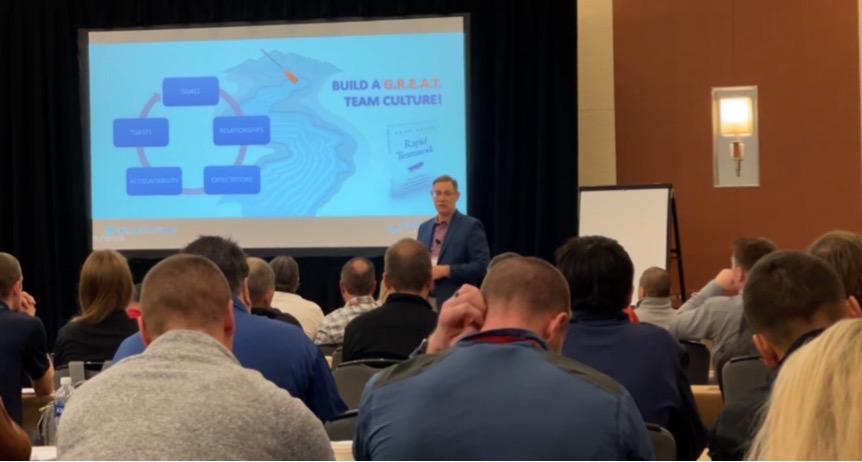
In the G.R.E.A.T. culture framework, Relationships is the second pillar because nothing else functions without it. Goals require people to trust the leader communicating them. Expectations require people to feel safe enough to ask clarifying questions. Accountability requires a relational foundation that makes direct feedback feel like support rather than judgment. AI does not build that foundation. Only consistent, intentional human interaction does.
|
The Solution in My Programs: The DISC animal personality workshop creates the shared language that makes genuine connection possible across style differences. When a Lion understands why a Retriever needs time to process, and the Retriever understands why the Lion’s directness is not aggression, resentment stops masquerading as personality conflict. Rapid Teamwork delivers the G.R.E.A.T. model as a practical culture-building framework, and every facilitated event is specifically designed to build the empathy and awareness that no AI tool can produce. The empathy exercise Sean uses in programs, asking each person to share one thing they wish their teammates understood about their role, costs nothing and shifts everything. |
|
AI offers frictionless intimacy. Real relationships require friction. The discomfort of genuine human interaction is not a problem to be engineered away. It is exactly where trust is built. |
Harvard Business School research studying workers at a major consulting firm found that people using AI were significantly more likely to produce ideas ranking in the top ten percent of all submissions. The productivity gains are real and they are not marginal.
But the same research surfaced a less-celebrated finding: when teams rely on AI for synthesis and idea generation, individual outputs begin to converge. Everyone using the same tool, drawing on the same training data, shaped by the same patterns, tends to arrive at similar conclusions. The cognitive diversity that produces breakthrough thinking, the Beaver who asks the uncomfortable question that nobody else thought to ask, the Otter who reframes the entire problem, the Lion who demands a decision when everyone else is still processing, gets smoothed over when AI mediates the collaboration.
Microsoft Research named this directly as one of the most pressing unsolved challenges in the field: AI works well for individuals but does not yet work well for teams. And the gap between those two realities is widening as tool adoption accelerates.
The teams that outperform in an AI-saturated environment will not necessarily be the ones who use AI most aggressively. They will be the ones whose human collaboration is strong enough to productively challenge what AI produces. That requires psychological safety, communication skills across style differences, and the shared trust to sustain productive friction without it becoming dysfunction. None of those capabilities come from an AI tool.
|
The Solution in My Programs: The 10 Commandments of Winning Teammates answers the collaboration problem. When team members are genuinely interested in each other, actively listen rather than waiting to respond, and are coachable enough to have their own thinking challenged, diverse human perspectives produce something AI-alone cannot. The DISC workshop gives teams the shared language to make those different perspectives additive rather than combative. A facilitated session specifically designed around the team’s current collaboration friction surfaces exactly the dynamics that AI synthesis has been hiding. |
Organizations are already deploying AI in performance management. Predictive models can flag retention risk. Natural language processing tools can identify patterns across hundreds of feedback forms. AI can catch the objective behavioral data that busy managers miss and surface it in time to do something about it.
These are genuine capabilities. But every serious expert in this space is converging on the same boundary: AI is decision support, not decision authority. The European Union’s AI Act, with broader application beginning in August 2026, specifically requires human oversight for high-stakes employment decisions. The U.S. regulatory environment is moving in the same direction. The reason is not bureaucratic. It is that accountability conversations require something AI genuinely cannot deliver: the empathy moment where a person genuinely understands how their behavior affected another human being, and cares about it.
That moment is the I step in the POINT feedback model. Identify the Impact. Help the person understand not just what they did but who it cost and how. An algorithm can describe a behavior accurately. It cannot sit across from someone and help them feel the weight of that behavior on the colleague who stayed late to absorb it. That conversation requires a person who has invested in the relationship, who understands the human on the other side of the table, and who has a structured framework for doing it well.
As AI handles more of the measurement, the quality of the human conversations that follow those measurements becomes the critical differentiator between teams that perform and teams that merely comply.
|
The Solution in My Customized Programs: The POINT model from What Effective Leaders Do gives leaders a five-step structure for the exact conversation AI cannot have: Permission and Purpose, Objectively Describe the Behavior, Identify the Impact on the Team, Negotiate Next Steps, and Track Progress. The Accountability PIE framework, Purpose, Identity, and Empathy, explains why the conversation has to be preceded by the right relational conditions before any data or model will produce lasting behavior change. When AI surfaces a performance pattern, a leader with these two frameworks knows exactly what to do with it. One without the other is incomplete. Together they are the full accountability system that AI adoption makes more necessary, not less. |
|
“AI should never make final decisions about ratings, pay, promotions, or exits because these outcomes require human understanding of context and nuance. Keeping humans accountable for management performance decisions protects fairness and maintains trust.” AIHR Institute, 2026 Performance Management Guide |

This is the shift that surprises leaders the most when they first encounter it in their own teams. A team member who has been with the organization for eighteen months uses AI to build a technical proficiency overnight that rivals a veteran executive’s decade of accumulated knowledge.
The traditional hierarchy of expertise, the assumption that tenure equals authority because tenure equals knowledge, is being quietly dismantled by tools available to anyone with an internet connection.
That is genuinely good news for organizations that embrace it.
The best thinking on any problem is no longer locked behind years of experience. But it creates a leadership challenge that most organizations have not named yet: how do you lead effectively when someone significantly less experienced might produce better work than you on any given day? How do you maintain team cohesion when the expertise gradient is constantly shifting? How do you stay relevant as a leader when the information advantage that used to define your authority is gone?
The answer is coachability. Not as a personality trait but as a deliberate, practiced commitment to staying curious, staying honest about your own current reality, staying humble enough to learn from people at every level of the org chart, and staying focused on building positive habits even when comfort tempts you toward complacency.
The four ceilings that prevent growth described in Staying Coachable, contentment, ignoring reality, personal pride, and knowing without doing, are precisely the four ceilings that will determine whether a leader uses AI as a growth tool or as a sophisticated comfort mechanism. The leader who accepts AI-generated output without challenging it because it confirms what they already believe is not using AI.
They are using AI to stay stuck.
Coachability is also the prerequisite for all other winning teammate behaviors.
You cannot build genuine trust if you are not willing to hear honest feedback. You cannot collaborate across style differences if you are not willing to question your own defaults. You cannot hold yourself accountable if you are not willing to see your own patterns clearly. In an AI-accelerated environment, the coachable leader is the one who keeps growing while everyone else is getting comfortable.
|
The Solution in My Programs: Staying Coachable delivers the four questions that drive relentless improvement in any environment, including an AI-saturated one: What is your goal? What is your honest current reality? What obstacles exist? What does the team need? These questions are as relevant to an organization navigating AI adoption as they are to a player on a basketball team navigating a new system. The Staying Coachable keynote gives teams a shared framework for the kind of adaptive mindset that turns AI-driven disruption from a threat into an accelerant. When the entire team is coachable, AI tools become learning multipliers. When they are not, AI becomes the world’s most expensive way to stay exactly where you are. |
I worked with a technology organization that had invested heavily in AI tools across their product and operations teams. The productivity gains were visible and measurable. What was also becoming visible, more quietly, was a culture problem that the AI adoption had accelerated rather than created.
People were doing more work in isolation. Collaboration had become asynchronous and tool-mediated. The social texture of the team, the spontaneous conversations, the shared understanding of how each person worked and what they were dealing with, was thinning. On paper, output was up. In the room, something felt wrong.
We designed a full-day facilitated experience built around three things: a DISC workshop that gave the team a shared language for the style differences that had been causing friction, a structured accountability session that introduced the POINT model and the Accountability PIE, and a series of facilitated activities specifically designed to build the empathy and relational awareness that distributed AI-assisted work had been quietly eroding.
The debrief produced the moment that matters most in any facilitated session.
A senior engineer, a high Beaver, said publicly that she had been reading the product team’s urgency as a lack of respect for her process. The product lead, a high Lion, said he had never once thought about what his pace was costing her. He had been thinking about the deadline. She had been absorbing the aftermath of every decision he made without enough information.
That conversation had not happened in twelve months of working together. It happened in a facilitated room in about ninety minutes. Not because I gave them information they did not have. Because I created the conditions for them to finally see each other.
That is what these programs do. And that is the specific outcome AI cannot produce, no matter how sophisticated the tool.
The leaders who will build the strongest teams in an AI-driven world are not the ones who compete with AI or resist it. They are the ones who understand exactly where the boundary between artificial intelligence and human leadership lies, and who invest deliberately on their side of that line.
Here is what that looks like across those dimensions of team culture.
| Dimension | What AI handles (IQ) | What leaders must now do (EQ) | How to implement it |
|---|---|---|---|
| Connection |
|
|
|
| Collaboration |
|
|
|
| Accountability |
|
|
|
| Adaptability |
|
|
|
The first two columns define the leadership challenge AI creates. The third column shows the human skills leaders must now develop and demonstrate. The fourth column identifies how Sean Glaze’s keynotes, workshops, and team building programs help organizations implement those skills deliberately and durably.
The G.R.E.A.T. culture framework was built from twenty years of observing what separates teams that function from teams that merely coexist. Every pillar addresses a specific vulnerability that AI adoption either creates or amplifies.
No. AI adoption makes intentional team building more necessary, not less. As more individual work moves to AI-assisted isolation, the human connection, shared language, and empathy that hold teams together must be built more deliberately. A well-facilitated team experience creates the awareness, trust, and shared vocabulary that allow AI tools to serve the team’s human culture rather than replace it. AI can surface the data that tells you a team needs this work. It cannot do the work itself.
The most documented effect is accelerated disconnection. Gallup’s 2024 data shows declining engagement cost the global economy $438 billion, with the sharpest drop among managers. Harvard Business Review research found that the top employee use of generative AI shifted from idea generation in 2024 to emotional companionship in 2025. Workers are turning to AI for validation their workplace is not providing. That is a culture problem expressed as a technology trend.
The POINT model is a five-step accountability conversation framework from Sean Glaze’s book What Effective Leaders Do: Permission and Purpose, Objectively Describe the Behavior, Identify the Impact, Negotiate Next Steps, and Track Progress. As AI tools handle more of the performance measurement in organizations, the human conversation that addresses what the data means, and specifically helps a team member understand the human impact of their behavior, becomes the critical differentiating skill. AI informs. The POINT model is how leaders do something meaningful with that information.
Everything. The four growth ceilings described in Staying Coachable, contentment, ignoring reality, personal pride, and knowing without doing, are precisely the four ceilings that will determine whether a leader uses AI as a genuine growth tool or as a sophisticated way to stay exactly where they are. The coachable leader uses AI feedback to improve. The uncoachable leader uses AI to confirm what they already believe. In an environment where AI tools are available to everyone, coachability is the remaining differentiator between teams that keep growing and teams that get comfortable.
DISC gives teams the shared language to make cognitive diversity productive rather than disruptive. As AI tools tend to homogenize individual outputs and narrow the range of ideas a team generates, the Beaver who asks the uncomfortable verification question, the Otter who reframes the problem entirely, and the Lion who demands a decision become more valuable rather than less. DISC helps teams understand and use those differences intentionally. Without it, those same differences produce friction. With it, they produce the creative tension that generates the team’s best thinking.
The behaviors from The 10 Commandments of Winning Teammates remain the primary determinants of team performance in any environment: being genuinely trustworthy, being coachable, being interested in the people around you, being accountable without being told to be, and being willing to put the team’s needs above individual convenience. When AI tools handle information work, these interpersonal behaviors are what separate teams that use AI well from teams that use AI to stay stuck.
AI is useful in preparation and follow-up: analyzing pre-event survey responses, generating tailored debrief questions, tracking commitment follow-through after a session. The facilitation itself cannot be replicated or improved by AI. The moment when a team member sees for the first time how their behavior has been affecting a colleague they care about requires a skilled human facilitator who has done the pre-event work to understand this team’s specific dynamics. That moment is the whole point of the program.
Organizations looking to address AI-era leadership challenges at their next conference should consider how to choose a workplace culture speaker who speaks to this moment specifically rather than delivering content that could have been written five years ago.
Every organization will have AI.
The question is what kind of human culture those tools are serving.
A team with strong trust, genuine relationships, shared accountability, and the coachability to keep growing will use AI as a force multiplier for something worth multiplying.
A team that is disconnected, siloed, and operating on compliance rather than commitment will use AI to produce more of the same insufficient results, faster.
Great Results Teambuilding delivers intentional, facilitated programs for groups of 8 to 800. Every program is fully customized based on pre-event discovery. Every attendee receives a published book. Every debrief is designed to produce specific insights your team applies on Monday morning.
Past clients include Cisco, John Deere, the CDC, Emory University, Ecolab, Southern Company, the USPTO, and World Wide Technology – Over 100 client testimonials and 20 five-star Google reviews!
Ready to talk about your team?
Book a Call