How to Build Trust
on a Team
Why Most Leaders Start in the Wrong Place
Why Most Leaders Start in the Wrong Place
The short answer is that building trust on a team is the single most important thing a leader can do. It is also the thing most leaders approach backwards.
Most trust-building efforts start with activities.
Icebreakers. Offsite events. Happy hours.
And there is nothing wrong with any of those things.
But they address the symptom, not the source. Teams do not lack trust because they have not spent enough time together.
They lack trust because one or more of three specific things has gone missing from how the leader shows up every single day.
Trust is not built in a day. But it can be damaged in a moment. And most leaders have no framework for understanding why their team trusts them, or does not, until the damage is already done.
The framework that follows comes from twenty years of coaching teams, first on a basketball court, then with organizations like Cisco, John Deere, the CDC, and Emory University. It starts with a distinction most trust conversations never make, and it has never failed to explain the trust dynamic on any team I have ever worked with.

Before you can build trust effectively, you need to understand something that almost no leadership content addresses directly: not everyone on your team arrives with the same capacity to extend trust.
Every person who joins your team brings with them a trust disposition shaped by every leader, colleague, parent, and relationship that came before you. Some people extend trust quickly and generously. Others guard it carefully, releasing it only after seeing consistent evidence over a long period of time. Some have been burned badly enough that their default is skepticism regardless of what you do.
That disposition is what I call trust-willingness.
And here is the honest truth about it: you cannot control it. You did not create it. You inherited it along with the person when they joined your team.
What you can control, entirely and consistently, is your trust-worthiness.
That is whether you demonstrate the behaviors that make you someone worth trusting. And that is exactly where a leader’s focus belongs.
|
Trust-WILLINGNESS |
Trust-WORTHINESS |
|
What it is: How open someone is to extending trust based on their history, past relationships, and personal beliefs. Can you control it? No. People arrive on your team with a trust disposition already shaped by every leader and relationship that came before you. What it means for you: Some people will trust quickly. Others will require consistent evidence over a long period. Neither response is about you personally |
What it is: How reliably you demonstrate the behaviors that make you someone worth trusting. Can you control it? Yes. Entirely. This is where the three-legged stool lives and where your leadership focus belongs. What it means for you: You cannot change someone’s trust-willingness. You can absolutely influence it over time by making your trustworthiness undeniable. |
This distinction matters.
And it explains something that frustrates a lot of leaders.
You can do everything right and still have someone on your team who extends trust slowly. That is not a failure of your leadership. It is a reality of their history. Your job is not to override their trust-willingness. Your job is to make your trustworthiness so consistent and so visible that it eventually becomes the most compelling evidence they have ever been given.
Leaders who want to hold their teams to a higher standard without damaging morale need to understand that accountability conversations only work inside a trust relationship, and the trust has to come first.
Leaders and winning teammates who understand this stop taking slow trust personally. They stop interpreting caution as disrespect.
And they redirect their energy from trying to persuade people to trust them toward simply demonstrating, day after day, the three behaviors that earn it.
“Trust is the glue of life. It’s the most essential ingredient in effective communication. It’s the foundational principle that holds all relationships.”
– Stephen R. Covey
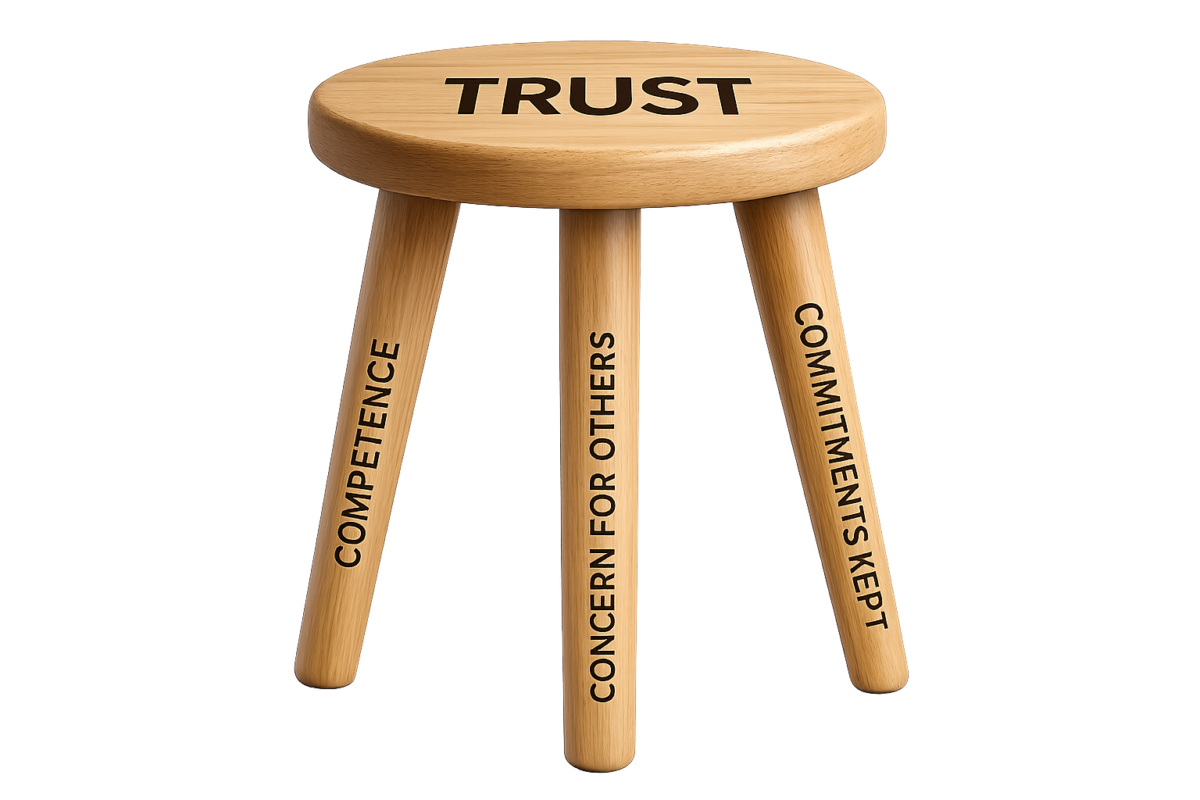
In my book What Effective Leaders Do, a mentor named Tony explains trust-worthiness to a struggling new manager named Jenn using a simple image.
He borrows her pen and draws a three-legged stool in her notebook.
Then he names the three legs.
The surprising order matters. Competence matters least. Concern matters most, closely followed by commitments.
That means a technically imperfect leader who genuinely cares about their people and reliably keeps their word will build more trust-worthiness faster than a highly skilled leader who is indifferent to the people around them. This runs counter to how most promotions are made and most leadership is evaluated, which is a problem worth naming directly.
And here is the connection back to trust-willingness: for the team member who arrived with a low default trust level, consistent demonstration of all three legs is the only thing that will move the needle.
Not charm. Not a team happy hour.
Not a rousing all-hands speech.
Just the quiet, relentless accumulation of evidence that you are competent, that you care, and that you keep your word.
When leaders discover their team does not fully trust them, the instinct is usually to ask what happened. What went wrong. Was there a decision that felt unfair? A promise that was broken? A moment when someone felt dismissed?
Sometimes, yes. But more often the erosion is quiet. It happens across dozens of small interactions where the leader, without realizing it, sent the wrong signal. They were too focused on results to ask about the person. They said they would follow up and forgot. They clearly knew the technical side of the job but did not seem to care about the human beings doing it.
Broken trust is the most common invisible driver behind performance gaps, which is why talented teams underperform when trust is missing even when every other condition for success is in place.
Here is the critical insight that most leadership content misses: trust-worthiness has three distinct legs, and most leaders only actively tend to one of them. When even one leg weakens, the whole stool wobbles. When two are weak, even someone with a high trust-willingness will stop extending it.
The research reinforces why this matters so urgently.
According to Gallup’s 2024 State of the Global Workplace report, organizations with high engagement, which is built on a foundation of trust, report 23 percent higher profitability and 51 percent lower voluntary turnover than organizations with low engagement. Trust is not a soft metric.
It is a performance driver with a direct line to your bottom line.
One reason trust-building is so inconsistently applied is that different people trust differently. Trust-willingness varies by history, but how people express and receive trust-worthiness also varies by behavioral style.
One underused tool for accelerating trust between team members is personality awareness, and understanding how DISC helps teammates understand why each style needs different things to feel trusted can dramatically speed up the process.
What makes a Lion feel that a leader is trustworthy is not what makes a Retriever feel it. And a leader who only demonstrates trustworthiness in one style leaves most of their team unconvinced, regardless of how well-intentioned they are.
|
DISC Style |
What Builds Their Trust |
Practical Application |
|
Lion (D Style) |
Respects decisiveness and results. Trusts leaders who are direct, do not waste their time, and deliver on what they promise. |
Give them autonomy. Follow through on commitments. Be direct even when the news is hard. |
|
Otter (I Style) |
Trusts people who make them feel valued and seen as individuals, not just performers. |
Recognize their contributions specifically and publicly. Show enthusiasm. Remember what matters to them personally. |
|
Retriever (S Style) |
Trusts slowly but deeply. Needs consistency over time and wants to see that you are the same person whether things are going well or not. |
Never surprise them. Be steady. Check in regularly without an agenda. Be honest about changes before they happen. |
|
Beaver (C Style) |
Trusts competence and accuracy. Needs leaders who do what they say and have the data to back up their decisions. |
Be precise. Follow through on every detail you commit to. Never overpromise. Give them time to verify. |
When a leader understands these differences, trust-building stops being a generic activity and becomes a targeted practice.
You are not trying to make everyone feel the same thing.
You are trying to give each person the specific evidence they need to conclude, on their own terms, that you are worth trusting.

One of the most useful diagnostic tools I use with leaders is what I call the Monday Morning Trust Test. It is a set of four questions to ask yourself at the start of every week, focused entirely on the trustworthiness variables you control.
These are not comfortable questions. But they are the right ones. Trust is always a symptom of the interactions that came before it. The Monday Morning Trust Test is a practice of looking honestly at those interactions before the week begins rather than after something has broken.
Notice that none of these questions are about the other person. None of them ask whether a team member seems willing to trust you. They are all about your trustworthiness. That is the only variable in front of you.
I worked with a technology leader at a mid-size software company who was genuinely excellent at his job. His technical competence was unquestioned. His team respected his expertise and regularly sought his input on complex problems.
But engagement on the team was low.
People were doing their jobs and not much more. Turnover had picked up. When I interviewed team members before our session, the pattern was consistent: they trusted his judgment but did not trust him.
The distinction was stark. They knew he was smart.
They did not believe he cared about them.
He had been so focused on the work that he had never invested in the relationships. One-on-one meetings were exclusively about project status. He rarely asked about anything outside the deliverable. When someone shared a personal challenge, he would nod and quickly redirect to the task at hand.
The third leg, commitment, was actually strong. He did what he said he would do. But the second leg, concern for others, was almost entirely absent. And for a couple of people on his team who had experienced managers like this before, their trust-willingness was already low. They were not inclined to extend benefit of the doubt because they had learned not to.
We worked on one thing first: redesigning his one-on-ones with a simple opening question asked in every meeting. Not about the project. About the person. What has been most challenging for you this week? What are you most excited about right now? What do you need from me that you are not currently getting?
Within eight weeks, the shift was visible.
People were staying late voluntarily. A team member who had been quietly job searching told him directly that she had decided to stay. Another told him in a performance review that it was the first time in two years he felt like his manager actually knew him.
Nothing about the work changed.
The only variable was the second leg of the stool. He had not changed their trust-willingness. He had made his trustworthiness impossible to ignore.
Trust is not a standalone initiative.
In the G.R.E.A.T. culture framework, it lives in the Relationships pillar, but it touches every other pillar directly. And the trust-willingness versus trustworthiness distinction shows up inside each one.
This is why trust is not one thing you build alongside everything else.
It is the substrate beneath everything else. Get the three legs right, and every other culture initiative becomes easier.
Miss even one leg, and everything built on top of it stays fragile, regardless of how willing the team might be to extend trust in the first place.
Trust-willingness is how open someone is to extending trust based on their personal history and past relationships. It varies from person to person and is not something a leader can control. Trustworthiness is whether a leader consistently demonstrates the behaviors that make them worth trusting. That is entirely within a leader’s control. Effective leaders stop focusing on whether people seem willing to trust them and start focusing on making their trustworthiness undeniable.
The fastest way to build trustworthiness is to focus on the two legs of the stool that have the most impact: Concern for Others and Commitments You Keep. Start with genuine interest in each person as a human being, not just a performer. Then make small commitments and keep every single one of them. Some people will respond quickly. Others with lower trust-willingness will require more consistent evidence over a longer period. Neither response is a failure. Both are addressed the same way.
Teams with high trust communicate more honestly, hold each other accountable more naturally, take more creative risks, and recover from setbacks faster. According to Gallup research, organizations with highly engaged, high-trust cultures report 23 percent higher profitability and 51 percent lower turnover. Trust is a direct performance driver, not a cultural luxury.
The three most common trust-worthiness killers are: leaders who only care about results and never invest in the people delivering them; broken commitments, even small ones, allowed to accumulate without acknowledgment; and inconsistency between what a leader says and how they behave under pressure. For team members who already have a low trust-willingness, any one of these confirms exactly what they were already guarding against.
Different personality styles build and lose trust differently. Lions trust through results and directness. Otters trust through recognition and relationship. Retrievers trust through consistency and stability over time. Beavers trust through competence and accuracy. A leader who only demonstrates trustworthiness in one style will leave most of their team unconvinced, regardless of how genuinely they intend to be trustworthy.
There is no universal timeline, and trust-willingness is a significant variable. Some people will extend trust after a handful of positive interactions. Others with more guarded dispositions will require months of consistent demonstration before the stool feels stable to them. A well-facilitated team experience can accelerate the process by surfacing shared understanding, but the leader’s daily behavior is the only sustainable driver.
The three-legged stool is a framework from Sean Glaze’s book What Effective Leaders Do that describes the three components of trustworthiness: Competence in Your Role, Concern for Others, and Commitments You Keep. Of the three, Competence has the least impact. People will give grace for a leader who is still growing technically, as long as they believe that leader genuinely cares about them and reliably does what they say they will do.
Yes, when they are intentionally designed and properly debriefed. A well-facilitated team experience creates shared awareness, builds empathy, and gives people a common language for the differences that already exist on the team. For people with lower trust-willingness, shared experiences that surface genuine connection can be the accelerant that months of ordinary working life would not produce. Recreational activities alone rarely do this. Intentional, facilitated experiences with structured debrief do.
If your team is not performing at the level you know they are capable of, the first question worth asking is not about strategy or skill. It is about trust. Specifically: which leg of the stool is wobbly right now, and how many people on this team arrived with a trust-willingness that has never been met with the consistent trustworthiness it would take to move them?
Those are not easy questions. But they are the right ones.
And they point directly toward the work that actually changes team dynamics.
Great Results Teambuilding delivers intentional, facilitated programs for groups of 8 to 800. Every program is fully customized based on pre-event discovery. Every attendee receives a published book. Every debrief is designed to produce specific insights your team applies on Monday morning.
Past clients include Cisco, John Deere, the CDC, Emory University, Ecolab, Southern Company, the USPTO, and World Wide Technology – Over 100 client testimonials and 20 five-star Google reviews!
Ready to talk about your team?
Book a Call