How to Improve Accountability
Without Micromanaging
Why Empathy Is the Foundation of an Accountable Team Culture

Why Empathy Is the Foundation of an Accountable Team Culture
The Short Answer is that accountability without micromanaging is possible, but it requires something most leaders skip: building enough relational trust and shared awareness that people actually care about the impact of their work on others.
Most accountability problems are not discipline problems.
They are empathy problems.
The team member who consistently misses deadlines, underdelivers, or checks out is rarely trying to sabotage the project. More often, they do not fully understand how their behavior affects the people around them.
They are not connecting the dots between what they do and what it costs their teammates, their clients, and the culture they share.
The leaders who build genuine accountability cultures do three things consistently.
They invest in regular 1-1 conversations that build real relationships.
They create experiences that grow awareness of how individual behavior impacts the team.
And when a direct conversation is necessary, they use a structured feedback framework that starts with empathy, not judgment.
That framework is called the POINT model.
And when it is used consistently inside a culture built on relationships and real expectations, it produces something micromanagement never can: people who hold themselves accountable because they genuinely care about the people around them.
The surest way to lose great employees is to consistently tolerate bad ones.
But the surest way to destroy a team is to confuse control for accountability.
They are not the same thing.
Here is the problem with how most organizations approach accountability: they try to build it through systems before they have built it through relationships.
They install dashboards, set KPIs, run performance reviews, and document everything. Those are not bad tools. But when they are deployed in a culture where people do not trust each other and do not fully understand how their behavior impacts the team, those systems produce compliance at best and resentment at worst. People learn to manage the metrics, not the actual work.
Real accountability is not about what happens when someone falls short. It is about whether people care enough about the people and projects around them to hold themselves to a high standard before anyone has to say a word.
Leaders who try to build accountability before addressing the relationship underneath it usually fail, because trust has to be established before accountability conversations can work without triggering defensiveness or disengagement.
That kind of accountability only grows in one direction: from the inside out. And it starts with awareness. Specifically, it starts when someone genuinely understands how their behavior, their attitude, their follow-through, or their silence, affects the teammates who are counting on them.
That is why the most powerful team building experiences I run are not games or activities. They are structured moments that shift perspective. When a group goes through a well-designed, well-debriefed shared experience and someone realizes for the first time that their Retriever teammate has been absorbing the fallout from the Lion’s impatience for months, something changes.
Not because I told them to change. Because they finally saw it.
Accountability gaps are rarely about willingness or effort, and understanding why talented teams underperform when accountability is missing reframes the problem in a way that makes it solvable rather than personal.
Empathy is the foundation of accountability.
You cannot demand it. You have to cultivate it.
A 2021 Catalyst survey found that employees of more empathetic leaders were three times more engaged, four times more innovative, and significantly more loyal than employees of less empathetic leaders.
Empathy is not a soft skill. It is a performance driver.
And it is the prerequisite for the kind of accountability that actually changes behavior.
I spent years as a young basketball coach trying to hold my players accountable the wrong way.
I provided consequences when standards were not met. I ran people for missed assignments. I used pressure as a substitute for connection.
What I got was compliance.
What I never got was commitment. Because no amount of consequence ever reached the internal decision a person makes to actually care about doing things right.
Sam Silverstein, one of the most respected voices on accountability in leadership, captured this directly:
“Accountability can never be mandated. It can only be inspired.”
After coaching basketball for twenty years and facilitating team development programs for organizations like Cisco, the CDC, and John Deere, I have distilled what inspires accountability down to three ingredients.
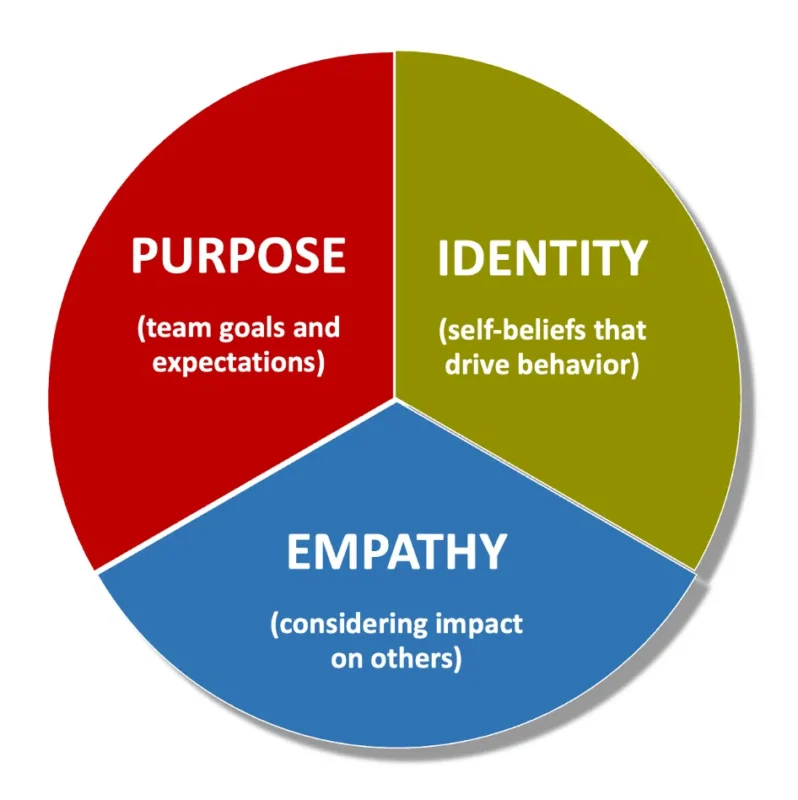
I call them the Accountability PIE.
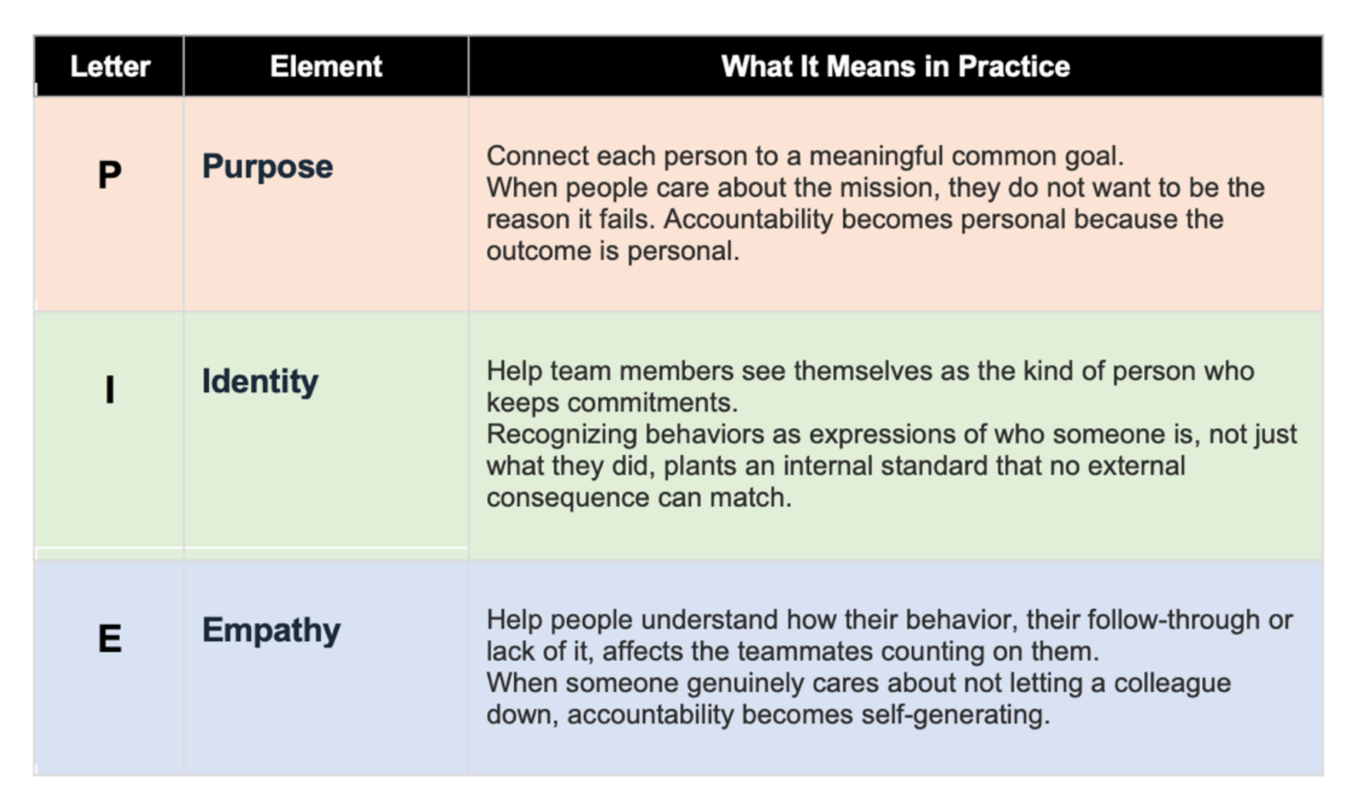
The first ingredient is purpose.
A clear and meaningful common goal is one of the most powerful drivers of accountability that exists, because when people genuinely care about the mission they are contributing to, they do not want to be the person responsible for letting the team down.
Engagement, for any employee or volunteer, is determined largely by how much that person cares about the results their efforts are contributing to. When you help someone see the direct line between their daily work and a goal that matters, accountability stops being about rules and starts being about ownership.
This is also why setting clear expectations is non-negotiable.
Connecting someone to a purpose is powerful. But connecting them to a purpose and then leaving their role within it vague is a setup for the exact frustration you are trying to avoid. Purpose plus clarity is the combination that actually works.
The second ingredient is identity, and this is the one most leaders never think to address.
One of the things I learned as a coach is that our identity drives our behavior far more consistently than any external reward or punishment. When I told a player “you really worked hard on that drill today,” I was commenting on a single incident.
When I told them “you are the kind of person who outworks everyone in the room,” I was shaping how they saw themselves.
The difference in impact was not subtle. Noticing a behavior celebrates a moment. Naming the behavior as an expression of who someone is plants an internal standard. And once a person has accepted that identity, they hold themselves to it without anyone having to remind them.
Want someone to step up for a struggling teammate?
Try: “That is not really like you. You are somebody who looks out for the people around you.” You are not manipulating. You are reflecting back to them the best version of who they already are. And most people will rise to meet it.
The third ingredient is empathy, and it is the one that connects most directly to the POINT model that follows.
Empathy in the context of accountability means helping people genuinely understand how their behavior, their follow-through or lack of it, affects the colleagues who are counting on them. None of us wants to let down someone we care about. None of us wants to make a teammate’s day harder.
But most people are simply not making that connection in real time. The team member who consistently misses a deadline is not thinking about what that costs the person downstream. They are thinking about their own workload, their own pressures, their own reasons.
When a shared experience, a well-facilitated team building activity, a DISC workshop, a structured team conversation, creates the moment where someone actually sees and feels the impact of their behavior on a real person they know and work alongside, everything changes.
That is not a soft outcome.
That is the moment when accountability becomes personal and self-sustaining.
The most powerful thing a professional team building experience does is not build connection through fun. It builds empathy through awareness. And empathy is the final ingredient in the accountability PIE.
Even in a culture with strong relationships and real trust, there will be moments when a direct conversation is necessary. Someone’s behavior is affecting the team.
The pattern has gone on long enough. You need to address it.
Most leaders handle this badly, not because they are bad leaders, but because they have never been given a structure for how to have that conversation effectively. They either avoid it until it becomes a crisis or they go in without a plan and say something that puts the other person immediately on the defensive.
The POINT model gives you a five-step structure for feedback conversations that address the behavior, protect the relationship, and produce real follow-through.
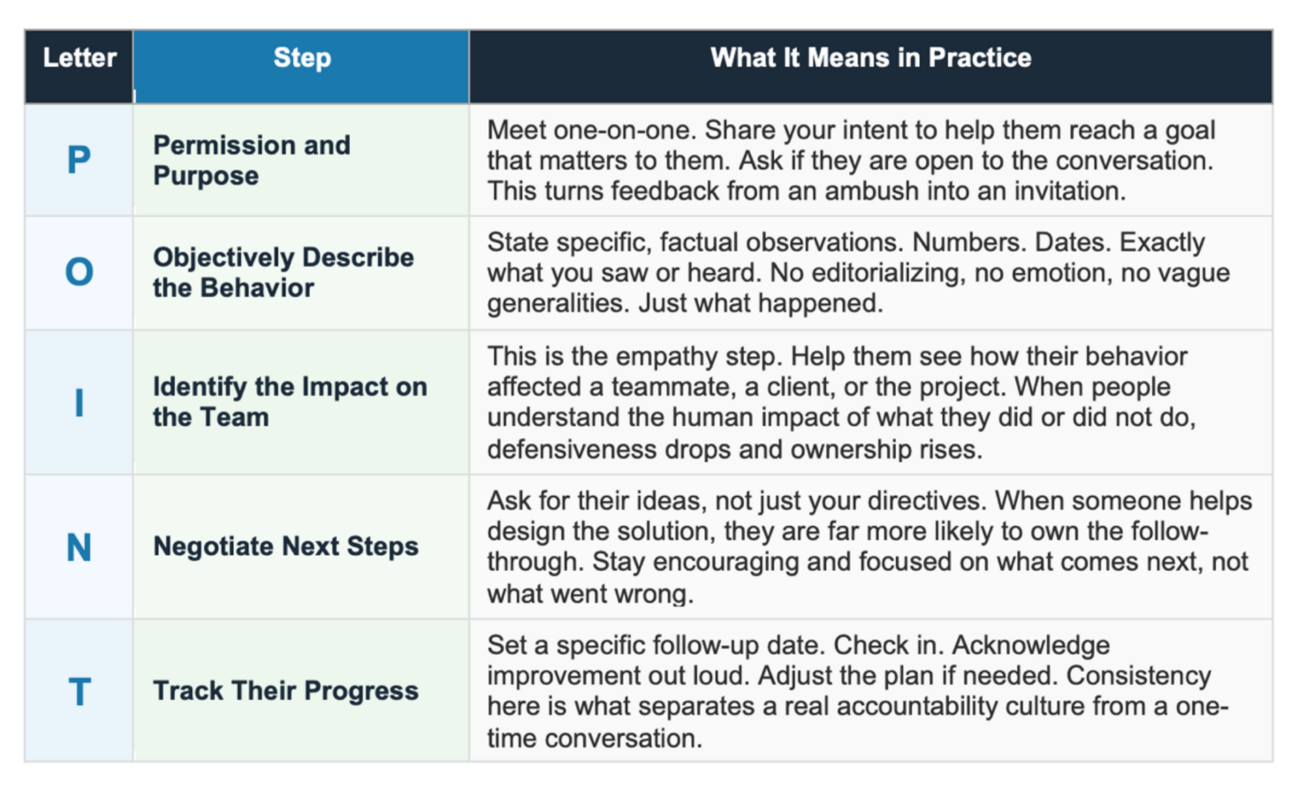
The “I” step is where most leaders shortchange the conversation.
They describe the behavior, state what they want changed, and move on. But the moment that changes a person’s behavior long-term is not when they learn what they did wrong. It is when they genuinely understand who was affected and how.
That is the empathy moment.
That is where ownership begins.
From my book What Effective Leaders Do, here is how the POINT model was introduced: “Yes, empathy is the foundation of accountability. When people are part of the solution, they are a lot more likely to own it.”
That line captures exactly why this model works when scripted directives do not.
I worked with a government agency whose branch chief came to me with a familiar problem. His team was technically competent and individually motivated, but accountability between team members was almost nonexistent. People completed their own tasks but were not watching out for each other.
Deadlines were slipping because no one felt responsible for anything outside their own lane.
When I talked with him about his current practice of one-on-ones, the pattern became clear immediately. He was using those meetings to check on project status. He would ask what was done, what was pending, and what was blocked. His team members answered the questions and walked out. The meetings were efficient and completely hollow.
We redesigned his one-on-one approach around three simple shifts.
First, he started each meeting with a genuine question about the person, not the project. What has been most challenging this week for you personally? What are you most proud of right now? Those questions are not icebreakers. They are the foundation of the trust that makes real accountability conversations possible later.
Second, he started using the POINT model in the moments when he needed to address a behavior pattern. Not as a corrective punishment, but as a structured conversation rooted in what the behavior was costing the team. The “I” step consistently produced a response he had never gotten before: people acknowledging on their own that they had not thought about how their behavior was landing on the people around them.
Third, he started running short facilitated team experiences at his quarterly staff meetings that were designed specifically to build shared awareness of how each person’s style affected the team. Not recreational activities. Intentional, debriefed experiences that surfaced the real dynamics.
Six months later he told me two employees who had never gotten along had committed publicly to working together differently.
His team was showing up early to meetings. And he had not once raised his voice or issued a formal warning.
That outcome did not happen because of a policy change.
It happened because people finally understood how their behavior was affecting the people around them. Awareness created empathy. Empathy created ownership. Ownership created accountability.
That is the sequence leaders need to understand.
Accountability is the fourth pillar of the G.R.E.A.T. culture model, and its placement is intentional. You cannot build real accountability before you have built the three things that come before it.
The POINT model lives inside the Accountability pillar, but it only works at full strength when the other four pillars are also in place.
That is why great team building experiences that address all five pillars simultaneously are far more powerful than a one-time accountability training that drops into a culture with no relational foundation underneath it.

Accountability focuses on whether people understand the impact of their behavior on the team and take ownership of improving it. Micromanagement focuses on monitoring whether tasks are completed and directing every step of how they get done.
Real accountability builds trust and self-direction over time. Micromanagement erodes both.
Most accountability systems fail because they are built on surveillance and consequence rather than on the relational trust and shared awareness that actually drives behavior change.
When people do not understand how their behavior affects the people and projects around them, systems produce compliance at best and resentment at worst. Accountability that lasts is built from the inside out.
The Accountability PIE is a framework developed by Sean Glaze that names the three internal conditions required for accountability to become self-generating rather than enforced.
Purpose connects people to a meaningful common goal they do not want to fail. Identity helps people see themselves as the kind of teammate who follows through. Empathy helps people understand how their behavior affects the colleagues counting on them.
When all three are present, people hold themselves accountable before anyone has to say a word.
Regular one-on-one meetings build the relational foundation that makes accountability conversations possible without defensiveness. When a manager invests in knowing their team members as people, not just performers, feedback lands differently.
The person receiving it knows it comes from someone invested in their growth. That changes how they hear it and what they do with it.
The POINT model is a five-step structure for accountability conversations developed by Sean Glaze and introduced in his book What Effective Leaders Do.
The steps are: Permission and Purpose, Objectively Describe the Behavior, Identify the Impact on the Team, Negotiate Next Steps, and Track Their Progress. The model is designed to address behavior while protecting the relationship and producing real follow-through.
Well-designed team building experiences create structured moments of shared awareness that shift how people see the impact of their behavior on others.
When a team member genuinely understands how their patterns, their communication style, their follow-through or lack of it, affects their teammates, empathy develops. That empathy is the foundation of genuine accountability. The most durable accountability cultures are built through shared experience and honest conversation, which is why it matters to understand what a facilitated team experience does that a policy memo never will.
Recreational team activities do not produce this outcome. Intentional, facilitated, and properly debriefed experiences do.
There is no shortcut here. A single workshop can shift awareness and give a team a shared language, but culture change happens over months of consistent leadership behavior.
The leaders who build genuine accountability cultures are the ones who invest in regular one-on-ones, who address issues directly using a structured model rather than avoiding or exploding, and who recognize effort and improvement out loud and consistently.
Empathy is the foundation.
People hold themselves and each other accountable because they care about the impact their behavior has on the people around them.
Without that caring, accountability is just surveillance with paperwork. The “I” step in the POINT model, Identify the Impact, is specifically designed to build the empathetic awareness that produces ownership rather than mere compliance.
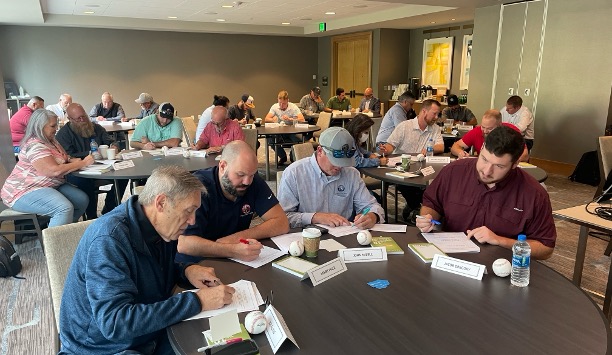
Building an Accountability Culture Takes More Than a Policy. It Takes an Experiences.
If your team is struggling with accountability, the problem is almost certainly not that people do not know what is expected of them.
The problem is that one or more of the PIE ingredients is missing.
Purpose is vague, or identity has never been intentionally shaped, or empathy has never been built through the kind of shared experience that makes someone else’s struggle feel real and personal.
That awareness is built through relationships, through intentional shared experiences, and through leaders who are willing to have honest, structured, caring conversations when the moment calls for it.
Great Results Teambuilding delivers intentional, facilitated programs for groups of 8 to 800. Every program is fully customized based on pre-event discovery. Every attendee receives a published book. Every debrief is designed to produce specific insights your team applies on Monday morning.
Past clients include Cisco, John Deere, the CDC, Emory University, Ecolab, Southern Company, the USPTO, and World Wide Technology – Over 100 client testimonials and 20 five-star Google reviews!
Ready to talk about your team?
Book a Call