
Most organizations don’t struggle because of a lack of talent.
They struggle because of a lack of intention.
As a basketball coach, we had a sign on our locker room wall:
APP TPW
(Average Players PLAY – Tough Players WIN)
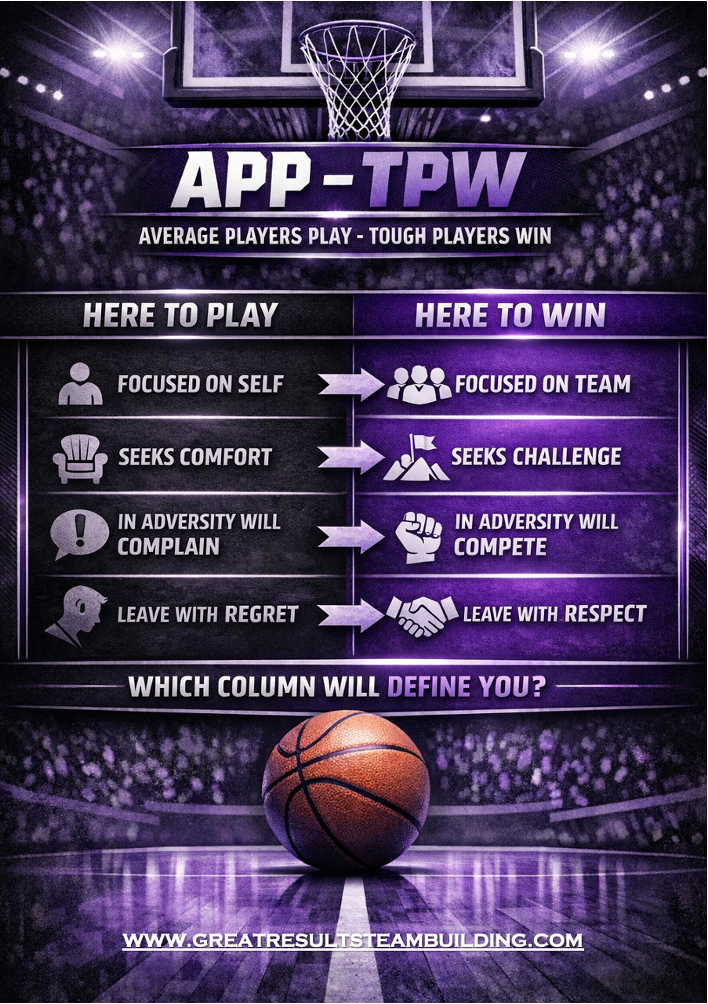
Average players focus on themselves, but WINNERS focus on the team.
Average players seek comfort, but WINNERS seek challenge.
Average players complain in adversity, but WINNERS compete.
And average players usually regret their performance looking back, while WINNERS leave a project or team with an abundance of respect.
As a leadership speaker now, I share with teams that every workplace has two kinds of contributors sitting in the same meetings, using the same tools, and holding the same titles. One group arrives just to go through the motions, protect their lane, and check boxes.
The other group shows up with purpose, shared ownership, and a clear commitment to results.
Both groups are technically “doing their jobs.”
Only one group consistently drives momentum, resilience, and sustained success.
If you want stronger execution, fewer silos, and a culture where people hold themselves accountable without being chased, the difference isn’t found in strategy decks or job descriptions. It’s found in how teammates choose to show up.
Personal Ease vs. Ownership of Results
Teams that drift tend to be made up of individuals who prioritize self-preservation.
Their focus stays narrow, and they ask themselves: How does this affect me?
Or Will this increase my workload?
These questions aren’t malicious; they’re natural. But when they dominate daily thinking, collaboration suffers.
In contrast, high-performing groups are populated by people who think beyond personal responsibility. They consider how their actions affect timelines, colleagues, customers, and outcomes.
They ask “What does the TEAM need?”
They don’t abandon their role; they expand their perspective.
How This Shows Up at Work
When people protect themselves first, information moves slowly. Problems get passed sideways. Meetings feel transactional rather than productive. Employees complete assignments exactly as written, even when flaws are obvious, because ownership ends at the job boundary.
When people adopt a shared-results mindset, something shifts. They speak up earlier. They offer help without being asked. They flag risks before deadlines are missed. Decisions improve because insight is pooled rather than guarded.
Managers often ask how to “increase accountability.” The truth is accountability grows naturally when teammates feel responsible to one another instead of responsible for themselves alone.
Preference for Ease vs. Willingness to Stretch
Every role contains moments of tension: difficult conversations, ambiguous projects, tight deadlines, and unfamiliar expectations. Some people instinctively look for the most comfortable path through those moments. They minimize effort, delay decisions, or default to what worked previously – even when conditions have changed.
Other teammates lean into discomfort. They Stay Coachable.
They view challenge as a signal, not a threat. Instead of avoiding friction, they engage it thoughtfully, understanding that growth rarely occurs in calm conditions.
How This Shows Up at Work
Comfort-seeking behaviors often appear harmless.
A manager postpones feedback to keep peace. A team reuses an outdated process because learning something new feels inconvenient. A contributor stays silent during a flawed plan because speaking up feels awkward.
Over time, these small decisions accumulate. Innovation slows. Skill development stalls. Frustration quietly increases because problems persist without resolution.
Teams willing to stretch behave differently. They rehearse hard conversations. They test new approaches even when outcomes aren’t guaranteed. They treat mistakes as data rather than embarrassment. As a result, they adapt faster and outperform competitors who cling to familiar routines.
Leaders don’t need people who crave difficulty. They need people who don’t retreat from it.
Reacting with Complaints vs. Competitive Responses
Adversity reveals culture faster than any mission statement. When goals are missed, clients push back, or resources tighten, people respond in predictable ways.
Some default to frustration. They vent, assign blame, and dwell on what’s unfair. Energy gets spent narrating the problem instead of addressing it. While emotional expression is human, chronic complaining drains focus and lowers standards.
Others respond with resolve. They acknowledge obstacles quickly, then pivot toward solutions.
Their language shifts from “This shouldn’t be happening” to “What can we control next?”
How This Shows Up at Work
Complaint-driven environments create hesitation. People wait for direction. Ownership diffuses. Performance conversations become defensive rather than constructive. Eventually, even motivated employees disengage because negativity dominates the atmosphere.
Teams that compete through adversity behave differently.
They adjust expectations without lowering effort. They separate emotion from execution. They challenge one another respectfully and stay anchored to outcomes.
This doesn’t mean ignoring stress or pretending challenges don’t exist. It means refusing to let difficulty dictate behavior. In competitive cultures, pressure sharpens focus instead of eroding trust.

Why APP TPW Matters More Than Skill or Strategy
Organizations invest heavily in hiring, onboarding, and planning. Yet many overlook the daily behavioral choices that determine whether those investments pay off.
The gap between teams that “do their work” and teams that deliver wins is rarely intelligence or experience. It’s mindset. It’s whether people view their role as a set of tasks or as a contribution to something larger.
Culture is not a poster.
It’s the values you define and the repeated actions people take when nobody is watching, especially when conditions are uncomfortable. Leaders who treat culture as optional eventually spend more time managing problems that culture would have prevented.
When great teammates think collectively, stretch willingly, and respond constructively under pressure, execution improves. Trust strengthens. Results follow.
Culture isn’t soft. It’s strategic. And it’s one of the few competitive advantages competitors can’t easily copy.
A Practical Next Step for Leaders Who Want Results
If this article resonates, the question isn’t whether your organization has both types of teammates. Every organization does. The real question is which behaviors your environment consistently reinforces.
If you want to shift habits, expectations, and conversations (not just inspire people for a day) that work requires clarity, repetition, and engagement.
Sean Glaze helps organizations do exactly that. As an experienced keynote speaker and interactive facilitator, Sean works with leaders and teams to translate concepts like ownership, resilience, and commitment into practical behaviors people can apply immediately. If your next professional development day needs to be memorable, actionable, and aligned with real performance goals, reach out to Sean Glaze to start that conversation. Your team’s results will reflect the choice.
– – – – –
Sean Glaze is a sought-after leadership and workplace culture speaker, who gained valuable insights on turning talent into teamwork as a successful basketball coach – and now he travels around the country to share those actionable lessons.
Sean’s engaging conference leadership keynotes and custom team building programs have helped clients like Cisco, John Deere, the CDC, and Emory University to increase collaboration, boost productivity, and build Sticky Cultures that inspire more profitable teamwork.
Sean’s books, Rapid Teamwork, What Effective Leaders DO, The 10 Commandments of Winning Teammates, and Staying Coachable are entertaining parables that accelerate the growth of leaders and teams!