Why Do Workplace Safety Programs Teach Compliance When the Real Issue Is Culture?
The Best Safety Speakers Focus on Culture and Standards, Not Rules
The Best Safety Speakers Focus on Culture and Standards, Not Rules
The short answer is because compliance is measurable and manageable. You can count it. You can document it. You can present it in a quarterly report and feel like progress is being made.
But compliance only determines what employees do when someone is watching. It tells you nothing about what happens on a Tuesday afternoon when the supervisor steps away and a shortcut presents itself.
Culture determines what happens in that moment.
And the organizations with the strongest safety records have figured out that you cannot audit your way to a safe workplace. You cannot post your way there. You cannot train your way there with another annual certification that everyone completes and nobody remembers.
You have to build a culture that makes people genuinely care. Not because they fear consequences. Because they feel connected to a mission that matters and to teammates who are counting on them.
That kind of culture does not show up in a compliance report. But it shows up everywhere else. In the near miss that gets reported instead of ignored. In the concern that gets raised before it becomes an incident. In the standard that gets held at the end of a long shift when nobody would have noticed either way.
Compliance is the floor.
Culture is everything above it.
And the gap between those two things is where most workplace safety programs are leaving results on the table.
Early in my coaching career, I had a player who knew every play in the book.
He had been through every drill. He could recite every expectation we had set.
And then one afternoon, during a routine practice, he stopped calling out screens. Not because he forgot. Because he had gotten comfortable. He had stopped seeing the impact his small decisions had on the teammates depending on him.
Nothing bad had happened yet. So nothing felt urgent.
Three possessions later, a teammate took a hard screen he never saw coming.
That is complacency.
And it shows up in every organization, on every team, in every industry where people do the same thing long enough to stop feeling the weight of it.
The compliance-versus-culture problem shows up far beyond safety programs, and understanding how culture actually forms through awareness, not rules, is the foundation of any meaningful behavior change initiative.
Most workplace safety programs are designed to prevent the third possession. They add another rule, another reminder, another training session. What they rarely address is why the player stopped calling out screens in the first place.
The answer is almost never that he forgot the procedure.
The answer is that he stopped believing it mattered.
Most safety programs focus on behavior. They measure incident rates, track compliance, and add procedures every time something goes wrong.
That approach treats the symptom. The strongest safety cultures treat the source.
Behavior is visible.
But behavior is driven by belief. And beliefs are shaped by what people experience, notice, and conclude about their organization, their leaders, and their teammates every day they come to work.
The framework is straightforward:
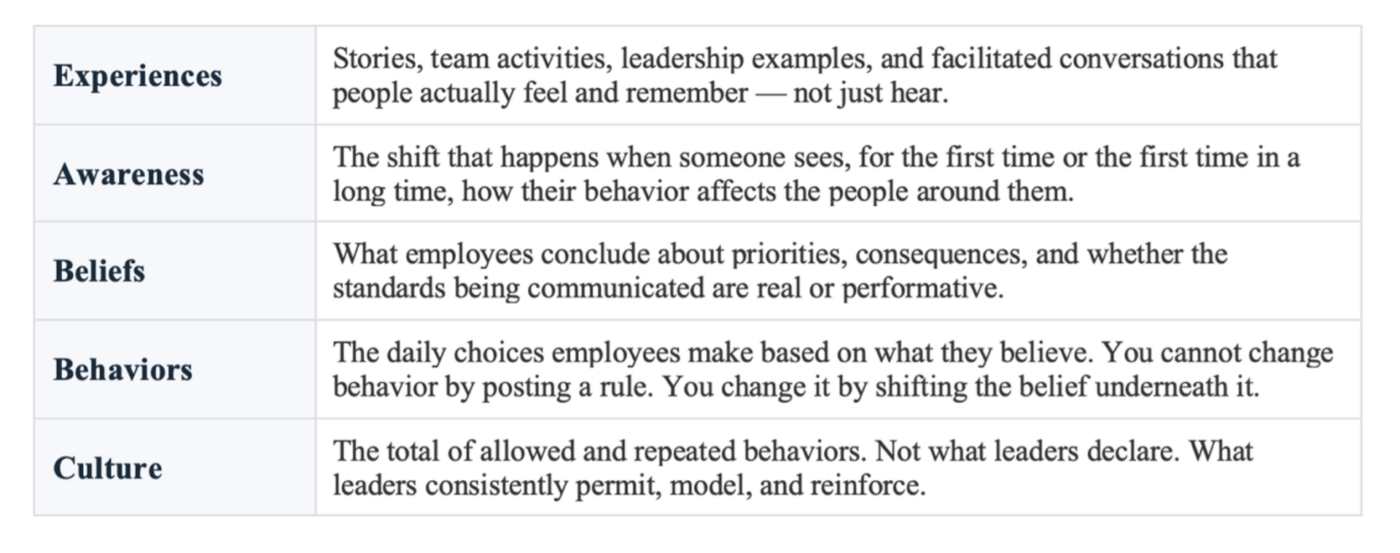
Culture is not what leaders declare. It is the total of what leaders allow to be repeated.
If you want safer behaviors, you have to influence the beliefs producing those behaviors. And if you want to shift beliefs, you have to create experiences that increase awareness. Policies inform people. Experiences change them.
That is the difference between a safety program that produces compliance and one that produces culture.
People rarely ignore safety procedures because they lack information. They take shortcuts because of what they believe in that moment.
When an employee cuts a corner, it is usually because they believe at least one of the following:
Notice that not one of those is a knowledge problem. Every one of them is a belief problem.
And beliefs do not change because you post a new sign or add a module to the onboarding training. They change when people have experiences that make the consequences feel personal and real. When someone tells them a story that sticks. When an activity reveals how a small choice ripples outward and affects the teammates standing next to them.
That is why the most effective safety cultures invest in experiences, not just information.
In every organization I work with, employees tend to operate at one of three levels when it comes to any safety standard. Knowing which level describes your people tells you exactly what kind of intervention will actually move the needle
Most safety programs are designed to move people from non-compliant to compliant. That is necessary. But it is not enough.
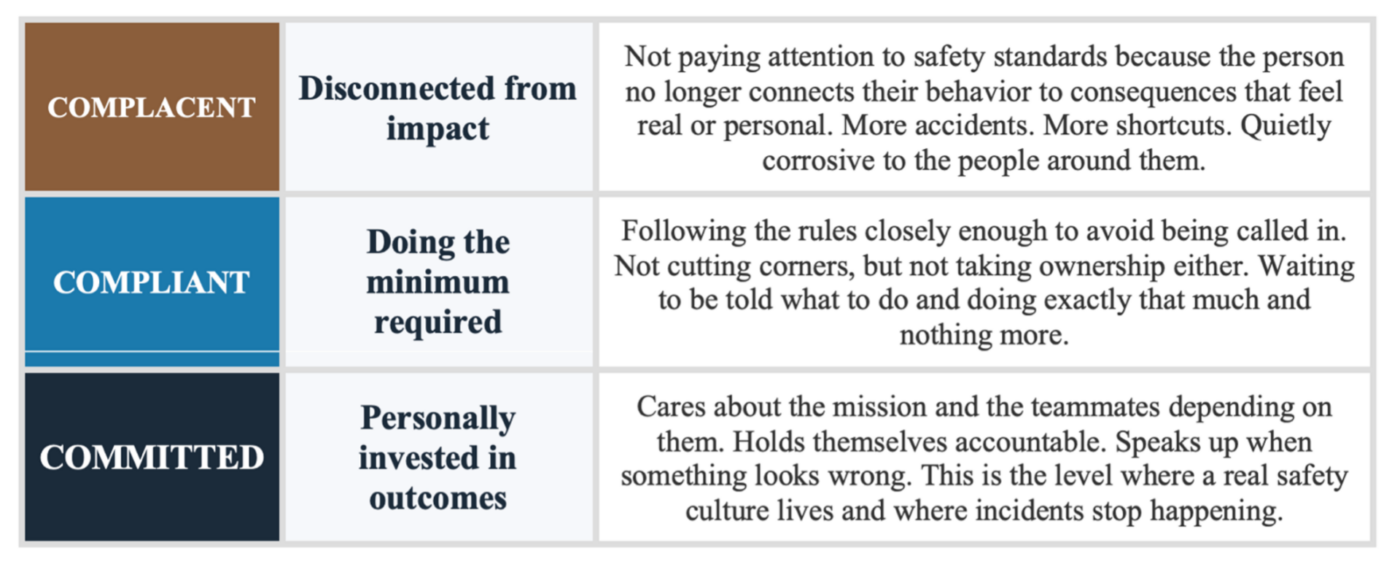
Compliant is not far above complacent.
A person who follows the standard because they fear consequences will stop following it the moment the supervisor leaves the room.
Committed is where real safety culture lives.
And commitment cannot be trained into someone. It has to be connected. It has to be earned through experiences that make the mission feel personal and relationships feel real.
Most safety programs are built around rules.
Rules are external. Rules are enforced. Rules exist because someone decided they were necessary, and they stay in place because someone is checking.
The problem with rules is simple. The moment nobody is checking, the rule loses its power.
Standards are different.
A standard is something a team owns collectively. It is not imposed from the outside. It emerges from inside a group of people who have decided together what they are committed to and why it matters. Standards do not require a supervisor in the room. They require teammates who genuinely care about each other and about the outcome they are building together.
That distinction is the difference between compliance and commitment.
A compliant employee follows the safety procedure because the handbook says so and because someone might be watching.
A committed employee follows it because they know who gets hurt when someone does not.
One of those motivations disappears when the supervisor leaves the floor. The other one does not.
It requires two things and only two things.
First, connect people to a meaningful mission with real human stakes. Not a policy objective. Not a metric. A story about who is affected when the standard slips and who benefits when it holds.
Second, build the relationships that make accountability feel like care rather than correction. When teammates genuinely know and trust each other, holding a standard becomes an act of loyalty rather than an act of compliance.
Rules tell people what to do.
Standards remind people who they are doing it for.
The organizations with the strongest safety cultures have figured out that you cannot write a procedure for commitment. You can only build the culture that makes commitment the natural choice.
That is the work worth doing.
And that is exactly what the right speaker helps your organization begin.
Most safety conference planners do not think of team building as a safety tool.
That is the gap this section is here to close.
Meaningful team building creates experiences. Experiences create awareness. Awareness shifts beliefs. Shifted beliefs change behavior. And changed behavior, repeated over time, becomes culture.
That chain connects directly to safety outcomes.
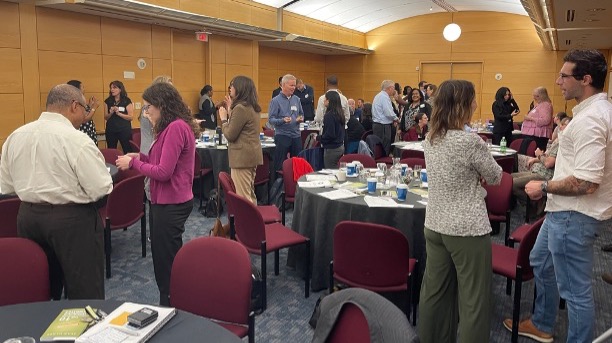
When employees participate in a well-facilitated team building event vs an escape room, something happens that no compliance training can replicate. They see each other differently. They have honest conversations they have been avoiding. They discover that the person they have been silently frustrated with was operating from a completely different set of assumptions, not bad intentions. They feel, sometimes for the first time in a long time, what it actually means to depend on someone and to be depended on.
That feeling changes beliefs.
And changed beliefs change behavior on Monday morning.
This is why organizations that invest in intentional, facilitated team experiences tend to see improvements in safety culture even when safety is not the explicit topic of the program. The cultural conditions that make safe behavior consistent are being strengthened in the room.
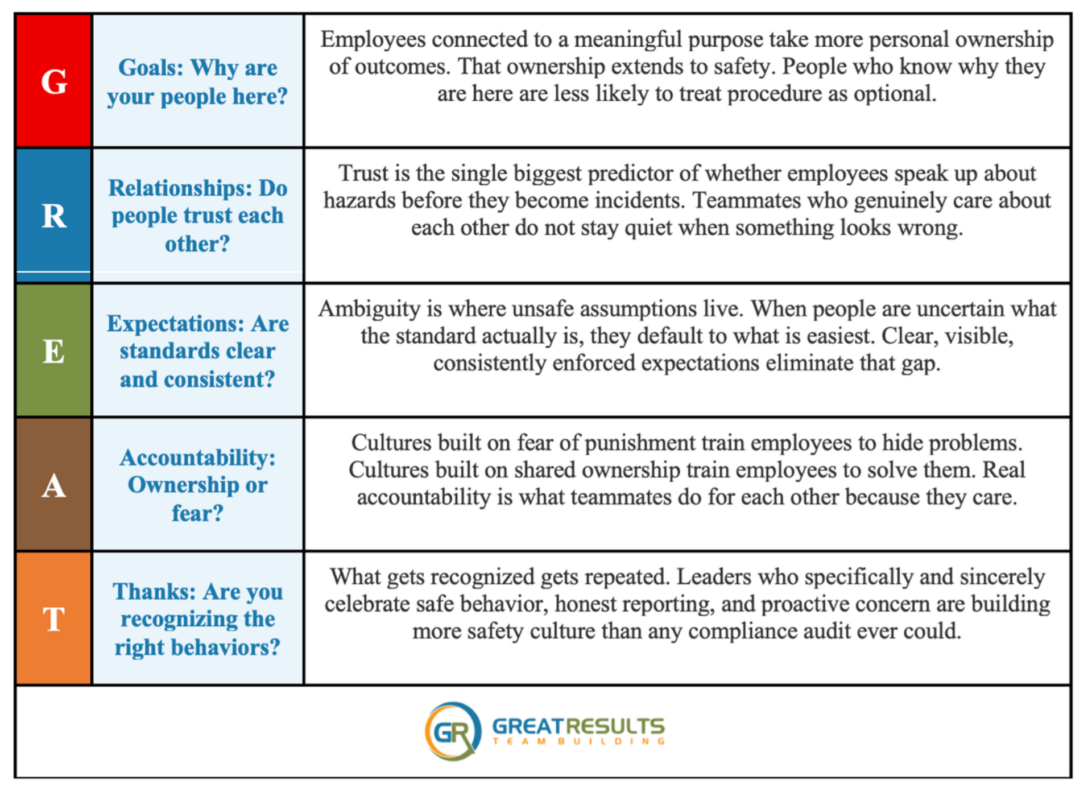
There are five questions that reveal any organization’s safety culture.
I use them in every keynote and culture program I deliver, because each one identifies a specific belief gap that produces unsafe behavior when it goes unaddressed.
These are not abstract leadership concepts.
Each of these 5 traits of GREAT teams addresses a real belief gap. Purpose closes the gap that produces indifference. Trust closes the gap that keeps hazards hidden. Clarity closes the gap where dangerous assumptions live.
Accountability closes the gap between standards and actual behavior.
Recognition closes the gap between what leaders say they value and what employees believe they actually value.
.
Organizations searching for a workplace safety culture speaker are often looking for something most traditional safety speakers do not provide.
They want someone who can help their leaders understand why culture is the actual driver of safety outcomes. Someone who can give their people an experience that shifts beliefs rather than a presentation that adds information.
Someone who leaves the room with a language and a framework they can actually use on Tuesday morning.
Unlike safety speakers who focus primarily on compliance, regulations, and procedure updates, my programs help organizations strengthen the cultural foundations that determine whether those procedures are actually followed when it matters.
As a safety culture keynote speaker, I work with leaders and teams to address the human side of safety performance: the trust that makes people speak up, the accountability that keeps standards consistent, the recognition that reinforces the right behaviors, and the shared experiences that make the mission feel personal.
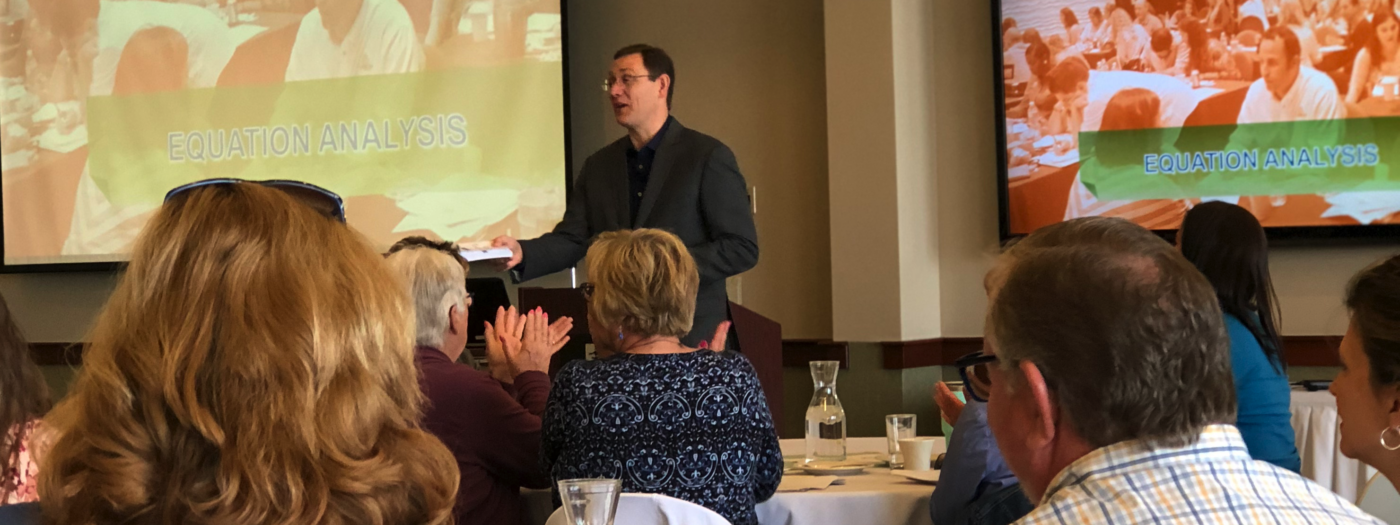
My keynotes and workshops are interactive and story-driven.
Attendees do not just learn about culture. They experience the kind of session that creates the awareness that makes behavior change stick.
With over twenty years of experience building cultures at organizations like Cisco, the CDC, John Deere, Ecolab, Southern Company, Emory University, and World Wide Technology, I bring a practitioner’s perspective to every safety leadership event, not a regulator’s checklist.
Workplace safety culture is the collection of beliefs and repeated behaviors that determine whether employees actually follow safety standards or simply perform compliance when someone is watching.
It lives in what leaders model, what teams celebrate, and what gets quietly tolerated between formal training sessions.
Compliance is following the rule.
Culture is believing in the reason behind it. A compliant employee does the minimum required to avoid consequences. A committed employee holds standards because they genuinely care about what happens to the people around them. Organizations that measure compliance as a proxy for performance often miss the deeper issue, and it explains why talented teams underperform when compliance is mistaken for commitment and leaders stop looking for the real cause.
Compliance disappears when supervision does. Culture does not.
Poor safety culture almost always traces back to one or more of these: leaders whose behavior contradicts the stated standards, unclear or inconsistently enforced expectations, a recognition system that only rewards production, and a team environment where people do not trust that speaking up will be welcomed.
These are culture problems, not training problems.
Leadership behavior is the most powerful signal in any organization. What leaders tolerate, model, celebrate, and ignore communicates the real priorities far more clearly than any policy document.
A supervisor who bypasses a procedure once sends a message that travels faster than any safety memo. Safety culture at its best looks a lot like the kind of peer accountability that high-performing teams develop naturally, which makes it worth studying how to build accountability that people choose rather than follow out of fear.
Yes, when it is intentional and facilitated rather than purely recreational.
Meaningful team experiences create awareness of communication patterns, build the trust that makes people willing to speak up, and strengthen the relationships that make accountability feel collaborative rather than punitive. Those outcomes directly improve safety culture.
What does a workplace safety culture speaker actually teach?
A strong safety culture keynote goes well beyond regulations and checklists.
It helps leaders and employees understand the belief systems driving behavior, gives them a framework for strengthening the cultural conditions that produce safe choices, and creates the kind of awareness that changes behavior more durably than any compliance training session.
If your organization is experiencing safety challenges, the first and best question leaders should consider asking is not:
What new rule do we need?
The better question to reflect on is:
What beliefs are producing the behaviors we are seeing?
.
Because people do not act according to policies.
They act according to beliefs.
And beliefs are shaped by experiences.
That is why the strongest safety cultures are not built through more rules. They are built through meaningful experiences that increase awareness, shift beliefs, strengthen relationships, clarify expectations, reinforce accountability, and create a culture where people consistently choose behaviors that protect themselves and one another.
That is the work I help organizations do.
Great Results Teambuilding delivers intentional, facilitated programs for groups of 8 to 800. Every program is fully customized based on pre-event discovery. Every attendee receives a published book. Every debrief is designed to produce specific insights your team applies on Monday morning.
Past clients include Cisco, John Deere, the CDC, Emory University, Ecolab, Southern Company, the USPTO, and World Wide Technology – Over 100 client testimonials and 20 five-star Google reviews!
Ready to talk about your team?
Book a Call