What Do the Best Leadership Keynote Speakers Deliver Beyond Inspiration?
Inspiration fades by Monday. Frameworks change behavior.

Inspiration fades by Monday. Frameworks change behavior.
The Short Answer is that the best leadership keynote speakers do three things that most speakers never deliver. They give audiences a practical framework rather than a story to admire and forget. They create awareness that shifts beliefs rather than information that piles on top of beliefs that are already producing the wrong behaviors. And they connect their content to the specific leadership challenges the audience is actually living with, not a set of principles that sound true but apply to nobody in particular.
The measure of a leadership keynote is not how the audience felt in the room.
It is what they do differently on Monday morning.
Inspiration fades by Friday.
A well-built framework changes behavior on Monday.
The best keynotes deliver six specific things: a shared language the team uses after the event, frameworks that apply immediately to real leadership challenges, awareness of how their own behavior creates culture, stories that make abstract ideas personally urgent, content customized to the organization’s specific situation, and a tangible takeaway that extends the investment beyond event day.
If a speaker cannot name the specific behavior change their program produces, they are selling enthusiasm. That is not nothing.
But it is not leadership development.
I want to be direct about something most speakers will not say out loud. The majority of leadership keynotes do not produce lasting behavior change.
They produce a good afternoon.
That is not a criticism of the speakers delivering them. Many are genuinely skilled, deeply knowledgeable, and compelling on stage. The problem is structural. A keynote built around inspiration alone is operating on the wrong model of how people change.
People do not change their behavior because they felt moved. They change their behavior because their awareness shifted in a way that changed what they believe, and that changed belief drove a different action. Inspiration is the spark.
Framework is the fuel. Without the framework, the spark goes out.

The best leadership keynote speakers do three things most speakers do not.
They give audiences a framework they can use rather than a story they can only admire. They create awareness that shifts beliefs rather than information that simply adds to what people already know. And they connect their content to the specific leadership challenges the audience is actually living with, not a generic set of principles that could apply to anyone anywhere.
Here is the problem most organizations have experienced at least once.
They booked a speaker who delivered a genuinely good hour. The room was engaged. The stories were compelling. The energy at the end was real. And by Friday, the enthusiasm had evaporated and nothing on the team had changed.
That is not a failure of inspiration. The speaker may have been excellent at inspiring. It is a failure of framework.
Inspiration without a usable structure gives people a feeling without a vehicle for applying it. Feelings fade. Frameworks last.
This page explains what two decades of experience in leadership development show about what actually separates the speakers who change behavior from the ones who produce a good afternoon, how to evaluate speakers before you book them, and what separates a leadership keynote that becomes a turning point from one your audience has forgotten by the following Monday.
I use a simple standard when evaluating whether a program actually worked.
I call it the Parking Lot Test. When your attendees reach their cars at the end of the day, what can they do differently because of what happened in that room?
Not what did they learn. Not what did they feel. What can they do?
Can they name a specific approach to a leadership challenge they have been avoiding? Can they describe a framework for a conversation they have been dreading? Can they identify a belief they have been carrying that is producing the behaviors their team is suffering through?
If the answer is only that they feel energized and inspired, the program passed the inspiration test and failed the parking lot test.
The Monday Morning Test goes one step further.
It is the question I close every program with, and I mean that literally. I ask every audience before they leave to name the one specific thing they will do differently on Monday morning as a result of what we covered.
Not a general intention. A specific behavior. An actual conversation they will have. A framework they will apply to a real situation waiting for them at work.
This simple practice is what separates a program that produces temporary enthusiasm from one that produces permanent change. Commitment is more durable when it is specific and public. When someone has said out loud what Monday morning looks like for them, they are far more likely to follow through than someone who walked out of a room feeling good but without a named next step.
Lasting change from a keynote requires six specific things. Most speakers deliver two or three of them. The programs that actually shift culture deliver all six:
Here is how those two different approaches compare:
| Dimension to Consider |
Compliance-Focused Keynote |
Culture-Focused Leadership Keynote |
|
Primary goal |
Generate positive emotion and enthusiasm |
Shift awareness and produce specific behavior change |
|
What attendees receive |
Inspiration and energy for the week ahead |
Frameworks, shared language, and applicable tools |
|
Impact at end of day |
High energy, excellent feedback scores |
High energy plus a framework they can name and use |
|
Impact after one week |
Enthusiasm largely faded, behavior unchanged |
Framework referenced in meetings, behavior visibly different |
|
Measure of success |
Audience reaction and applause |
Behavior on Monday morning and in the weeks that follow |
|
Follow-through |
Event ends, content fades |
Books as takeaways, sequential curriculum available |
|
Customization |
Standard talk adapted for the industry |
Content built around your team’s specific leadership challenges |
|
What the team leaves with |
A good memory of a good afternoon |
A shared language and the awareness to use it with each other |
“We are now three weeks post event and a large section of our team is still talking about Sean and the event. They want him back, already. But it is not just him they talk about, as they continue to talk about the details they learned about in the event.
Sean’s ability to deliver the messages with key phrases has given us a reference in our everyday communications to continue working on becoming better teammates.”
– Ray Mashburn, Executive Director, Waikato
Inspiration asks people to feel differently. Equipping asks people to do differently.
The gap between those two outcomes is a framework.
Emotional engagement matters. A leader who leaves a keynote genuinely moved and energized is more likely to act than one who left bored. But emotional engagement without a practical structure is like a spark in a room with no kindling. It burns bright for a moment and then it is gone.
A framework does what inspiration alone cannot.
It gives people a specific tool to pick up when the emotion has faded and the real situation is in front of them. It gives teams a shared language so the growth does not live only in one person’s head. And it gives organizations something to reference, reinforce, and build on over time rather than starting from zero the next time a speaker comes to town.
Here is an honest inventory of what the frameworks I bring to every program give audiences that a compelling story without structure cannot:
|
Framework |
Program |
What It Gives Leaders That Inspiration Cannot |
|
G.R.E.A.T. Culture Model |
Rapid Teamwork (keynote) |
Five pillars leaders implement immediately: Goals, Relationships, Expectations, Accountability, Thanks. Gives the whole team a shared vocabulary for culture. |
|
DISC Animal Personality |
Team Building and Workshops |
Four communication style profiles that explain why people think, communicate, and make decisions differently. Replaces frustration with empathy. |
|
Three-Legged Stool of Trust |
What Effective Leaders Do (keynote) |
Competence in your role, concern for others, and commitments kept. Leaders see exactly which leg they are underinvesting in. |
|
POINT Feedback Model |
Leadership Workshop |
Five-step framework for honest feedback conversations that point at behavior without attacking the person. A practiced skill, not just a concept. |
|
Staying Coachable Questions |
Staying Coachable (keynote) |
Four questions that drive continuous growth: What do I want? Where am I now? What is the gap? What is my next step? Leaders apply these in real time. |
|
Monday Morning Test |
All programs |
A single accountability question: what will your team do differently on Monday? Applied at the end of every session to anchor content in real behavior. |
Each of those frameworks does something a story without structure cannot.
It gives the person a tool they can pick up and use in a real situation without the speaker being in the room. That is the difference between a keynote that ends when the speaker leaves and one that keeps working.
These questions help you evaluate any speaker you are considering. For each one, have a clear sense of what a strong answer looks like before the conversation starts.
1.What specific behavior change do you want attendees to be capable of after this session? A speaker who creates lasting change can name a specific, observable behavior their program produces. Not a feeling. A concrete capability. If the speaker describes their outcome primarily in terms of how the audience will feel, you have identified a gap before you have signed anything.
2. Does the speaker have proprietary frameworks, or are they presenting ideas available in any business book? Borrowed ideas are fine as a starting point, but a speaker who has invested years in this work should have developed original tools and models. Proprietary frameworks are evidence of genuine depth. They also give your team something distinctive to refer back to that they will not confuse with the last three speakers they heard.
3.Can the speaker customize content to your organization’s specific leadership challenges? A speaker who delivers the same talk to every client regardless of industry, culture, or challenge is a presenter, not a leadership development partner. Ask what the pre-event process looks like. The answer tells you a great deal about what the content will feel like in the room.
4. What takeaway will attendees leave with that reinforces the content after the event? A leadership keynote that leaves attendees with nothing tangible to carry back to their desks is betting that enthusiasm alone will sustain the change. It will not. Ask directly what the speaker’s plan is for what happens after they leave the room.
5. Can the speaker deliver additional value for the same travel investment? Many speakers charge a full fee for each individual session at a travel event. A speaker who can deliver a keynote in the morning and a breakout or facilitated workshop in the afternoon for the same travel cost is offering substantially more value for the same budget. Ask about this before you assume the standard model is the only option.
Culture is not a poster on a wall. It is not a values statement or a mission paragraph in the employee handbook. Culture is the total of behaviors that are allowed and repeated on your team. And here is the part most leadership programs miss.
Those behaviors are always driven by beliefs, and those beliefs are always shaped by awareness. This is what I call the Awareness Cycle, and it is the mechanism behind every program I design:
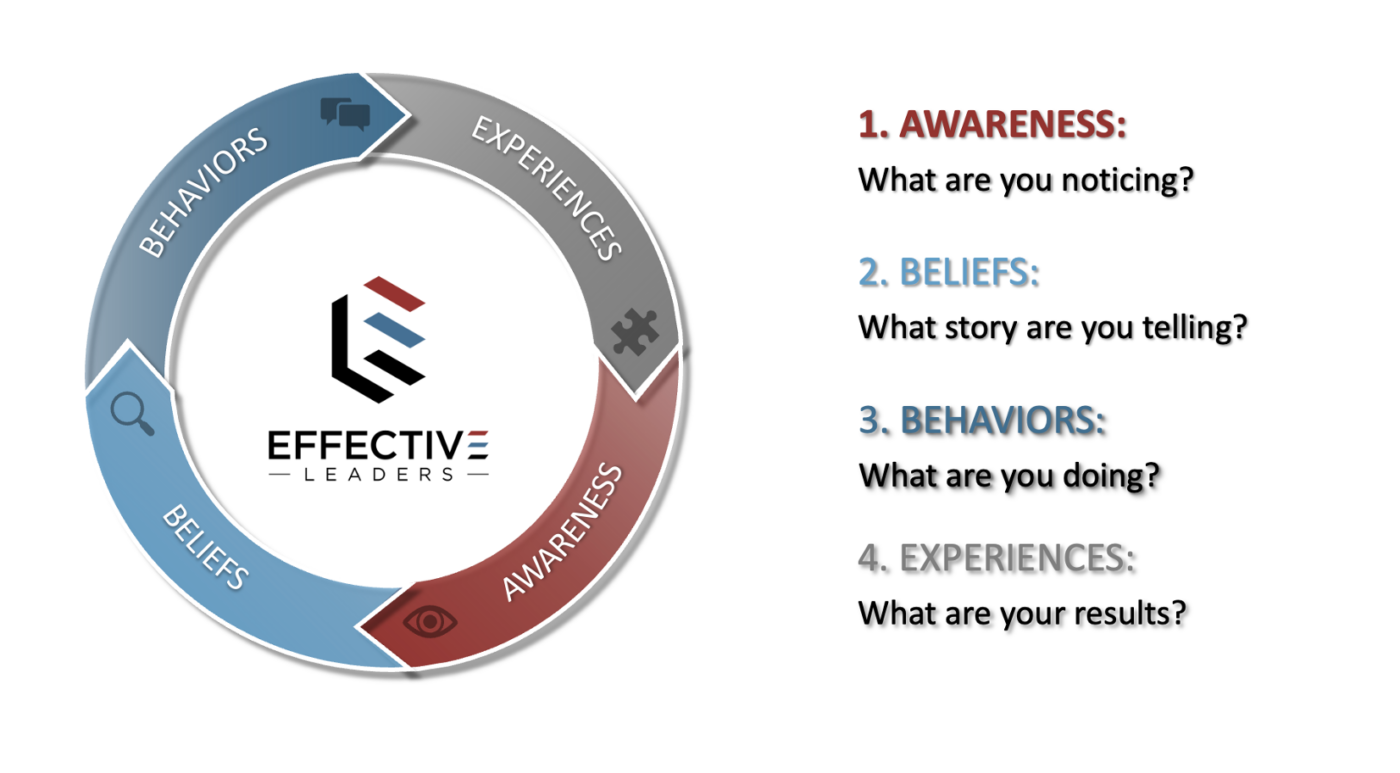
A leadership keynote sits at the very beginning of that chain.
It is an experience. But not all experiences are equal. The ones that produce awareness are structured to surface the right insight at the right moment, connect abstract ideas to felt reality through story and example, and give attendees a specific lens for noticing their own behavior in a new way.
When that awareness shift happens, beliefs change. When beliefs change, the behaviors those beliefs produce change. And when those behaviors change across a leadership team, the culture they create together changes.
This is why a single well-designed keynote can produce more lasting culture change than a year of traditional compliance training. Training adds information to existing beliefs. A great keynote challenges the beliefs themselves.
And beliefs are what drive behavior.
Knowing what great looks like is useful, but the practical next step is understanding how to choose a workplace culture speaker using the right criteria before you commit, so the evaluation process is as intentional as the event itself.
.
The short answer is yes, with one important caveat.
The frameworks that drive behavior change work in any format. The G.R.E.A.T. model, the Monday Morning Test, the DISC communication styles, the POINT feedback framework — none of those require a physical room to land. What they require is a facilitator who knows how to create engagement without relying on the energy of a live crowd to do the heavy lifting.
That is a different skill than delivering a great in-person keynote.
A speaker who crushes a room of 400 people can fall completely flat on a Zoom screen if they have not adapted their approach. The pacing is different. The interaction has to be built into the structure rather than drawn from the room. The stories need to work without the visual cues that a live audience provides.
The programs I deliver virtually are designed specifically for the format.
That means shorter content segments, structured interaction built into the flow rather than bolted on at the end, and deliberate moments of reflection that replace the organic energy of a physical room.
For hybrid events, where part of the audience is in the room and part is on screens, the design challenge is more complex. The most common failure in hybrid keynotes is that the remote audience becomes passive observers of an in-room experience rather than genuine participants in their own right. The solution is to design for the remote audience first and then layer in the in-room experience, not the reverse.
A few practical considerations for booking virtual or hybrid programs:
Platform matters less than preparation. Whether you are using Zoom, Teams, Webex, or a conference-specific platform, the content and facilitation approach matter far more than the technology. What matters is that the speaker has delivered in your format before and knows what the common failure points are.
Breakout functionality is worth using. Virtual programs that include structured small-group conversations produce meaningfully better engagement and retention than those that do not. It is valuable usually to build them into the agenda.
The debrief still applies. The same principle that holds for in-person work holds virtually: the activity or content segment is the vehicle, and the facilitated reflection is where the behavior change actually happens. Do not cut the debrief to save time.
Shorter length is not less valuable. A 45 to 90 minute virtual keynote with genuine interaction built in will produce better outcomes than a 2-hour virtual session designed like an in-person talk. Attention works differently on a screen, and the best virtual programs are designed with that reality in mind rather than fighting it.
The takeaway still travels.
Every attendee at my virtual programs receives one of my leadership books, shipped directly to them. The physical book is a deliberate choice. It gives people something to hold that the digital experience cannot replicate, and it keeps the content alive long after the screen is closed.
I am a leadership keynote speaker and team building facilitator based in Atlanta, Georgia. I have delivered programs for organizations including Cisco, John Deere, the CDC, Emory University, Ecolab, Southern Company, World Wide Technology, and the United States Patent and Trademark Office, among many others.
Before I transitioned to the speaking world, I spent 20 years as a basketball coach, turning around underperforming teams and learning exactly what the gap between talent and performance looks like in real time.
I am a National Speakers Association member, a PeopleKeys Certified DISC Facilitator, and the author of four leadership parables:
Rapid Teamwork,
The 10 Commandments of Winning Teammates,
Staying Coachable, and
What Effective Leaders Do.
Each book serves as a tangible takeaway that extends the content far beyond the event day. Every attendee at my programs receives a copy.
Every engagement I deliver begins with a pre-event discovery conversation. I study the organization’s specific challenges, collect input from the attendees directly when possible, and customize the stories, examples, and frameworks to connect to what your people are actually navigating.
The deepest culture change comes from sequential investment.
A keynote is the right place to start because it creates the awareness and shared language that all subsequent work builds on. But the leaders who see the most sustained change are the ones whose organizations invest in connected programs over time.
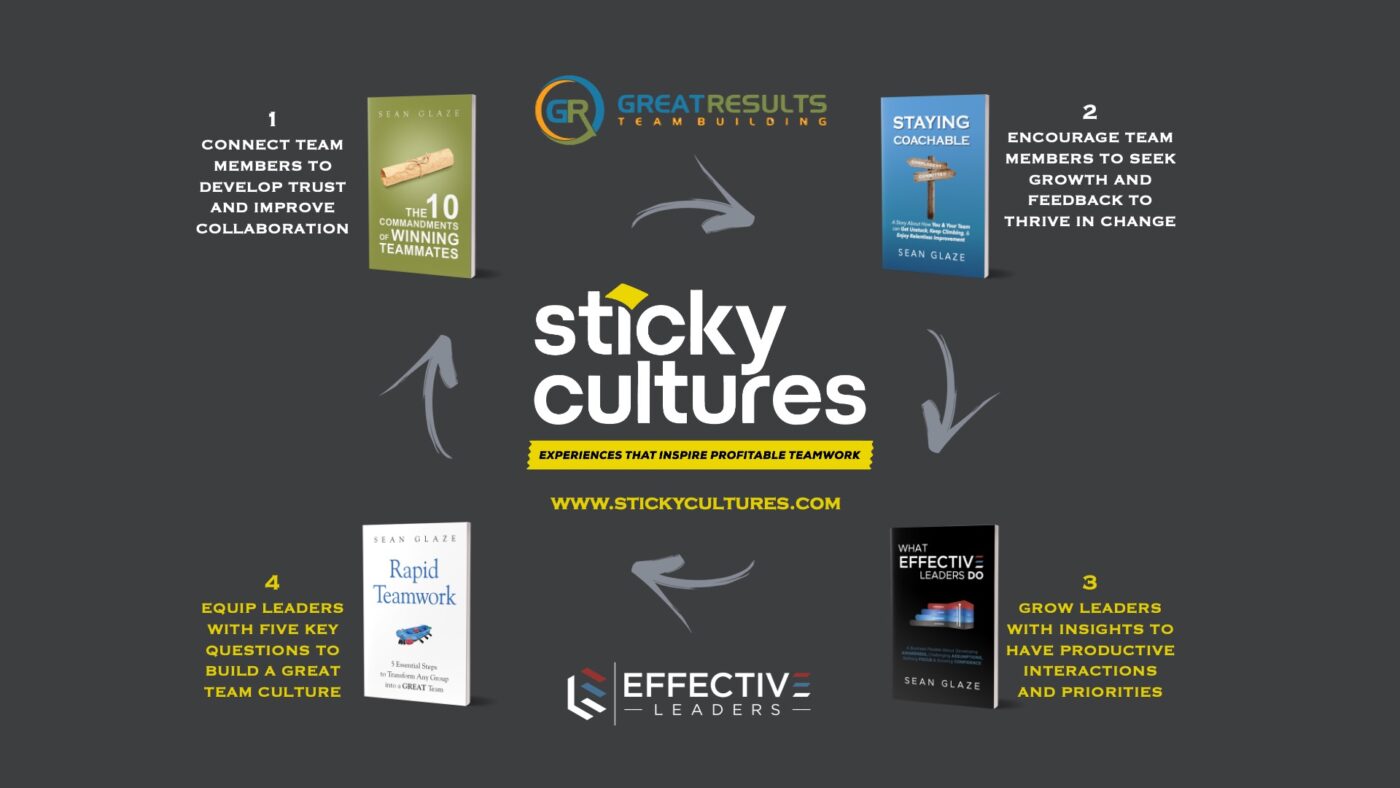
That is the design behind the four-keynote Sticky Cultures curriculum.
Each program builds on the one before it, taking leaders from initial awareness through culture alignment, individual teammate accountability, and finally the mindset that sustains growth through change. Each session is valuable on its own. Together they create genuine culture transformation rather than a good event season.
.
|
Keynote |
What It Delivers |
Best For |
|
What Effective Leaders Do |
Leadership awareness and the cycle of culture. Leaders understand that culture is always a symptom of their own behavior and leave with a model for changing it. |
Leadership team kickoff, new manager programs, annual leadership conference |
|
Building a G.R.E.A.T. Workplace Culture |
The five pillars of team culture alignment. Organizations gain a shared framework and language for diagnosing and improving their specific culture gaps. |
All-hands meetings, department summits, culture initiative launches |
|
What Winning Teammates Do Differently |
The interpersonal behaviors that separate average team members from the ones everyone wants to work with. Shifts accountability from the leader to the individual. |
Individual contributor programs, cross-functional team development, conference breakouts |
|
Staying Coachable for Relentless Improvement |
Four questions that sustain growth through change. Leaders develop the mindset and practice needed to keep improving in an environment that never stops shifting. |
Leadership retreat closing session, annual conference capstone, high-potential development |
The best leadership keynote speakers go beyond delivering information to creating awareness that changes beliefs, and they give attendees a framework they can apply immediately to real leadership challenges. They customize content to the specific challenges the audience is navigating, deliver proprietary frameworks rather than recycled principles, and close with a specific commitment to behavior change rather than a general call to action. The measure of a great leadership keynote is not how the audience felt in the room. It is what they do differently in the days and weeks that follow.
Start with five questions. What specific behavior change do you want attendees capable of after the session? Does the speaker have proprietary frameworks or are they presenting ideas available in any business book? Can they genuinely customize content to your organization’s specific leadership challenges? What takeaway will attendees have after the event to reinforce the content? Can the speaker deliver two sessions for the same travel investment? Answers to those five questions will tell you more about what a program will actually produce than any demo video or testimonial page.
A motivational speaker is primarily in the business of producing emotional energy and enthusiasm. A leadership keynote speaker is in the business of producing a specific capability: a tool, a framework, a language, a shifted awareness.
Both can be genuinely skilled and valuable, but they are optimized for different outcomes. If you need your audience to feel energized and ready to engage, a motivational speaker may serve you well. If you need your leaders to communicate differently, hold themselves to a higher standard, or understand the connection between their behavior and their team’s culture, you need a leadership keynote speaker who equips as well as inspires.
Most conference keynotes run between 45 and 90 minutes, and the length matters less than the structure. A 45-minute keynote built around a clear framework and a specific commitment exercise can produce more lasting behavior change than a 90-minute keynote with excellent stories and no applicable tool. I typically work in a 60 to 75 minute window that allows for genuine audience engagement rather than lecture. If the program is a half or full day, the added time allows for deeper facilitation, activity-based learning, and the kind of applied reflection that produces the most durable change.
Yes, but with an important caveat. A single keynote changes awareness, and awareness is the beginning of culture change, not the end of it. Culture is the total of behaviors that are allowed and repeated on your team. Those behaviors are driven by beliefs. And beliefs shift when awareness shifts. A great leadership keynote creates the awareness shift that starts that chain.The case for investing in a culture-focused keynote becomes clearest when you understand why talented teams still underperform without the frameworks a great keynote can provide to close the gap between individual capability and collective results.
But sustained culture change requires that the awareness be reinforced through practice, follow-up, and ideally a sequential curriculum that builds on the initial session. The keynote is the spark. The culture work that follows it is the fuel.
At minimum, a leadership keynote should deliver a specific framework the audience can name and use after the event, a shared language the team can use with each other rather than just individual takeaways, a tangible resource that extends the content beyond the event day, and a specific behavioral commitment each attendee makes before they leave the room.
Conference planners who are still deciding between formats will benefit from understanding the difference between a facilitator and a motivational speaker and why it matters for your event when the goal is behavior change rather than motivation.The best programs also include genuine customization to the organization’s specific challenges, proprietary models that cannot be found in any business book, and a clear connection between the content and the Monday morning situations the audience is actually facing.
Your audience does not need another hour of inspiration. They need frameworks that change how they show up for the people counting on them.
The leaders in your organization are navigating real situations that generic keynote content does not address. They have performance conversations they are avoiding. They have trust gaps on their teams they do not know how to close. They have accountability cultures they are trying to build without a clear model for how to do it. They have high performers who are quietly disengaging and they cannot name why.
A leadership keynote that produces lasting change gives those leaders a new lens. Not just for seeing the problems more clearly, but for understanding their own role in creating them and their own capacity to change them.
Great Results Teambuilding delivers intentional, facilitated programs for groups of 8 to 800. Every program is fully customized based on pre-event discovery. Every attendee receives a published book. Every debrief is designed to produce specific insights your team applies on Monday morning.
Past clients include Cisco, John Deere, the CDC, Emory University, Ecolab, Southern Company, the USPTO, and World Wide Technology – Over 100 client testimonials and 20 five-star Google reviews!
Ready to talk about your team?
Book a Call