
If you are searching for the best leadership checklist for managers, the honest answer is that there is no single winner. There are four recognized checklists worth knowing, and they were built for four different jobs.
So the real question is not which one is smartest.
It is which one solves your problem. And for most managers, the problem is not strategy or process. It is keeping good people from quietly heading for the door.
I have spent decades coaching basketball teams and corporate leadership teams, and I have watched a lot of smart leaders read a lot of good books and change almost nothing about how they lead on Tuesday. The problem is rarely the ideas.
The problem is that ideas fade, and a busy week buries them.
This is a straight comparison of the four leadership checklists managers actually reach for.
What each one does well, where each one falls short, and which one is built to protect the relationships that keep your team intact.

The Four Leadership Checklists at a Glance
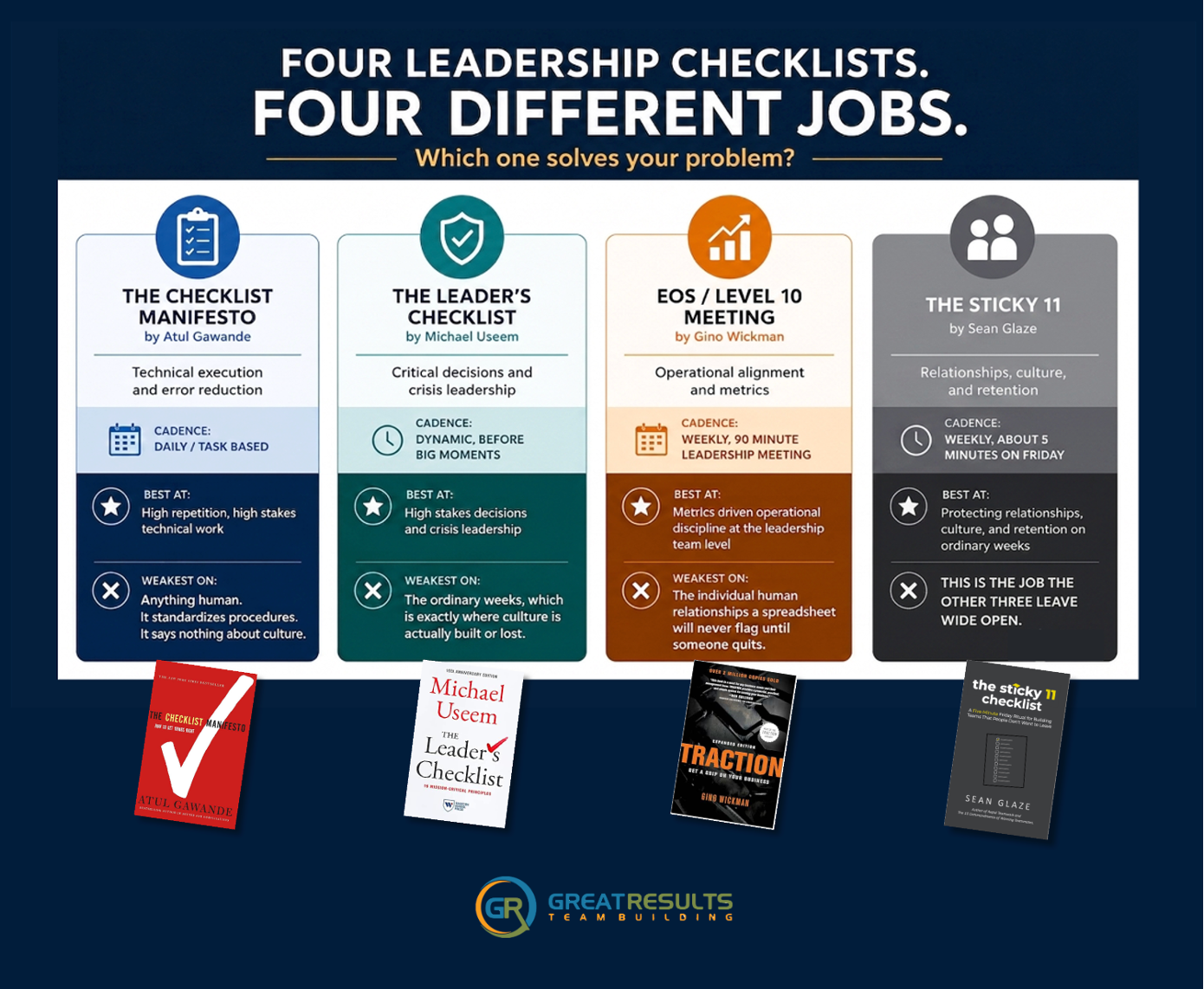
Four different tools, built for four different jobs, on four different schedules. Read this first, then discover what each one does well and where it falls short.
| Checklist | Primary Job | Cadence | Core Idea |
| The Checklist Manifesto
(Atul Gawande) |
Technical execution and error reduction | Daily / task based | A simple checklist helps experts execute what they already know under pressure. |
| The Leader’s Checklist
(Michael Useem) |
Critical decisions and crisis leadership | Dynamic, before big moments | Leaders need a cognitive safety net to avoid major strategic errors. |
| EOS / Level 10 Meeting
(Gino Wickman) |
Operational alignment and metrics | Weekly, 90 minute leadership meeting | A fixed scorecard and disciplined issue solving keep a leadership team on track. |
| The Sticky 11
(Sean Glaze) |
Relationships, culture, and retention | Weekly, about 5 minutes on Friday | Culture is built through small relational reps repeated until they become identity. |
1. The Checklist Manifesto, by Atul Gawande
The checklist for technical execution
Gawande is a surgeon, and he proved something that sounds obvious until you see the results. A simple checklist helps experts execute what they already know under pressure. Hospitals that adopted his surgical safety checklist cut complications and deaths, with no new training and no new talent. The checklist did not teach the surgeons anything. It just made sure they did the fundamentals every single time.
His key distinction is the one I keep coming back to.
He separates failures of ignorance, where we do not know enough, from failures of ineptitude, where we know exactly what to do and fail to do it anyway. In modern work, ineptitude is the bigger problem. We are drowning in knowledge and starving for follow through.
Best for: high repetition, high stakes technical work like surgery, aviation, and compliance. Weakest on: anything human. It standardizes procedures. It says nothing about culture.
2. The Leader’s Checklist, by Michael Useem
The checklist for the big moment
Useem is a Wharton professor who took Gawande’s idea and pointed it straight at leadership. His argument is that the absence of a leader’s action checklist is one of the most correctable lapses in leadership, and that running a short list of vital actions readies a leader for whatever comes next.
It is excellent architecture for steering through a crisis, or a major strategic call.
But notice how you actually use it. You reach for it when something big is happening. And that is the quiet limitation. A checklist you pull out only in a crisis cannot build the everyday trust that keeps a crisis from happening in the first place.
Best for: high stakes decisions and crisis leadership. Weakest on: the ordinary weeks, which is exactly where culture is actually built or lost.
3. EOS and the Level 10 Meeting, by Gino Wickman
The checklist for operational alignment
This is the operating system behind the book Traction, and it is genuinely good at what it does. The core ritual is the Level 10 Meeting, a fixed ninety minute weekly meeting for the leadership team. Same day, same time, same agenda. You review a scorecard of five to fifteen numbers, check your quarterly Rocks, and spend most of the meeting solving issues at the root.
If your leadership team argues about priorities, misses its numbers, or leaves meetings with nothing solved, EOS will fix that fast.
But look closely at what a Level 10 actually reviews. A scorecard. Rocks. An issues list. On track or off track. What it does not do, by design, is ask whether the quiet person on your team has said a word in three weeks. A scorecard measures output. It cannot measure whether someone feels seen.
Best for: metrics driven operational discipline at the leadership team level. Weakest on: the individual human relationships that a spreadsheet will never flag until someone quits.
4. The Sticky 11, by Sean Glaze
The checklist for the people, not the numbers
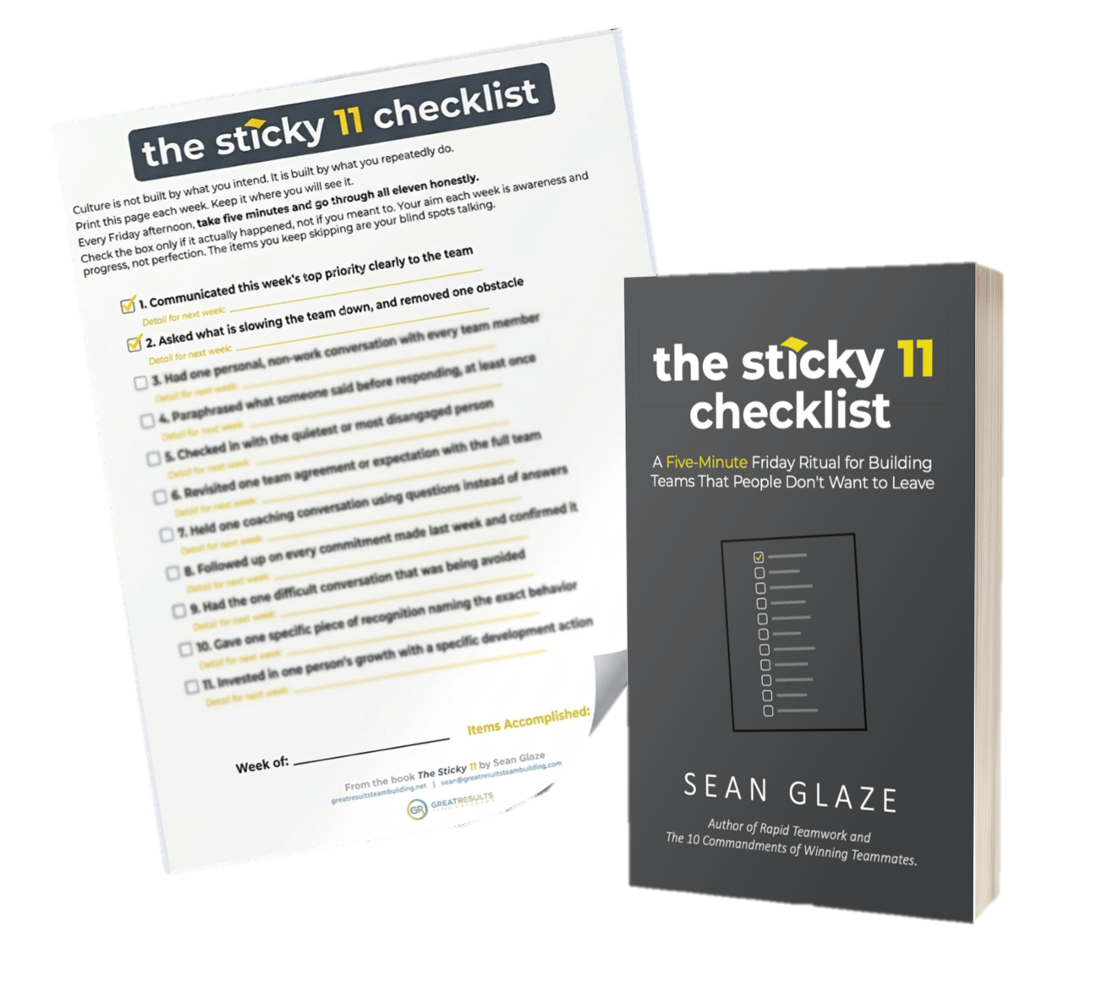
This one is mine, so let me be plain about what it is. The Sticky 11 is a synthesis, a weekly operating system built on top of my four books. It is eleven small relational habits that take about five honest minutes every Friday. It is built to protect the human side of a team before culture decay quietly turns into turnover.
Where the other three track the work, the Sticky 11 is a leadership checklist that tracks the relationships. It is not measuring your revenue. It is prompting you to do the eleven small things that keep good people from drifting toward the door. The personal conversation. The obstacle you cleared. The check on the quiet one. The specific thank you instead of a generic one. Tiny reps, repeated week after week, until they stop being effort and start being who you are.
Every habit pulls from one of my four books and from published research. Here is the full list, so nothing hides.
Best for: protecting relationships, culture, and retention on ordinary weeks. This is the one job the other three leave wide open.
Which Leadership Checklist Actually Keeps Your People?
Strip away the labels and the real contrast is simple. Three of these checklists track the work. One tracks the people. If retention is the problem you are trying to solve, that distinction is your answer. Here they are compared in a table.
| Checklist | What It Catches Well | What It Was Never Built to Catch |
| Gawande | Missed technical steps in high stakes, repeatable work | Whether your people feel seen, heard, or ready to walk |
| Useem | Blind spots during a crisis or major decision | The quiet erosion that happens on ordinary weeks |
| EOS / Wickman | Off track numbers and unsolved operational issues | The relationship damage a scorecard cannot measure |
| Sticky 11 | Slipping relationships before they become issues or team turnover | Your metrics, strategy, and technical execution |
Numbers versus people
Your scorecard tells you how the business is doing. It will never warn you that a good employee is about to leave. A weekly relational check will. Both matter. Most leaders only track one of them.
The everyday versus the big moment
Culture is not built in the crisis or the annual retreat. It is built in the small moments you barely notice, repeated fifty two ordinary weeks a year. The five minutes you skip on Friday is the resignation you did not see coming next quarter.
Knowing versus doing
Your problem is rarely that you forgot a technical step. It is that you meant to check on someone and the week ate the intention. You meant to follow up. You meant to have the hard conversation. You knew exactly what to do. You just did not do it. That is the same failure Gawande diagnosed, pointed at people instead of procedures.

A Note on Honesty, Because My Method Depends on It
Neither Gawande nor Useem ever tested the Sticky 11. No study has. The Sticky 11 is my synthesis of meaningful leadership habits, and I would rather tell you that plainly than dress it up as something a research study confirmed.
What the research validates is two separate things.
First, the method. Gawande and Useem both proved that a simple checklist helps capable people execute the fundamentals they already know. Second, each individual habit is backed by published research and by a specific book behind it. The specific list of eleven is my judgment about which moves earn the highest return on five minutes a week.
So, What Is the Best Leadership Checklist for Managers?
Not one. The best managers use more than one.
Use Gawande’s thinking to standardize the technical work that cannot afford an error. Use Useem’s approach when a big decision or a crisis demands a safety net. Run something like an EOS Level 10 if your leadership team needs a metrics driven weekly pulse.
Those are real tools for real jobs.
But none of them protects your people.
That job is still open. And it is the job that decides whether the talent you worked so hard to hire is still on your team a year from now. That is the whole reason I built the Sticky 11. Not to replace your scorecard. To sit next to it.
Your numbers tell you how the business is doing. The Sticky 11 Checklist tells you how your people are doing. You need both.
If this is the checklist your leadership team is missing, that is exactly the work I do live, as a keynote or a working session for your managers. If you want to bring it to your team, let’s talk. And if we never do, still do the one thing this Friday. Pick the habit that made you a little uncomfortable while you read this, and go do it.
That is where a sticky culture starts.
– – – – –
Sean Glaze is a sought-after leadership and workplace culture speaker, who gained valuable insights on turning talent into teamwork as a successful basketball coach – and now he travels around the country to share those actionable lessons.
Sean’s engaging conference leadership keynotes and custom team building programs have helped clients like Cisco, John Deere, the CDC, and Emory University to increase collaboration, boost productivity, and build Sticky Cultures that inspire more profitable teamwork.
Sean’s books, Rapid Teamwork, What Effective Leaders DO, The 10 Commandments of Winning Teammates, and Staying Coachable are entertaining parables that accelerate the growth of leaders and teams!