

Progress is the loyalty anchor leaders forget to check.
Your best people do not usually leave over one bad Monday. They leave when they cannot tell whether their work is going anywhere.
I have coached basketball for over twenty years and worked with corporate teams across many industries. The pattern is the same in both places. People care about results they can see themselves moving. When they cannot see it, they drift.
This article connects two things I teach.
First, the loyalty anchors that keep talented people from drifting away. Second, a simple weekly tool I built to make one of those anchors visible: the Team Progress Tracker.
Where Progress Fits Among the Loyalty Anchors
Anchors keep expensive ships from drifting when the wind changes.
Your best people are those ships. They have options, and the wind is always blowing somewhere.
There are six anchors that hold talent in place: Pay, Purpose, People, Parameters, Progress, and Praise. Pay is the one a manager often cannot control. You can influence the other five, and they line up with the five areas of the GREAT culture model:
- Purpose is Goals
- People is Relationships
- Parameters is Expectations
- Progress is Accountability
- Praise is Thanks
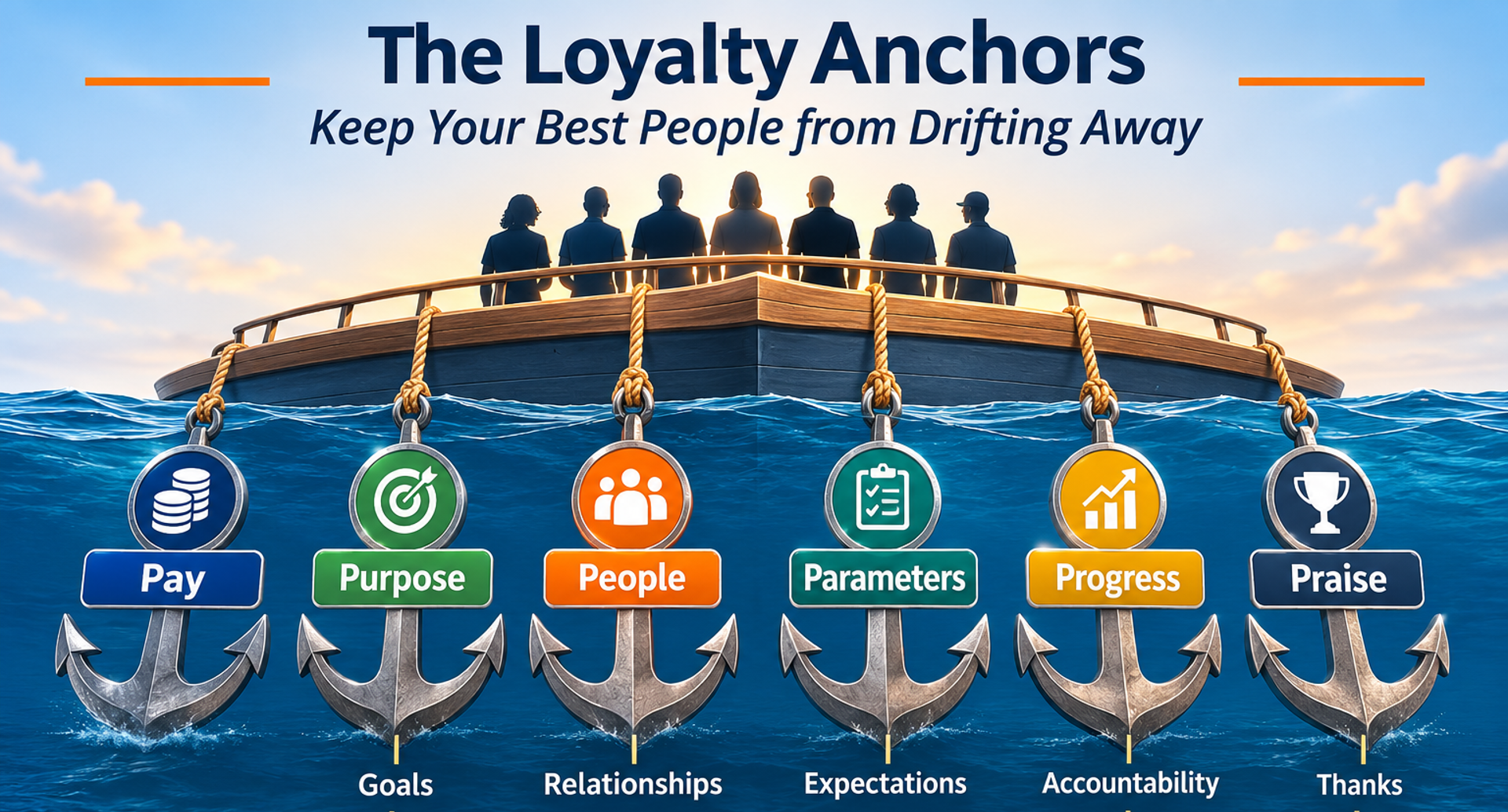
Progress is the least obvious match on that list.
Say the word accountability and most people think of getting in trouble. That is the wrong picture. In a healthy culture, accountability means someone cares enough to track whether you are growing, finishing what you start, and getting better.
Progress has two layers, and you need both.
The growth path.
Training, mentoring, stretch assignments, and a future worth working toward.
This tells people where they are headed.
The visible movement.
The weekly proof that effort is moving a number that matters.
This tells people they are getting there.
A path with no visible movement feels like a promise someone forgot. A job with no growth feels like a parked car.
The growth path says where your people are going. Visible progress proves they are on the way.
Why Seeing Progress Changes How People Show Up
Engagement has a simple definition.
Engagement is how much a person cares about the results their efforts are contributing to.
Look at what that requires. The person has to see the results.
They have to see that their effort contributes. And they have to care. You can influence all three, and the first one is where leaders fall short.
I think about team buy in as a ladder with three rungs:
- The person does not see or care about the impact of their effort.
- The person does the bare minimum to stay out of trouble.
- The person cares about the results their effort contributes to. Commitment is nearly the same thing as engagement.
Ask yourself which rung each person on your team stands on. You may be surprised.
Meaningful mission and meaningful relationships pull people up that ladder. Evidence keeps them climbing.
Picture a basketball game with no scoreboard.
The players still run. They still sweat. They still follow the plays. But nobody can tell if any of it is working. I would not want to coach that game, and your team does not want to play it.
Leaders run teams like that every week.
They ask for effort and never show the score.

What Harvard Research Found
Harvard Business School professor Teresa Amabile and psychologist Steven Kramer asked professionals to keep a daily diary. They collected about 12,000 diary entries from knowledge workers, then looked at what separated the best days from the rest.
The answer was progress.
Of all the events that shaped the best days, making progress on meaningful work was by far the most common. It did not have to be big. Small wins counted.
Amabile points out something that should make every leader uncomfortable.
If you asked a room of managers to name the biggest influences on how people feel at work, progress would be missing from their list.
Why?
Because progress looks small up close.
One renewal. Two calls. A process written down. None of it feels worth mentioning, so nobody mentions it.
The other side matters just as much.
Setbacks can hit people hard, even small ones. A stalled decision. A missing approval. A tool that does not work. Each one can tell a person their effort is going nowhere. That is why the tracker below asks you to clear what is in the way before you ask for more.
Takeaway: A paycheck does not give someone a good Tuesday.
Progress does.
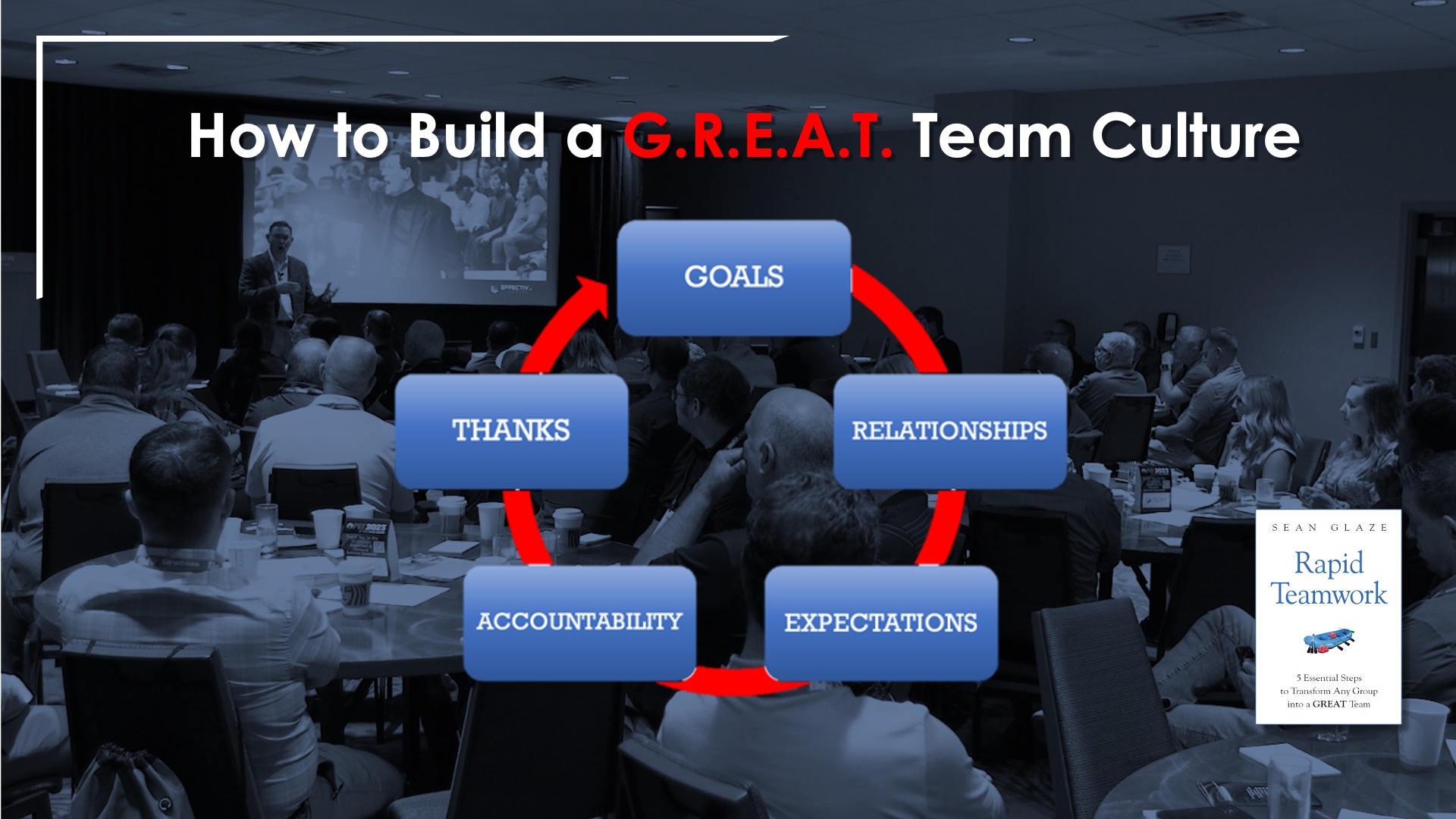
How Progress Builds a G.R.E.A.T. Culture
Progress is not a standalone anchor.
It works because of its neighbors, and each one maps to a letter in the GREAT model.
- Purpose gives the progress meaning. The goal tells people what to move.
- The weekly 1:1 is where progress becomes a conversation, and people feel their leader is paying attention.
- A clear number with a starting point and a target removes the guessing about what done looks like.
- Someone tracks the movement, and the tracking says “your work matters enough to count.”
- Praise makes sure the person who made the progress knows you saw it.
Remove any one of those and the anchor loosens.
A number with no thanks feels like surveillance. Thanks with no number feels like flattery. Put them together and people feel seen and challenged at the same time.
That combination is what a sticky culture feels like.
Meet the Team Member Progress Tracker
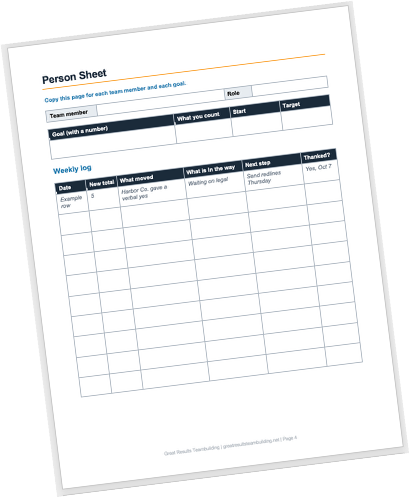
You do not need a new program. You need a tool that fits inside the weekly 1:1 you already hold. I built the Team Progress Tracker for exactly that. The 1:1 takes about 15 minutes and follows four moves, in this order.
1. Keep score
Give each person one or two goals with a number you can check in one minute. Seven discovery calls out of 12. Five renewals out of eight. Nine open tickets down to three. Write the starting number and the target.
Each week, ask for the new total and write it in the person’s log. Then ask what moved.
Skip: “How is the project going?”
Try: “You were at four calls last week. Where are you now, and what moved?”
2. Clear the path
Ask what is in the way. Write it down. Pick one thing you will remove before the next 1:1. Setbacks hit hard, so do not leave a blocker sitting.
Skip: “Just work around it.”
Try: “I will get the contract language from legal by Thursday. I will tell you when it is done.”
3. Say “thank you for…”
When the number moves, say what changed and who it helped. Say it this week, and log it on the Thanks Log. This is also the T in my POINT Feedback Model: Track progress. You cannot track what you never name out loud.
Skip: “Great job.”
Try: “Seven calls booked, and three came from referrals you asked for. That is the habit this team needs.”
4. Agree on the next step
Pick the one thing that moves the number this week. One thing. Not seven.
What to Do When the Number Stalls
Some weeks the number will not move.
Do not turn the 1:1 into an interrogation. Ask three questions, in this order:
- Is the goal clear? If the person cannot say what done looks like, that is on you.
- Is something in the way? Check the blocker list before you check the person.
- Does the person see why it matters? Tie the number back to a customer, a teammate, or a result they care about.
Only then talk about effort. By that point you will know whether you have an effort problem or a leadership problem.
Keep score. Clear the path. Say thanks.
Do it every week and your people will always know where they stand.
Pick one person on your team today. Write down their number. Find out where they stand, and ask what is in their way. Then say thanks for something specific before the week ends.
If you want your leaders practicing this with their teams, I would love to help.
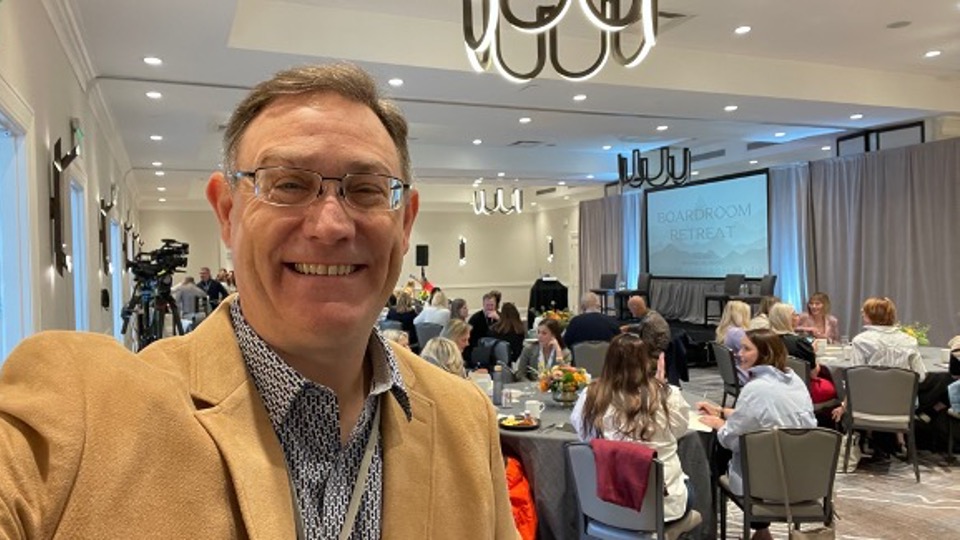
Sean Glaze is a workplace culture keynote speaker and team building event facilitator who spent 20 years coaching basketball before transitioning to corporate speaking. He has worked with organizations including Cisco, John Deere, CDC, Emory University, and Southern Company, helping teams build accountability, trust, and stronger collaboration.
He is the author of several leadership books including Rapid Teamwork, What Effective Leaders Do, and The 10 Commandments of Winning Teammates, and he built the G.R.E.A.T. Culture Model, a framework leaders use to diagnose and strengthen team dynamics.