

Accountability does not fail because people are lazy.
It fails because nobody built a system for it.
I coached basketball for a long time before I ever stood in front of a corporate audience.
And for too many of those seasons, I thought accountability was my job. I set the standard. I watched for who missed it. I handed out the consequence.
Then I wondered why my players seemed more interested in avoiding my attention than in showing up for each other.
Here is what I eventually figured out…
When the coach o rleader is the only one holding a standard, the team does not own it.
They rent it.
That same problem shows up in locker rooms and in conference rooms.
What a Lack of Accountability Looks Like on Athletic Teams

- Effort depends on who is watching. Players go hard in the drills the head coach runs and coast through the ones the assistants run.
- Captains will not confront teammates. They are friends first and leaders second, and nobody ever taught them how to hold a peer to a standard without damaging the friendship.
- The roster splits into groups. Seniors stick with seniors. Starters stick with starters. Freshmen and reserves figure it out on their own.
- Standards live on a poster. “We compete. We finish. We play for each other.” Great words. Ask a player what any of them look like at practice on a Tuesday and you get a shrug.
What It Looks Like on Business Teams

- Accountability only flows down. The manager follows up. Everyone else waits to be followed up with.
- Silos replace relationships. People barely know their colleagues in other departments. So when a handoff breaks, they assume bad intent instead of picking up the phone.
- Goals live in a system nobody opens. Objectives set in January and rediscovered at December review.
- Standards stay vague. “Communicate better.” “Take ownership.” “Be a team player.” Ask five people what those mean and you will get five different answers.
- Thanks is rare and generic. A “great job, team” email does not tell anyone what they did that mattered.
Different uniforms, same root problem:
standards are fuzzy, accountability belongs to one person, and relationships are left to chance.
A Coach Who Solved It with an Index Card
Bob Ladouceur coached football at De La Salle High School for 34 seasons.
His teams won 151 games in a row between 1992 and 2004, and he retired with a record of 399 wins, 25 losses, and 3 ties. His program inspired the book and film When the Game Stands Tall.
Plenty of programs have talent.
What caught my attention about De La Salle was a simple weekly habit.

Every week, Coach Ladouceur paired his players up, always in a different order.
Each player wrote three goals on a 3×5 index card: a conditioning goal, a practice goal, and a game goal. Then he read that card out loud to his partner and handed it over.
The one rule: every goal had to be measurable and observable.
At the end of the week, the whole team could see who kept their word.

In an interview with Don Yaeger for Forbes, Coach Ladouceur explained that he wanted his players to be responsible to each other and to understand that their contributions impact the team as a whole. He also said most of his former players kept those cards for years.
The scoreboard got the headlines.
The cards built the men.
How the Commitment Card Works
I have adapted his process for the coaches and leaders I work with.
Here is the short version.
1 – Write it. Each person writes a few specific goals on a card. Athletes write a game goal, a practice goal, and a conditioning goal. Business teams write a results goal, a growth goal, and a teammate goal.
2 – Run the activity. Every goal has to pass one question: could a teammate watch it and count it? “Block better” fails. “Take a positive first step on every run play” passes. “Communicate more” fails. “Send my project update to the ops team every Friday by noon” passes.
3 – Commit out loud. Read the card to your partner and hand it over. Your partner keeps it.
4 – Check in midway. A two minute nudge at practice or a five minute coffee. Not an audit. Just “how is it going?”
5 – Report out to the group. Your partner reads each goal and asks, “Did you keep it?” You answer yes or no. No excuses.
6 – Rotate partners. Athletic teams rotate weekly. For business teams, I recommend monthly partners with cards every two weeks.
There is one team rule that makes the whole thing work:
Owning a missed commitment gets applause. Excuses get silence.
When people learn that admitting a missed commitment is respected, they stop hiding and start growing.
Why It Grows Culture, Not Just Results
This is where the card earns its spot in my GREAT culture model.
One small weekly habit touches all five elements.
- Big team goals become small, specific actions that people can see and count.
- Rotating partners connect seniors with freshmen and sales with operations. Over a season or a quarter, everyone has made a promise to someone they barely knew.
- The standard is written down and spoken out loud. Nobody has to guess what “take ownership” means anymore.
- Peers follow up with peers. “Did you keep your card?” is a lot easier to say than “you have been slacking.”
- Kept commitments get recognized in front of the team, and partners thank each other for the push.
There is a character piece here too.
Coach Ladouceur used the cards to teach that nobody is perfect. A missed card is not a failure. It is a chance to learn something and adjust.
That habit of saying what you will do and then doing it follows people long after the season or the project ends.
Two Free Guides, One System
I put together two guides so you can start right away.
For coaches and athletic teams
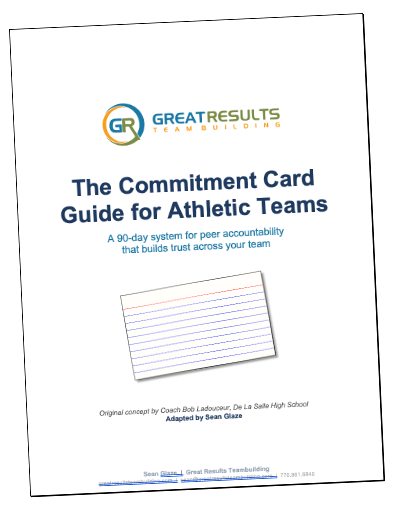
The Commitment Card Guide for Athletic Teams walks you through a full season in five phases, from preseason install to postseason reflection. It includes the weekly cycle, a report out script, the coach’s role, troubleshooting tips, an optional FCA huddle add on, and printable cards.
For leaders and business teams
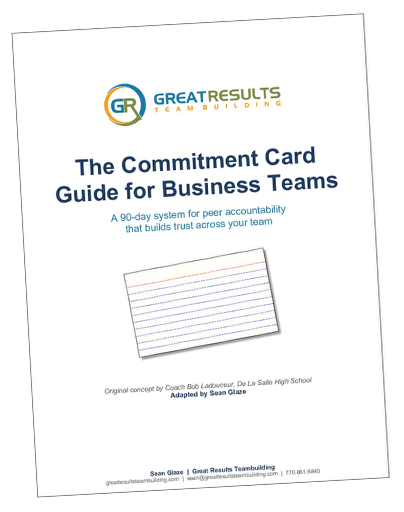
The Commitment Card Guide for Business Teams gives you a 90 day rollout with monthly partners and two week card cycles. It includes tips for remote and hybrid teams, guardrails (like keeping the cards out of performance reviews), and ready to use templates.
(You can also find the business guide in the Goals section of my free Team Leadership Toolbox,
along with dozens of other resources organized around the GREAT culture model.)
How to Start This Week
You do not need a team retreat to begin. You need one card.
- Write your own card first. Leaders and coaches go first. Always.
- Pick one goal that passes the filter. If someone could not watch it and count it, rewrite it.
- Read it to someone on your team. Ask them to check on you by Friday.
- Report back, out loud. Then invite your team to try it next week.
Accountability gets real when a teammate is holding your card and waiting for your answer.
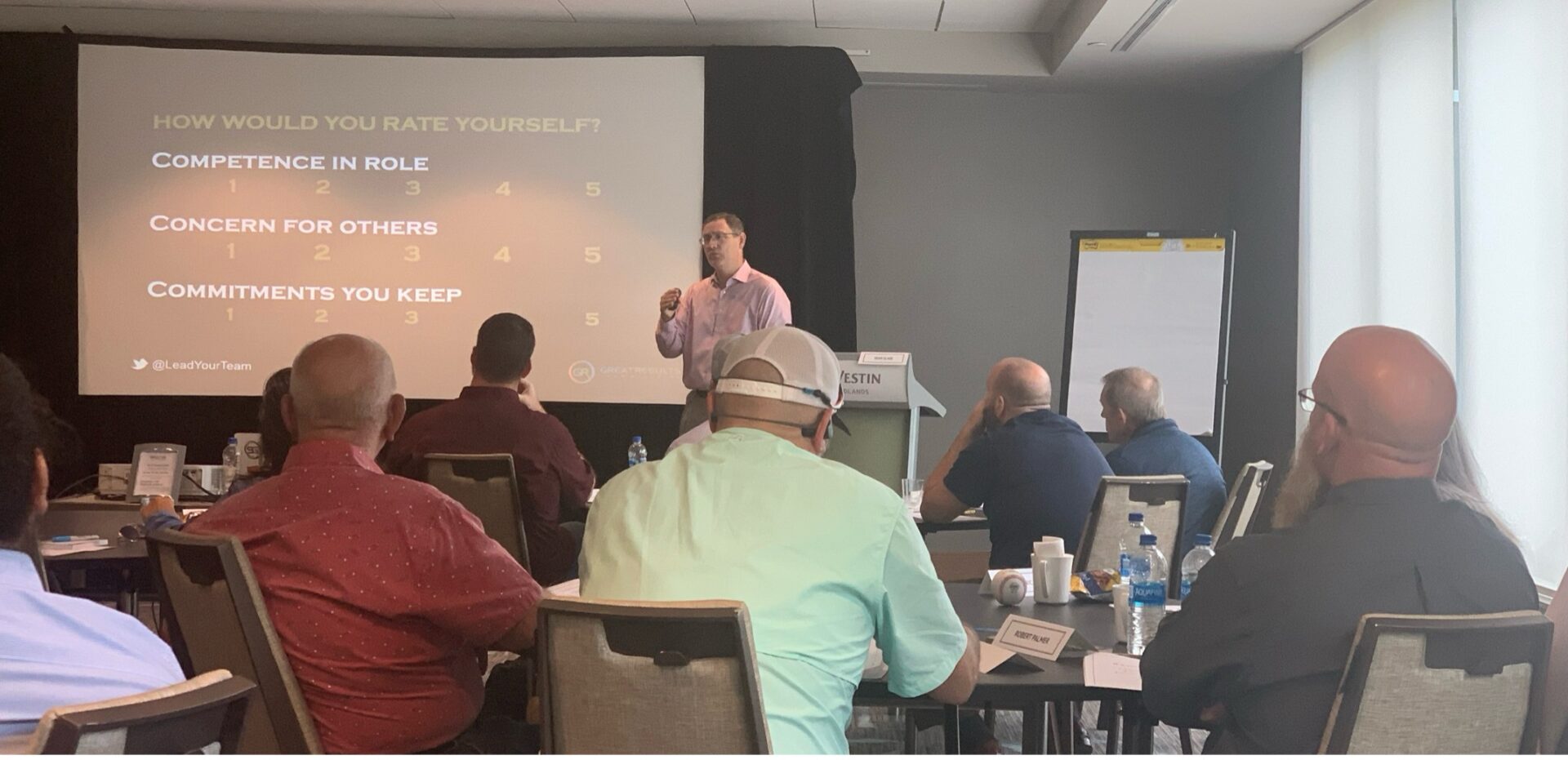
Sean Glaze is an engaging teamwork keynote speaker and team building event facilitator who spent 20 years coaching basketball before transitioning to corporate speaking. He has worked with organizations including Cisco, John Deere, CDC, Emory University, and Southern Company, helping teams build accountability, trust, and stronger collaboration.
He is the author of several leadership books including Rapid Teamwork, What Effective Leaders Do, and The 10 Commandments of Winning Teammates, and he built the G.R.E.A.T. Culture Model, a framework leaders use to diagnose and strengthen team dynamics.