Vision vs. Mission vs. Values: What’s the Difference, and How Do You Make Them Stick?
What executive leaders need to know about 3 words every team uses (but few agree on)

What executive leaders need to know about 3 words every team uses (but few agree on)
Vision, mission, and values are not three ways of saying the same thing.
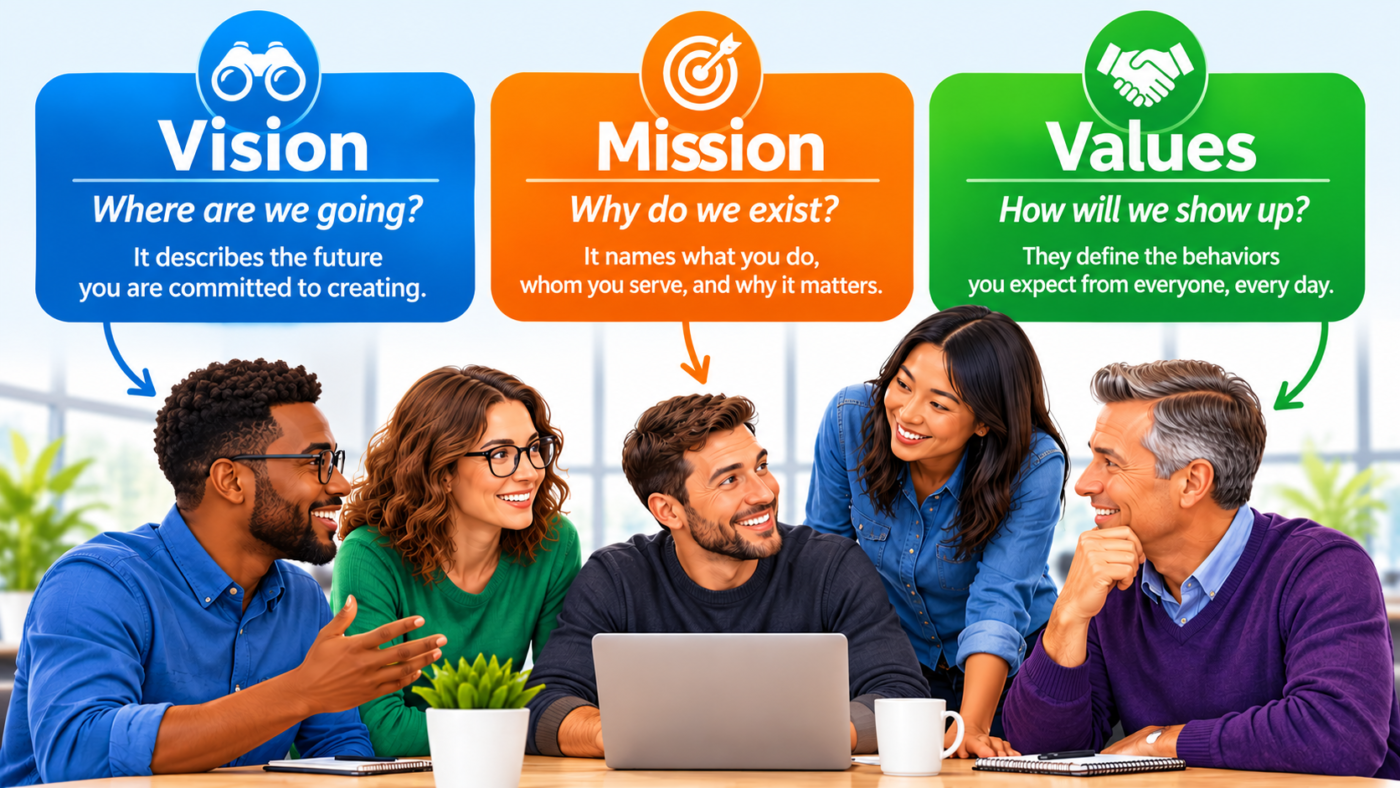
Your vision answers “Where are we going?”
It describes the future you are committed to creating.
Your mission answers “Why do we exist?”
It names what you do, whom you serve, and why it matters.
Your values answer “How will we show up?”
They define the behaviors you expect from everyone, every day.
Vision is the future. Mission is the present.
Values are every interaction in between.
I have walked a lot of executive teams through this conversation, and the problem is rarely that a company is missing these statements.
The problem is that the statements live on the wall instead of in people’s heads. I call that the Poster Problem.
This page will show you the difference between all three, what good ones look like, and how to turn them into behaviors your people actually see.
| VISION | MISSION | VALUES | |
| The question | Where are we going? | Why do we exist? | How will we show up? |
| What it describes | The future we are committed to creating | What we do, whom we serve, and why it matters | The principles and behaviors that guide how we work |
| Time orientation | The future | Present and ongoing | Every day |
| Helps people understand | What we are working toward | Why our work matters | How we are expected to work together |
| Without it | People lack direction | People lack purpose | People lack behavioral standards |
| The leadership question | Are we moving toward the future we describe? | Can everyone explain why our work matters? | Are we demonstrating the behaviors we expect? |
| The reality test | If it doesn’t stretch people, it’s a forecast, not a vision. | If people can’t explain it in their own words, it’s a poster, not a mission. | If you can’t see it, coach it, and thank people for it, it’s a wish, not a value. |
ClearCompany, as cited in Unito’s 2020 State of Workflow report.
Before I worked with corporate teams, I spent more than twenty years teaching in high schools, and I worked in five different buildings. The principals were different. The students were different. Even the floor plans were different.
But one thing was the same at every school.
There was a mission statement framed in the main office and hung on the hallway walls.
And at every school, it stayed right there on the wall.
In a building with 140 faculty members, I would argue there were 140 different missions. Every teacher had decided, consciously or not, what their daily work was really for. Every one of them meant well.
None of them were connected to a compelling common goal.
That is the Poster Problem.
Organizations invest real time and money writing these statements, then invest almost nothing in making sure people understand, believe, and use them.
It costs more than you think. Gallup found that just a 10% improvement in employees’ connection with the mission or purpose of their organization leads to an 8.1% decrease in turnover and a 4.4% increase in profitability.



| When this is unclear | Employees experience | Leaders need to clarify |
| Vision | Conflicting priorities and uncertainty about the future | Where we are going |
| Mission | Confusion about what matters most and why their work is important | Why we exist and whom we serve |
| Values | Inconsistent behavior, friction, and unclear expectations | How we expect people to behave |
| All three | Disconnection, inconsistent decisions, and no shared direction | What we stand for and how we will work together |
An organization can have talented people, ambitious goals, and a smart strategy and still struggle, because people don’t share an understanding of where they’re going, why their work matters, and how they’re expected to work together.
That is why clarifying these statements is a leadership responsibility, not a branding exercise.
| Criteria | Vision | Mission | Values |
| Clear | Describes a future people can picture | Explains your purpose in plain language | Defines expectations people recognize |
| Memorable | Easy to picture and repeat | Easy to explain without reading it | Few enough to name from memory |
| Meaningful | Connects to something bigger than revenue | Explains why the work matters to someone | Reflects what you truly believe |
| Actionable | Guides long term priorities | Helps decide what work matters most | Guides everyday choices and behavior |
| Believable | Ambitious, but credible | Connected to the work you actually do | Modeled by leadership first |
A strong statement isn’t the most impressive sounding one. It’s the one people understand, remember, believe, and use to make decisions.
Mission statements that work
Vision statements that work
Notice that each mission names what the organization does and why it matters to someone, and each vision describes a future you can picture but will never fully finish.
Clear statements are the starting point. Culture is what happens after. In my work with organizations, I use the G.R.E.A.T. culture model to turn statements into daily habits:
Here is the process I use when I facilitate this session with leadership teams:
Get the same Mission and Vision and Core Values worksheets I use when I facilitate this session with leadership teams. Free, printable, and ready for your next offsite.

.
What is the difference between vision, mission, and values?
Vision describes the future an organization wants to create. Mission explains why the organization exists, what it does, and whom it serves. Values define the principles and behaviors that guide how people work and make decisions.
Is a vision statement the same as a mission statement?
No. A vision statement describes a desired future. A mission statement describes your present purpose. One tells people where you are going. The other tells them why you exist and what you do every day.
Which should come first: vision, mission, or values?
There is no single right order, and all three must reinforce each other. With executive teams, I start with mission, because it grounds the group in the work they actually do today. From there, the vision becomes easier to picture, and the values become easier to define.
How many core values should an organization have?
I recommend three to five. If people cannot name your values from memory, they cannot use them to make decisions. Five values with clear behavioral definitions beat fifteen generic words every time.
Who should be involved in creating these statements?
Leadership should own the process, but employees should contribute. Gather input from different departments, levels, and locations. People commit to what they help create.
How do you know whether employees understand them?
Ask. Have people explain the mission in their own words, describe how their role contributes to it, and name the behaviors that demonstrate your values. Compare the answers across departments to find the gaps.
How do you communicate vision, mission, and values to employees?
Don’t rely on posters, slide decks, or the employee handbook. Repeat them in team meetings, onboarding, one on ones, performance reviews, and recognition. Leaders should be able to say them without reading them.
How often should you review them?
Review them every year or two, and any time strategy, leadership, ownership, or your market changes significantly. Values should stay fairly stable. Mission and vision may need refinement as the organization grows.
How do vision, mission, and values relate to strategic goals?
Vision sets the destination. Mission explains your purpose. Values guide behavior and decisions along the way. Strategic goals translate all three into measurable priorities and results.

Writing these statements is the easy part.
Getting a leadership team to agree on them, define them in behaviors, and actually live them is where outside facilitation pays for itself.
I facilitate this as a focused working session for executive teams.
You leave with a clear mission, a compelling vision, three to five defined team values, and a meaningful 30-day plan to make them stick.
Great Results Teambuilding delivers intentional, facilitated programs for groups of 8 to 800. Every program is fully customized based on pre-event discovery. Every attendee receives a published book. Every debrief is designed to produce specific insights your team applies on Monday morning.
Past clients include Cisco, John Deere, the CDC, Emory University, Ecolab, Southern Company, the USPTO, and World Wide Technology – Over 100 client testimonials and 20 five-star Google reviews!
Ready to talk about your team?
Book a Call