Your team’s cliques are not the problem.
The distance between them is.
That is the opposite of what most leaders believe when they call me. A department head or HR leader reaches out and says something like, “We need help breaking down the silos between our departments,” or “Can you help us get rid of the cliques on this team?”
And every time, my answer surprises them.

You do not need to destroy those tight circles on your team.
You need to build bridges to them.
I was reminded of this recently watching an episode of Ted Lasso.
The team’s sports psychologist is working through friction between the strikers, midfielders, and defenders, three groups that had drifted into their own tight little worlds inside one locker room. At one point she makes the observation that cliques form because people are looking for community in a stressful environment. That is exactly right, and it is not just a soccer club problem.
I have seen the same dynamic in hospital systems, government offices, sales organizations, and manufacturing plants. Different departments, different shifts, different regions of the same company, all forming isolated pockets of trust and connection that quietly exclude everyone outside the circle. It hurts collaboration both across teams and within them. It is not a soccer issue or a sales issue or a healthcare issue.
It is a people issue, and every leader runs into it eventually.
Why We Cluster in the First Place
Before you try to fix a clique, get honest about what it actually represents.
A clique, or a silo, is evidence of a strong relationship. People found each other. They built trust through shared challenges, shared language, and shared context.
Researchers have a name for this pattern. It is called homophily, one of the most well documented findings in the social sciences.
Sociologists Miller McPherson, Lynn Smith-Lovin, and James Cook summarized decades of research on the topic with a simple line, similarity breeds connection. That principle shapes nearly every kind of relationship we form, including the ones we build at work.
In other words, your people did not gather into tight circles because something is wrong with your culture. They gathered because that is what humans do.
That is exactly what you want your culture to produce, connection, loyalty, and a sense of belonging.

The Cost of Staying Lonely at the Top of Your Circle
The problem shows up only when that connection stops at the edge of the group. When the strikers only trust the strikers.
When accounting only trusts accounting. When the night shift only trusts the night shift. The relationship itself is healthy.
The boundary around it is what is costing you.
And the boundary costs more than most leaders realize. Gallup’s global workplace research has found that one in five employees report feeling lonely at work often, and that number climbs to one in four among fully remote employees.
People are not short on coworkers.
They are short on connection outside their own small circle. A tight clique inside a lonely, disconnected company is not a red flag. It is often the one healthy relationship a person has at work.
The goal is not to take that away from them. The goal is to help them build more relationships like it, with people outside the circle too.
Why Leaders Reach for the Wrong Silo Fix
When a leader tells me they want to break down silos, what they are really describing is a symptom.
Missed handoffs. Duplicated work. Meetings where one department seems to be speaking a different language than the next. Frustration that builds because nobody outside the circle understands what that group is dealing with.
But you cannot solve a connection problem by attacking the connection that already exists.
Tearing down a tight knit group does not create trust between departments. It just destroys trust in one place without building it anywhere else.
The real fix is not demolition. It is expansion.
The Real Goal: More Circles, Better Connected
I coached basketball for over twenty years before I ever stood on a stage. And one phrase from that world never sat right with me, there is no I in team.
It sounds good. It is also wrong.
Every athlete I coached was an individual first.
Every person on your team is an individual first too, with their own circle of trust they built for good reason. Leadership is not about erasing that individuality or that circle. It is about connecting individuals, and their circles, to something bigger than themselves.
There is a well known idea in sociology that describes exactly what this looks like. In 1973, Mark Granovetter published one of the most cited papers in the social sciences, called The Strength of Weak Ties.
His argument was that the close, trusted relationships in our lives, our strong ties, are where we get stability, support, and a sense of belonging. But those same tight clusters become cut off from everyone outside them. What connects one tight cluster to another is not another strong tie. It is a weak tie, a bridge, someone willing to reach across and connect two circles that would otherwise never interact.
That is the whole job of a leader trying to fix a divided team.
Not fewer circles. More circles, and more bridges between them.
Trust Comes Before Collaboration, Not After
Here is the part leaders usually miss….
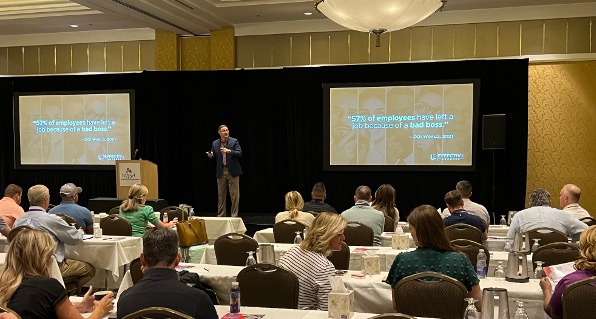
You cannot skip straight to collaboration. Every collaborative conversation that actually improves team performance, sharing an idea before it is polished, admitting a mistake before someone else finds it, asking for help before a deadline is blown, only happens on a foundation of trust.
Familiarity is not the same thing as safety.
People can know each other’s names, sit in the same meetings, and still never say what they actually think. Real trust, the kind that gets someone to raise their hand and say I do not understand this or I need help, takes more than proximity. It takes shared experience. That is why the bridge between circles cannot just be an org chart line or a shared Slack channel.
It has to be an actual shared experience that gives people a reason to depend on each other.
How to Actually Do This
This is not a slogan or a poster in the break room.
It takes deliberate structure.
Make the org chart mean something. Silos grow fastest where expectations are fuzzy. A clear picture of who owes what to whom, and by when, does more to connect departments than any trust fall ever will.
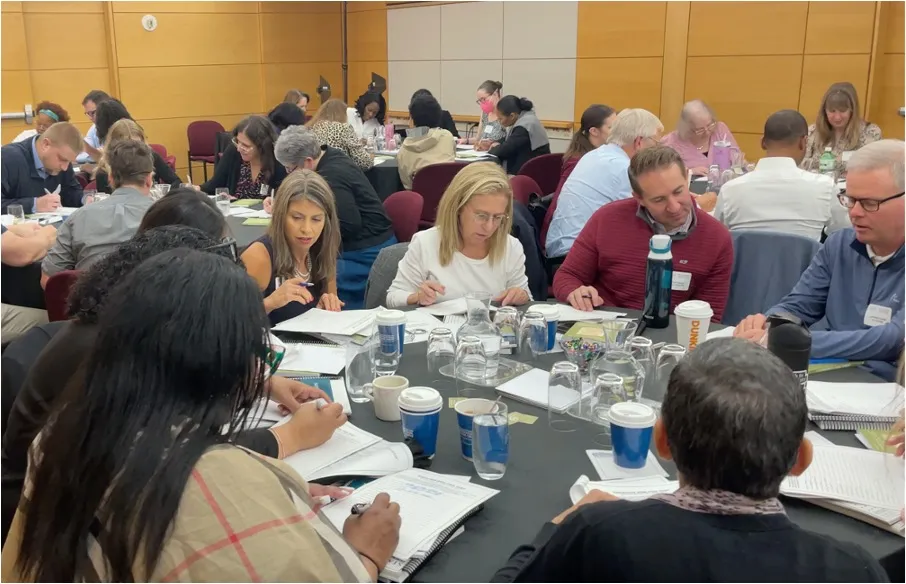
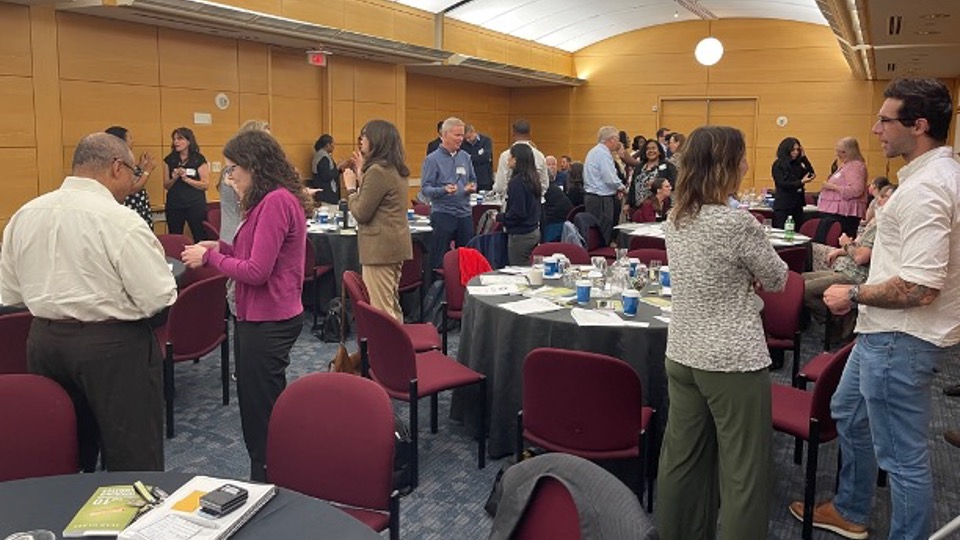
Engineer collisions. Left alone, people default back to their circle every time. Assigned seating in meetings, cross departmental project pairings, and shared problem solving sessions force the kind of contact that builds familiarity instead of assumption.
Choose intentional experiences over recreational ones. A happy hour lets people who already like each other enjoy each other more. A facilitated, intentional team building experience is built to put people who do not naturally interact into situations where they have to depend on each other. That is where real trust gets built between circles, not just inside them.
Protect the debrief. The activity is never the point. The conversation afterward, where people say out loud what they noticed about how the other group works and what they now understand differently, is where the shift actually happens.
The Bottom Line on Cliques for Leaders
The next time you catch yourself wanting to break up a tight circle on your team, stop and look at it differently.
Instead of asking “How do I get rid of silos and cliques on my team,” ask a different question.
Ask what caused the circle.
And ask how you can build bigger circles.
That circle is proof your people know how to build trust. Your job is not to break it. Your job is to help them build more circles like it, connected to each other by real bridges, all pulling toward the same goal.
That is the work I do with teams across the country, helping departments that have drifted into isolated pockets of connection build the trust they need to collaborate like they are on the same side.
Because they are.
– – – – –
Sean Glaze is a workplace culture keynote speaker and team building event facilitator who spent 20 years coaching basketball before transitioning to corporate speaking. He has worked with organizations including Cisco, John Deere, CDC, Emory University, and Southern Company, helping teams build accountability, trust, and stronger collaboration.
He is the author of several leadership books including Rapid Teamwork, What Effective Leaders Do, and The 10 Commandments of Winning Teammates, and he built the G.R.E.A.T. Culture Model, a framework leaders use to diagnose and strengthen team dynamics.