

A Team Meeting Template for Leaders:
(The 7 Part Structure That Makes Meetings Worth Attending)
Most team meetings deserve to be an email. If yours don’t, it’s because you built them on purpose.
Meetings are the single place where your team’s communication either gets stronger or gets wasted.
Every team, whether remote or in person, whether you meet daily or weekly, needs a structure for sharing information that moves people forward together. The problem isn’t that meetings are inherently bad. The problem is that most team meeting agenda templates were never designed to build anything.
They were designed to fill time.
After working with teams across dozens of industries for the past two decades, I’ve found that a productive team meeting always accomplishes five things. I call them the Five Cs:
The Five Cs of a Productive Team Meeting
1. Clarity on team purpose and standards
2. Connection to the team’s mission and to each other
3. Celebration of what’s going well and where values are showing up in action
4. Contribution from everyone in the room, not just the loudest voice
5. Clarification of the next actions each person will take
If your current meeting format is missing even one of these, you’re leaving value on the table every time your team gathers.
Download the Team Meeting Template
I’ve put together a free, downloadable team meeting template built around this structure.
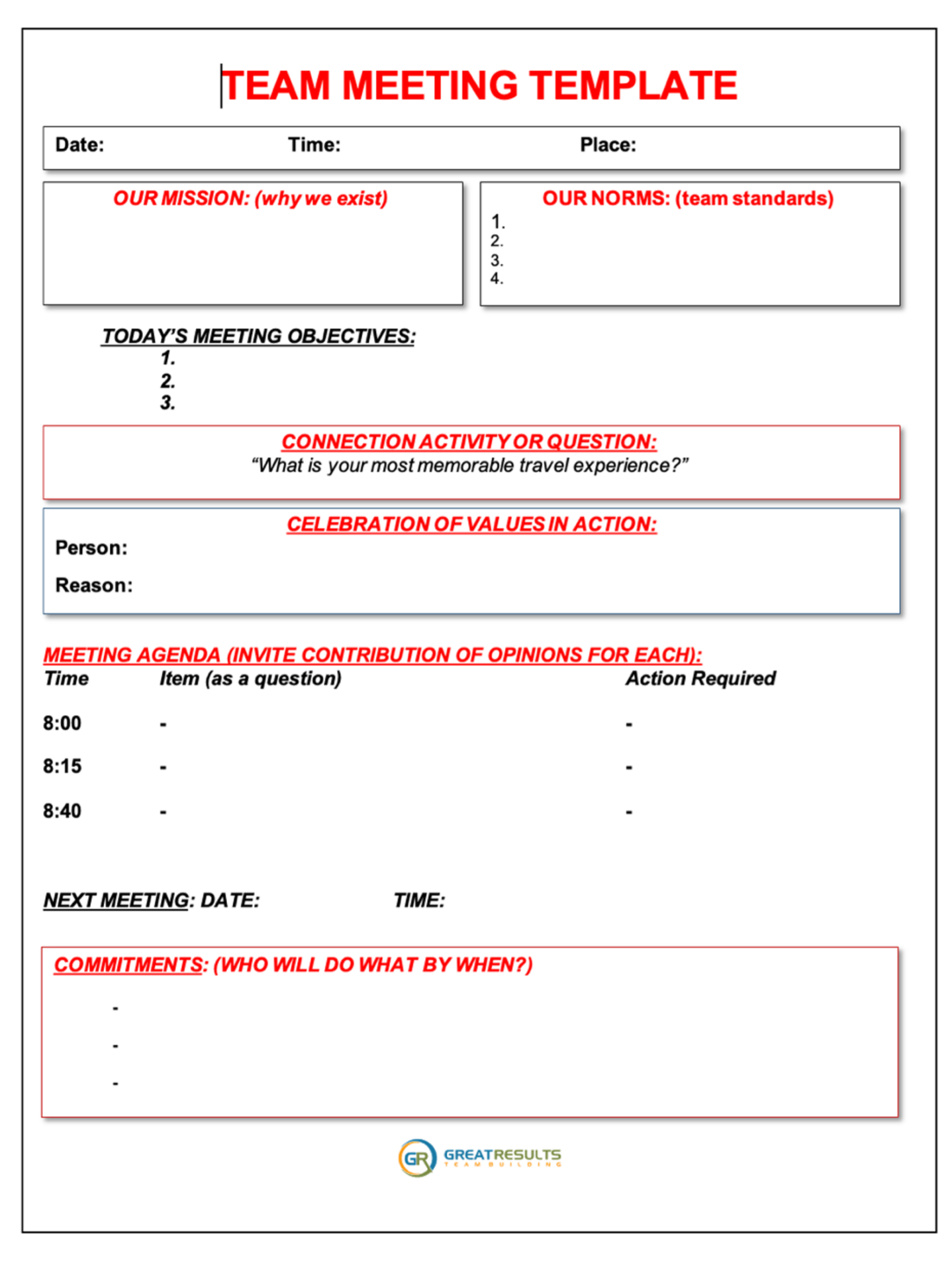
It’s an editable Word document, so you can adjust it to fit your team, your industry, and your cadence. Use it as a starting point, not a script.
Below are the seven elements I encourage every leader to build into that template, and why each one earns its place on the agenda.
1. Tell People When, Where, and Why They’re Coming
Only invite the people who genuinely need to be there, either to receive information or to contribute to it. Send the invite early enough that people can actually prepare, not just show up and hope they follow along.
If you can’t articulate why a specific person needs to be in the room, that’s usually a sign they don’t.
2. Open by Reviewing Your Mission and Team Norms
Every meeting is a chance to remind your team why they exist and how they’re expected to work together. This doesn’t need to be a long speech. A thirty second reminder of your team mission statement or your team norms keeps everyone anchored before you get into the details.
Teams drift when nobody restates the target. This step keeps the target visible.
3. State the Real Reason You’re Meeting
If there’s no clear reason to meet, cancel the meeting. When you do meet, open with a specific statement of what this meeting needs to accomplish and what you expect from the people in the room. Vague purpose produces vague participation.
4. Build in a Relationship Activity
Team connection drives team performance. I’ve written before about the statistics on team building and what they reveal about the link between relationships and results. You don’t need a full team building event to get this benefit inside a regular meeting.
Give each person five to ten minutes to answer a conversation card question. It’s a small investment that consistently builds trust and empathy across the group, especially on remote or hybrid teams where casual hallway connection doesn’t happen naturally.
5. Celebrate Behavior You Want Repeated
The values your organization claims to care about are only real if they show up as observable behavior. Use part of every meeting to highlight something recent that demonstrated one of those values, or progress toward a shared goal.
This is where stated values become visible behaviors instead of just words on a wall. What people see celebrated is what they’ll repeat.
6. Work the Agenda, and Invite Contribution
This is the working core of the meeting, where you cover the items that actually need to be addressed. Frame each agenda item as a question rather than a statement, and invite contribution of opinions for each one. That single shift changes a meeting from a report out into an actual conversation.
The most important discipline here isn’t the agenda itself. It’s making sure every person present contributes something, even briefly.
Go around the room, or the screen, and ask directly for input. Silence in a meeting isn’t agreement. It’s usually disengagement, and it compounds over time if you let it.
7. Close With Clear Commitments and a Follow Up
End every meeting with specific action items: what will be done, by whom, and by when. Follow up in writing, either by email or team chat, so there’s no ambiguity about what was agreed to. Confirm when the group will meet again.
A meeting without a documented next step is a meeting that will need to be repeated, usually with less patience the second time.

Make This Template Yours
These seven elements belong in any team meeting template, regardless of your industry. Some teams will have specific requirements this template doesn’t cover. That’s expected. Adjust it to fit what your team actually needs as an effective leader, not what a generic agenda says you should do.
The goal isn’t a perfect template. The goal is a meeting your team leaves feeling like their time mattered.
If you build these five Cs and seven steps into your next meeting, let me know how it goes. And if your team could use outside help building a stronger culture around how you meet, communicate, and work together, reach out. That’s exactly the kind of work I do.
– – – – –
Sean Glaze is a workplace culture keynote speaker and team building event facilitator who spent 20 years coaching basketball before transitioning to corporate speaking. He has worked with organizations including Cisco, John Deere, CDC, Emory University, and Southern Company, helping teams build accountability, trust, and stronger collaboration.
He is the author of several leadership books including Rapid Teamwork, What Effective Leaders Do, and The 10 Commandments of Winning Teammates, and he built the G.R.E.A.T. Culture Model, a framework leaders use to diagnose and strengthen team dynamics.