

Most leaders do not struggle because they lack effort, strategy, or tools.
They struggle because they are trying to solve human problems with operational thinking.
After more than two decades of coaching basketball teams and facilitating corporate team building events,, I have seen this pattern play out more times than I can count. A leader builds a solid process, sets clear targets, puts the right people in the right seats, and still watches the team underperform. Not because the strategy was wrong. Because the human needs underneath the strategy were going unmet.
Four researchers spent their careers studying exactly those human needs. Their work comes from different corners of psychology and organizational science, but it points to the same conclusion. GREAT teams are not built through strategy alone.
They are built when leaders understand how human beings actually work and design their daily behavior around that understanding.
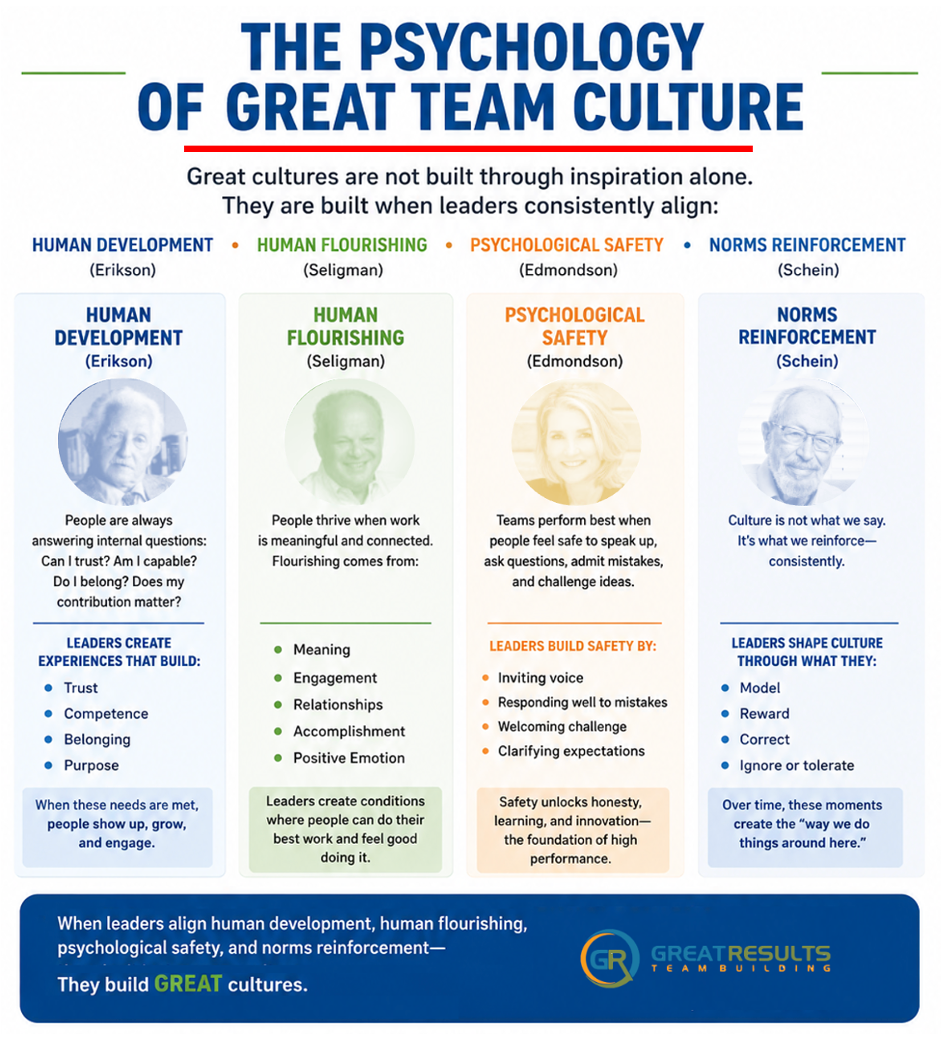
Here is what their research means for your team….
People Are Always Asking Developmental Questions
(Erik Erikson)
Erikson’s foundational insight was that human beings move through life answering a predictable sequence of psychological questions. Can I trust this place? Am I capable here? Do I belong? Does my work actually matter?
What most leaders do not realize is that those questions do not stop at the office door.
Every person on your team is quietly evaluating your culture through that same lens. The new hire in their first ninety days is not primarily worried about their career path. They are asking whether this environment is safe enough to invest themselves in. The strong performer who has gone unusually quiet is not necessarily struggling with the work. They may be asking whether their contribution still matters to anyone in the room.
When I was coaching basketball, I learned early that a player’s behavior on the court was almost always a reflection of a question that had not been answered off it. The kid who stopped taking shots was not suddenly less talented. He had stopped trusting that taking risks was safe. The player who quit communicating with teammates had stopped feeling like he belonged.
Leadership is largely the work of answering those questions through behavior, not words.
The practical test: can every person on your team answer yes to these four statements right now?
You are safe here. You are capable here. You belong here. Your work matters here.
If any answer is uncertain, you have found your most important leadership priority.
People Need More Than Clarity. They Need to Flourish.
(Martin Seligman)
Seligman spent decades studying not just what makes people function but what makes them thrive. His research identified the conditions under which human beings bring their best and most sustained effort. Meaning. Genuine engagement. Visible progress. Recognition that actually lands.
Most leaders read that list and nod. Then they go build accountability systems that track outputs and recognition programs that feel generic. And they wonder why engagement scores stay flat.
Here is what Seligman’s research is really telling us about the A and T in your G.R.E.A.T. model.
Accountability done right is not a performance management tool.
It is a flourishing mechanism. When people understand the impact of their work, when they can see the ripples their effort creates in real outcomes and real people, they stop needing to be managed toward standards. They hold themselves there because the work feels meaningful enough to protect.
The leaders I have seen build the most accountable teams were not the ones with the tightest consequence structures. They were the ones who helped people see why their contribution mattered to someone beyond the spreadsheet.
Thanks works the same way. Seligman’s research is unambiguous that recognition is not a nice extra. It is one of the primary conditions under which human beings choose to keep investing discretionary effort. The word discretionary is important there. You can buy compliance. You cannot buy the extra mile. That only comes from people who feel genuinely seen and valued for what they bring.
The practical test here is specific recognition versus generic recognition.
“Good job this week” is noise.
“I noticed how you handled that difficult client conversation on Tuesday and it made a real difference to the outcome” is the kind of Thanks that makes someone want to show up and do it again.
Flourishing is not accidental.
It is designed through leadership behavior, one specific acknowledgment and one meaningful accountability conversation at a time.
If People Do Not Feel Safe, They Will Not Perform
(Amy Edmondson)
Harvard researcher Amy Edmondson coined the term psychological safety, and her findings surprised a lot of leaders when they first came out. The highest-performing teams she studied were not the ones that made the fewest mistakes. They were the ones where people felt safe enough to admit mistakes, ask questions, challenge ideas, and say what they actually thought.
That seems counterintuitive until you spend time with real teams.
Most performance problems are not effort problems. They are risk problems. People are asking themselves whether it is safe to speak up, safe to be wrong, safe to push back on the plan, safe to admit they do not know something. When the answer feels like no, people protect themselves.
They go quiet. They execute without questioning.
They watch problems develop without saying anything because the cost of speaking up feels higher than the cost of staying silent.
I have seen this pattern in boardrooms and locker rooms. The team that looks compliant is often the team that has learned that honesty is dangerous here. And the leader usually has no idea that is what they built.
Edmondson’s work connects directly to the R and E in your G.R.E.A.T. model. Relationships built on genuine trust create the foundation that psychological safety requires. Expectations that are explicit and fair reduce the ambiguity that makes people afraid. When people know the standards and trust the people enforcing them, they stop self-protecting and start contributing.
As a leadership speaker who has worked with organizations like Cisco, the CDC, and Emory University, I can tell you that psychological safety is almost always the invisible variable behind the most persistent team performance problems I encounter.
When people know the standards and trust the people enforcing them, they stop self-protecting and start contributing.
The question worth asking yourself honestly:
When someone on your team brings you bad news or a contrary opinion, what happens next?
Your answer to that question, repeated over time, is your psychological safety policy.
Culture Is Built Through Standards, Not Slogans
(Edgar Schein)
Organizational psychologist Edgar Schein spent his career studying how workplace cultures actually form, and his most important finding is one that makes a lot of leaders uncomfortable.
The norms and standards that define how your team really operates are not set by what you put on the values poster. They are not established in the all-hands meeting or the annual review. They are formed through repeated behavior over time. Through how leaders react when something goes wrong. What gets praised and what gets ignored.
What standards get enforced under pressure and which ones quietly disappear when things get hard.
In other words, your team is watching what you do far more carefully than they are listening to what you say.
Employees do not learn the real operating norms of your team from the onboarding presentation. They learn them by watching what happens when someone misses a deadline. By noticing whose effort gets acknowledged and whose gets overlooked.
By seeing how conflict gets handled and how mistakes get addressed. Those repeated moments, not the mission statement, are what tell people what behavior is actually expected and rewarded here.
This is why the E, A, and T in the G.R.E.A.T. model are not one-time conversations. They are ongoing practices that either reinforce the standards you want or slowly erode them.
Expectations only shape team norms when they are communicated consistently and revisited when they are not met. Accountability only becomes a genuine team standard when it is applied with enough regularity that people internalize it as simply how things work here rather than something that happens when a manager is paying attention.
Thanks only reinforces the right behaviors when it is specific enough and frequent enough that people clearly understand what is worth repeating.
The norms on your team are being set every single day whether you are intentional about it or not. Every interaction is either reinforcing the standards you want or quietly building ones you will eventually have to fix.
Schein’s work is essentially a reminder that leadership is not a speech. It is a pattern. And the pattern you repeat is the culture you create.

What Erikson, Seligman, Edmondson, and Schein Agree On
Here is the thread that connects Erikson, Seligman, Edmondson, and Schein into a single leadership principle.
People are not underperforming because they need better systems or smarter strategies.
They are underperforming because unresolved human needs are getting in the way of their ability to contribute fully.
They need to trust their environment. They need to feel like they are growing and their work is meaningful. They need to feel safe enough to be honest. And they need to see desired behaviors consistently modeled and reinforced by the people leading them.
The G.R.E.A.T. model is not an abstract framework.
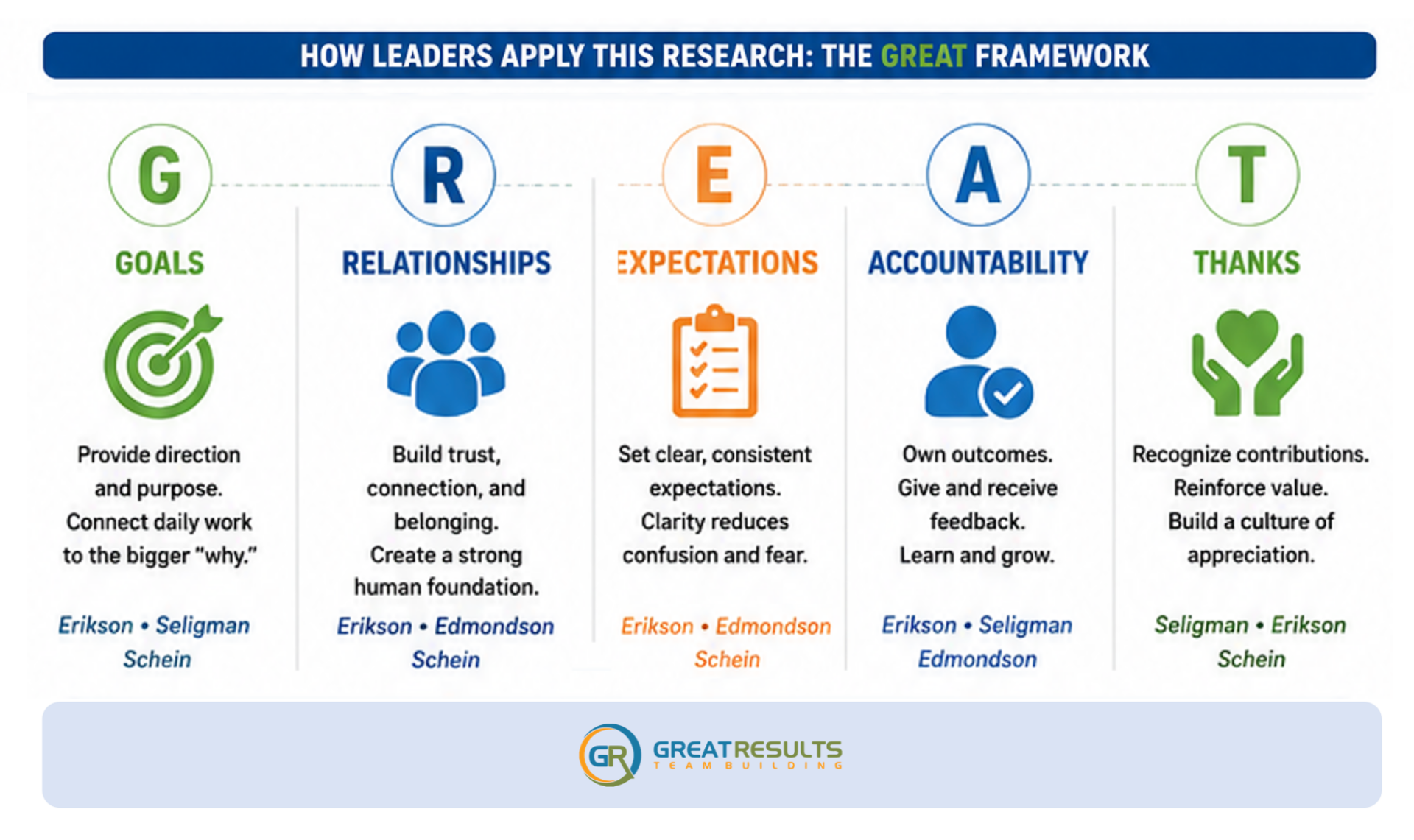
It is a practical operating system for meeting those needs on purpose.
Goals that connect work to meaning. Relationships that build trust and belonging. Expectations that create clarity and reduce fear. Accountability that drives ownership without punishment. Thanks that makes people feel genuinely seen.
That is not soft leadership. That is the architecture of a team where people choose to bring their best.
The leaders who understand that are not just building better workplaces. They are building teams that perform at a level their competition cannot easily replicate, because the thing they have built is not a process. It is a place where people feel like they matter.
And you cannot copy that. You can only build it, one intentional decision at a time.
Sean Glaze is a leadership keynote speaker, team building facilitator, and author based in Atlanta, Georgia. His engaging conference leadership keynotes and custom team building programs have helped clients like Cisco, John Deere, the CDC, and Emory University to increase collaboration, boost productivity, and build Sticky Cultures that inspire more profitable teamwork.
As a successful basketball coach, Sean gained valuable insights on turning talent into teamwork – and now travels around the country to share those lessons. Sean’s books, Rapid Teamwork, What Effective Leaders DO, The 10 Commandments of Winning Teammates, and Staying Coachable are entertaining parables that accelerate the growth of leaders and teams!