

Why Your Most Productive Team May Also Be Your Least Connected
AI can write the email, but it cannot build the trust that makes a team fight for each other when the project goes sideways.
That sentence matters more this year than it did last year. Every team I work with now generates infinite output. Drafts, decks, summaries, meeting notes, first passes at anything you can name. The tools are genuinely good. But something else is happening at the same time, and most leaders have not connected the two.
Short answer: AI does not create loneliness by itself. Unmanaged AI adoption does.
When tools replace the small human touchpoints of a workday and nobody replaces them with something intentional, connection quietly erodes while the productivity dashboard looks better than ever.
Workplace loneliness is a business problem, not a soft one
Start with the health data, because it sets the stakes.
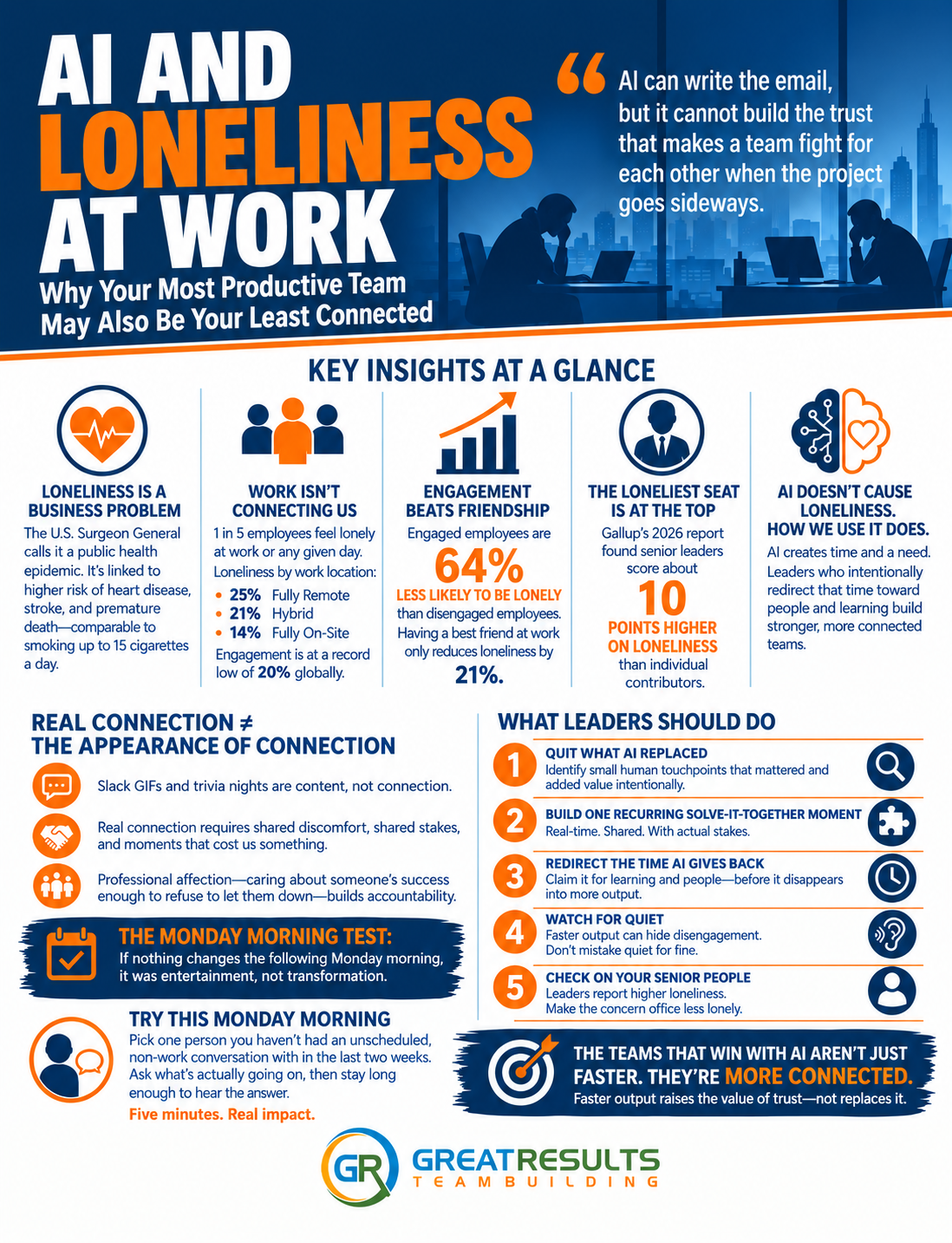
The U.S. Surgeon General declared loneliness a public health epidemic in 2023. The advisory reported that poor social connection is associated with a 29 percent increased risk of heart disease and a 32 percent increased risk of stroke, and that lacking connection can raise the risk of premature death to a level comparable to smoking up to 15 cigarettes a day.
That is not a wellness talking point. That is a mortality statistic.
Work is supposed to be one of the places where connection happens without anyone forcing it. You spend more waking hours with coworkers than with almost anyone else in your life. But the numbers say work is not doing that job well anymore.
Gallup reports that roughly one in five employees worldwide experience loneliness on a given day.
The gap by work location is worth writing down: about 25 percent for fully remote employees, 21 percent for hybrid, and 16 percent for fully on site. Gallup also found that global employee engagement fell to 20 percent in 2025, the lowest reading since 2020.
Here is the finding I keep coming back to. In U.S. research, Gallup found that engaged employees were 64 percent less likely to be lonely than employees who are not engaged. Compare that to having a best friend at work, which was associated with only a 21 percent reduction.
Engagement beats friendship as a loneliness intervention. Which means the fix is not more social events. The fix is work that feels meaningful and teammates who feel connected to it.
One more data point that most leaders will not expect. Gallup’s 2026 report found senior leaders score about 10 points higher on loneliness than individual contributors.
The corner office is the loneliest seat in the building.
Does AI actually cause loneliness at work?
The answer is actually interesting…
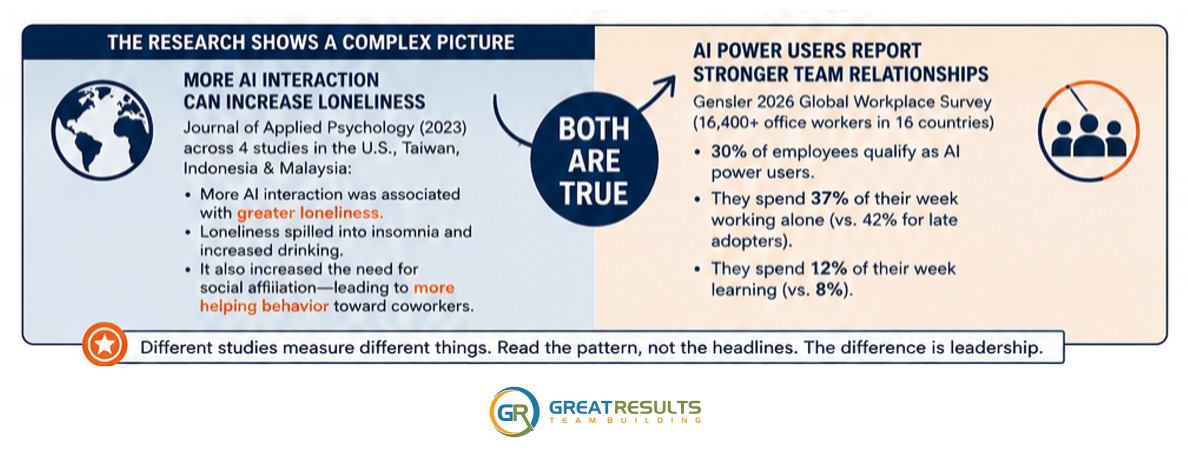
The strongest peer reviewed evidence comes from a 2023 study in the Journal of Applied Psychology by Pok Man Tang and colleagues, titled “No Person Is an Island.” Across four studies with employees in the United States, Taiwan, Indonesia, and Malaysia, more frequent interaction with AI systems at work was associated with greater loneliness, and that loneliness carried into life after hours in the form of insomnia and increased drinking.
But that same study found something the headlines mostly skipped.
Interacting with AI also increased employees’ need for social affiliation, and that showed up as more helping behavior toward coworkers. The same pressure that isolated people also made some of them reach out.
Now put that next to the other side of the ledger.
Gensler’s 2026 Global Workplace Survey, covering more than 16,400 office workers across 16 countries, found that the 30 percent of employees who qualify as AI power users report stronger team relationships, not weaker ones.
They spend 37 percent of their week working alone compared to 42 percent for late adopters, and 12 percent of their week learning compared to 8 percent.
So which is it?
Both. And the difference is not the technology.
AI hands your team back time and a need.
Whoever fills that space decides whether your culture gets stronger or quieter.
The teams in the Gensler data were not more connected in spite of AI. They redirected the time AI freed up toward learning and people. That does not happen by accident. Somebody decided it.
A note on the evidence: these studies measure different things in different ways, and none of them prove causation on their own. The Gensler findings are self reported and cross sectional. Read them as a pattern worth acting on, not as settled science.

Real connection is not the same as the appearance of connection
A Slack GIF is not connection. A virtual trivia hour is not connection.
Those things are content, and content is not the same as trust.
Real connection requires something with more weight to it. Shared discomfort. Shared stakes. A moment where one person on the team shows up for another in a way that costs them something, even something small.
That is what builds what I call professional affection, and it is different from empathy. Empathy is caring how someone feels. Professional affection is caring about someone’s success enough that you refuse to let them down.
Consequences inspire compliance. Professional affection inspires accountability.
You cannot generate that with a prompt. You build it the way it has always been built, through intentional shared experience rather than recreational filler that happens to be scheduled during work hours.
Here is the test I use with every client, and it works just as well for you evaluating your own team. If nothing changes the following Monday morning, whatever you just did was entertainment, not transformation. An escape room is a fine afternoon. It rarely changes how two people talk to each other when a deadline gets tense three weeks later.
I call the intentional version Profitable Fluff.
It looks like fluff on the calendar. It pays for itself in how people communicate afterward.
What leaders can do about AI and loneliness a work
You do not need to slow down AI adoption to fix this. You need to be deliberate about the human side while adoption happens, instead of hoping it sorts itself out.
Audit where AI quietly replaced a human touchpoint. Not every walk over conversation needed saving. But some of them were doing real relational work you were not tracking, because it never showed up as a line item. Name the ones that mattered and rebuild them on purpose.
Build one recurring moment where the team solves something together. Not each person alone with a tool. It does not need to be elaborate. It needs to be shared, in real time, with actual stakes attached.
Redirect the time AI gives back, before it disappears. The Gensler power users spent it learning. That is a leadership choice, not a personality trait. If you do not claim that time deliberately, it will get absorbed into more output and nobody will notice what was lost.
Watch for the people who have gone quiet. Faster output hides disengagement for a while, because the work still gets turned in on time. Quiet does not mean fine.
Check on your senior people too. If leaders carry more loneliness than the people they lead, the person most likely to be white knuckling it is the one running the meeting.
Pick one person on your team you have not had an unscheduled, non work conversation with in the last two weeks. Not a status update. A real one.
Ask what is actually going on, then stay long enough to hear the answer.
That is not a program. It is not a budget line. It is a five minute decision that either builds professional affection or it does not, and your team feels the difference either way.
Frequently asked questions
Does AI cause loneliness at work? Not on its own. Research in the Journal of Applied Psychology found more frequent AI interaction associated with greater loneliness, while Gensler’s 2026 survey found heavy AI users report stronger team relationships. The variable is whether leaders intentionally protect human connection during adoption.
Is remote work or AI the bigger driver of workplace loneliness? Location shows the clearer gap in current Gallup data, with fully remote employees at about 25 percent daily loneliness compared to 16 percent on site. AI compounds the effect by removing small interactions that used to happen regardless of location.
What is the fastest way to reduce loneliness on a team? Improve engagement rather than scheduling more social events. Gallup found engaged employees are 64 percent less likely to be lonely, a far stronger effect than having a best friend at work.
Do team building events actually fix this? Recreational ones do not. Facilitated experiences that surface how people think, communicate, and rely on each other do, because they change behavior instead of just filling an afternoon. The Monday morning test tells you which one you bought.
The teams that come out of this era strongest will not be the ones that adopted AI fastest. They will be the ones whose leaders understood that faster output raises the value of trust rather than replacing it.
If you want a deeper look at the difference between recreational team activities and the kind that actually change how people work together, I wrote about that distinction here: greatresultsteambuilding.net/profitable-fluff
And if your team is heading into a season of heavy AI adoption, that is exactly the right moment to put a real team building experience on the calendar. Not a party. An experience your people are still referencing in October.
Reach out and let us talk about what your group actually needs.
Sean Glaze is a workplace culture leadership keynote speaker, team building facilitator, and author based in Atlanta, Georgia. His engaging conference workplace culture keynotes and custom team building programs have helped clients like Cisco, John Deere, the CDC, and Emory University to increase collaboration, boost productivity, and build Sticky Cultures that inspire more profitable teamwork.
As a successful basketball coach, Sean gained valuable insights on turning talent into teamwork – and now travels around the country to share those lessons. Sean’s books, Rapid Teamwork, What Effective Leaders DO, The 10 Commandments of Winning Teammates, and Staying Coachable are entertaining parables that accelerate the growth of leaders and teams!