

The reason your people check every channel constantly – and get confused with who shared what and where – is not that they are distracted.
It is that you have not defined the expectations for each channel they use.
Think about what that costs.
If a message could arrive by email, or chat, or text, or a hallway comment, and any one of them might be the urgent one, then the only rational response is to monitor all of them, all day.
Nobody can do focused work in that state. So people either stop doing deep work, or they start ignoring channels selectively and quietly, which is how important things fall through.
A client brought me in learlier this year to help with what they described as email overload. Their leaders were drowning. What we found in the room was not an email problem at all.
Nobody had ever agreed on what anything meant.
When I described it to a few other leaders afterward, in industries with nothing in common, they recognized it immediately. Different tools, identical chaos.
Preference Is Not a Standard
Here is the mechanism.
In the absence of a shared agreement, every person defaults to their own preference. One manager thinks chat is for quick questions and email is for the record. Another thinks chat is where real work happens and email is where things go to die. A third texts because that is what gets answered.
None of them are wrong. They just never compared notes.
Now multiply that by forty people. What you get is not forty preferences coexisting peacefully. What you get is a system where the meaning of a message depends entirely on who sent it, which means everyone has to decode the sender before they can decode the message.
That is the tax. And it is invisible, which is why it never gets addressed.
Culture is the set of behaviors a group allows and repeats.
Communication chaos is not something that happened to your team. It is something the team built, one unexamined default at a time.
Why the Template Approach Fails
The instinct at this point is to write a policy. Pick the standards, put them in a document, send it around.
I have watched that fail more than once, and the reason is simple. A standard people receive gets ignored. A standard people build gets followed.
The document is not the point. The conversation that produces the document is the point. The document is just the residue.
So instead of handing you a matrix, here are the five questions to work through with your team. Block forty five minutes. Write the answers down where everyone can see them.
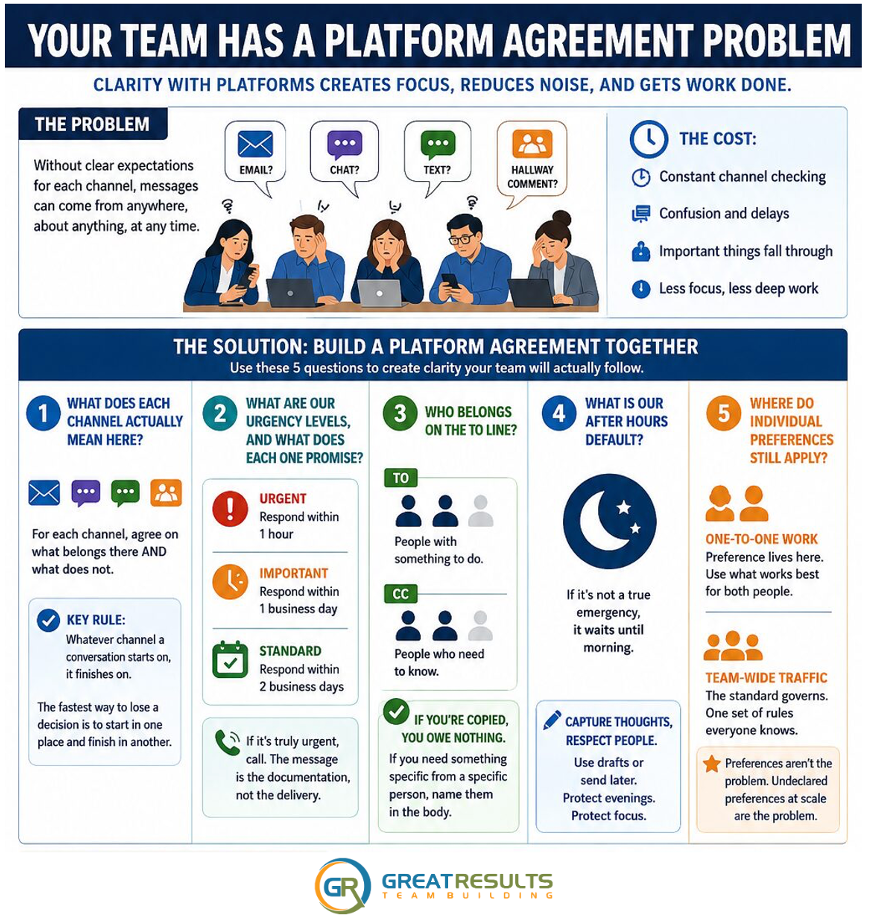
The Five Platform Agreement Questions
- What does each channel actually mean here?
Not what the vendor’s marketing page says. What it means in your building.
For each channel your team uses, agree on two things: what belongs there, and what does not. The second half is the one people skip and the one that does the work.
One rule I would push you toward regardless of what else you decide: whatever channel a conversation starts on, it finishes on. The single fastest way to lose a decision is to start it in chat, continue it in email, and resolve it in a hallway. Three months later nobody can find it and everybody remembers it differently.
- What are our urgency levels, and what does each one promise?
Most teams need two or three. Name them however you want.
The part that matters is that every level carries a response time promise. An urgency label with no promise attached is decoration. If “urgent” does not mean anything specific about when someone will respond, people will start marking everything urgent, and within a month the label means nothing at all.
One additional standard worth adopting: if something is genuinely urgent, you call. The email or message is the documentation, not the delivery mechanism. Anything that truly cannot wait deserves a voice.
- Who belongs on the To and CC lines?
The To line is for people with something to do. The copy line is for people who need to know. If you are copied, you owe nothing.
That last part is what unlocks it. Without it, being copied still feels like an obligation, and you have not reduced anyone’s load. You have just added a line to the header.
If you need something specific from a specific person inside a message that went to several people, name them directly in the body. Do not make people guess whether the request was aimed at them.
- What is our after hours default?
Decide this out loud, because if you do not, it gets decided for you by whoever sends the most late night messages.
The question is straightforward. If something is not a true emergency, does it wait until morning?
Most teams say yes and then do not do it, because the person sending at ten at night is not trying to demand anything. They are clearing their own list. But the person receiving it at ten at night does not know that. They feel a request, and increasingly they feel that the workday has no edge.
If your team wants the freedom to write when the thought arrives, that is fine. Use the drafts folder or the send later function. The thought gets captured, and nobody’s evening gets interrupted.
- Where do individual preferences still apply?
This is the question most policies get wrong, and I want to be careful here because I have seen the overcorrection.
Some organizations respond to communication chaos by declaring that individual preferences are the enemy and must be eliminated. I understand the impulse. It is also wrong, and it will cost you.
Preferences are real. Some people process complex information far better in writing and will give you a much better answer if you send it rather than say it. Some people need ninety seconds on the phone and will spin for a day on a message thread. Knowing that about your teammates is genuinely valuable, and a team that surfaces those preferences works better than one that does not.
The distinction is where preference governs and where the standard governs.
- One to one work is where preference lives. If you and I have figured out that we work better with a quick call than a long thread, that is a small efficiency worth keeping.
- Team wide traffic is where the standard governs. The moment a message goes to a group, or up the chain, the cost of everyone guessing goes up sharply. That is where you need one set of rules everybody knows.
Preferences are not the problem. Undeclared preferences applied at scale are the problem.
The Reality of Leadership
Your agreement dies the first time a leader ignores it.
If the standard says urgent means a phone call and the vice president fires off six urgent emails at eleven at night, the standard is finished. Not damaged. Finished. Everyone in the building just learned that the rules apply downward only, and they will act accordingly.
What you permit, you promote. Nowhere is that more visible than here, because communication behavior is the most watched behavior a leader has. People see every message you send, at every hour, in every channel.
So if you are the leader, the agreement applies to you first and most visibly. You should be the easiest person in the organization to point at as an example of it working.
Check the Platform Agreement Regularly
Put a date on the calendar ninety days out. Two questions.
What part of this are we actually doing?
And what part did we write down and quietly abandon?
The second answer is the more useful one. Something you all agreed to and then dropped within a month was either unrealistic or solving a problem you did not really have. Either way, change it or cut it. A standard nobody follows is worse than no standard, because it teaches people that written agreements around here are suggestions.
I built a free Channel Agreement Worksheet and it is available in my free Team Leadership Toolbox, along with over 60 other downloadable resources. If you want your leaders working through this together in a room rather than reading about it alone, that is what I do.
Sean Glaze is a leadership and workplace culture speaker, author, and coach who delivers interactive experiences that ignite team performance.
As a successful basketball coach, Sean gained valuable insights on turning talent into teamwork – his engaging team culture keynotes and custom team building programs have helped clients like Cisco, John Deere, the CDC, and Emory University to strengthen collaboration, increase accountability, and build Sticky Cultures that inspire more profitable teamwork.
Sean is the best-selling author of Rapid Teamwork, What Effective Leaders DO, The 10 Commandments of Winning Teammates, Staying Coachable , and The Sticky 11 Checklist – all entertaining books that provide insights and tactics to accelerate the growth of leaders and teams!